History
History of the nurse call: from bedside bell to smartphone
No document we found names one inventor of the nurse call. In 1853 Florence Nightingale required patients' bells that rang outside the nurse's door and showed who had rung. US patents filed in 1923 and 1929 improved call systems that hospitals already had. Today calls also reach staff smartphones, and standards such as UL 1069 set requirements for call equipment.
Today a patient may call a nurse with a button on a cord, a pull cord in the bathroom or a phone, while a lamp over the door shows where the call came from. This article traces the history of the nurse call through documents that can be checked — a letter from 1853, two US patents from the 1920s, recent research and today's standards — and notes the popular claims they do not support.
Who invented the nurse call?
None of the sources we checked names a single inventor. Florence Nightingale's letter of 1853 sets out requirements for patients' bells; it does not describe an invention. The earliest US patents we found, filed in 1923 and 1929, improve call systems that hospitals already had.
Taken together, the documents show a series of steps: bells, then lamps and audible signals, then two-way speech, then wireless devices and smartphones for staff.
Timeline at a glance
| Year | What is known | Source |
|---|---|---|
| 1853, 5 June | Florence Nightingale requires that patients' bells ring outside the nurse's door, each with a "valve" that stays open to show who has rung. | Cook, 1913, p. 131 |
| 1853, 12 August | She moves in as superintendent of the institution at No. 1 Upper Harley Street, London. | Cook, 1913, p. 133 |
| 1923 (granted 1927) | Patent for a wall-mounted call switch to upgrade signal systems already installed in old hospital buildings. | US 1,620,951 |
| 1929 (granted 1932) | Dictograph Products patent adds telephone speech to the existing lamp-and-sound call. | US 1,841,771 |
| 2017–2019 (published 2020) | Study of wireless nurse call systems with staff smartphones in five Norwegian residential care facilities. | Dugstad et al., 2020 |
| 2020 | UL Solutions: US healthcare facilities look for UL 1069 compliance to show compliance with NFPA 99. | UL Solutions |
| 2024 | Smartphones used by clinical staff receive nurse calls. | Howell & Knight, 2024 |
| 2026, August | DIN VDE 0834-1:2026-08 replaces the 2016 edition in Germany. | DIN Media |
1853: what Florence Nightingale actually wrote
In April 1853 Florence Nightingale agreed to become superintendent of the Establishment for Gentlewomen during Illness, a London institution for sick governesses that was looking for new premises. On 5 June 1853, writing from Paris to Lady Canning, one of the ladies who managed it, she listed the conditions a suitable house had to meet. The first was that a nurse should not have to leave her floor except for meals.
The second was about bells. The patients' bells should all ring in the passage outside the nurse's own door, and each should have "a valve which flies open when its bell rings, and remains open in order that the nurse may see who has rung" (Cook, 1913, p. 131).
The institution moved to No. 1 Upper Harley Street, where Nightingale took up residence on 12 August 1853 (p. 133). The letter is a requirement, not a report: the biography does not say how, or whether, those bells were fitted. Claims that Nightingale "installed" or "invented" the nurse call go beyond the evidence.
1920s: electric call systems were already in hospitals
A patent application filed in 1923 by William P. Crockett of Chicago, granted in 1927, offers a cheap electrical call switch, mounted on the wall, for upgrading signal systems already installed in old hospital buildings. The new switch could light a lamp at the patient's door and another at a nurses' station, and sound an audible signal.
A patent filed in 1929 by William H. Waite for Dictograph Products, granted in 1932, starts from what hospitals already used: the patient presses a button, a lamp lights and a signal sounds in the nurses' office, and the nurse walks to the room to ask what is needed, then walks again to bring it. The invention added telephone speech to save that first trip; the lamp over the door stays lit until the button is reset.
Neither patent claims to be the first nurse call, so no year can honestly be named as the start of electric nurse call.
Wireless systems and smartphones for staff
A 2020 study describes the traditional nurse call as bedside buttons or cords, light domes and audible alarms in corridors and at the nurses' station, plus pagers or portable phones for staff — systems that rely on the patient being able to call (Dugstad et al., 2020). The wireless systems it studied in five Norwegian residential care facilities added transmitters worn by residents, sensors and smartphones for staff.
The 98 care providers who answered the survey (a response rate of 28%) reported more facilitators than barriers; the main barriers were lack of prior knowledge and a system that felt hard to learn. In hospitals, smartphones used by clinical staff now receive calls from the nurse call system, and researchers are looking for ways to make those alerts quieter (Howell & Knight, 2024).
Standards for nurse call systems
In the United States, UL 1069, the Standard for Hospital Signaling and Nurse Call Equipment, was written for the electrical noise and interference common in healthcare facilities and is meant to ensure that calls for assistance are properly routed to the nurse station. Facilities look for compliance with it to show compliance with the NFPA 99 Health Care Facilities Code (UL Solutions, 2020).
In Germany, DIN VDE 0834-1 covers the equipment, planning, construction, inspection and operation of call systems in hospitals, nursing homes and similar institutions. The current edition, August 2026, replaced the 2016 edition, whose summary explains the reason for such rules: a call that is not signalled because of a fault can put the caller at risk.
What has not changed since 1853
- The signal goes to the nurse. Bells outside the nurse's door in 1853, lamps at the nurses' station in the 1920s, a phone in the pocket today.
- The nurse must see who called. Nightingale's valve showed which bell had rung; the 1920s patents used a lamp at the patient's door.
- The call stays visible until someone deals with it. The valve "remains open"; the 1929 door lamp stayed lit until reset.
- Knowing the need saves steps. Nightingale wanted the nurse kept on her floor; the 1929 patent added speech to avoid a wasted trip.
Evidence for patient-phone QR calls
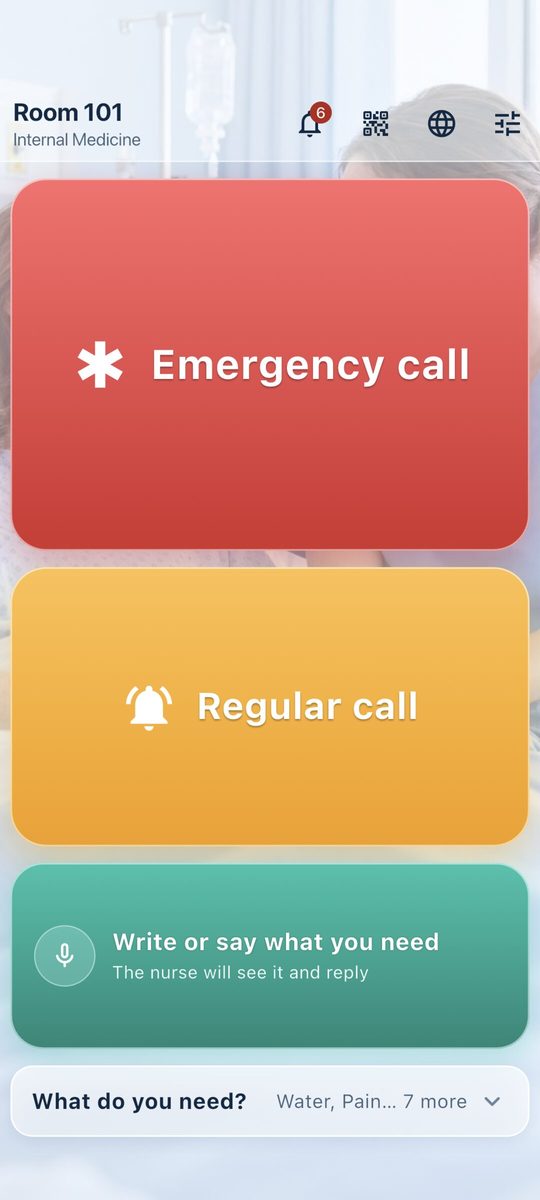
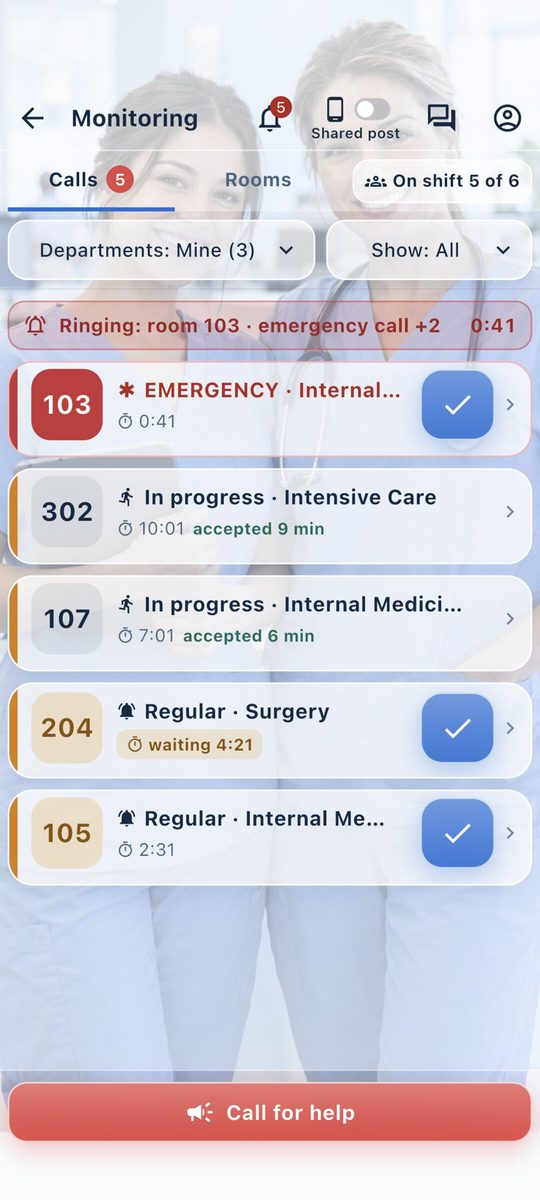
A newer idea is to let the patient call from their own smartphone: a QR code at the bed opens a call screen, and the call goes to staff phones. In the sources we selected for this article in November 2026, we did not find peer-reviewed studies of patients calling staff this way. That short search was not a systematic review and does not show that no such studies exist, but the sources we found are not enough to consider its effectiveness proven. It is an extra channel a ward can test, useful only for patients who can use a phone.
Frequently asked questions
Who invented the nurse call system?
No document we found names one inventor. Florence Nightingale described requirements for patients' bells in 1853, and the earliest US patents we found, filed in 1923 and 1929, improve call systems that hospitals already had. The documents show a series of improvements rather than a single invention.
Did Florence Nightingale invent the call bell?
There is no evidence for that. In a letter of 5 June 1853 she required that patients' bells ring outside the nurse's door, each with a valve that stayed open to show who had rung. It is a list of conditions for new premises, and the biography that quotes it does not say whether those bells were fitted.
When did nurse call systems become electric?
The sources do not give a starting year. A 1929 US patent describes, as something hospitals already had, a button that lights a lamp and sounds a signal in the nurses' office. A 1923 patent offers an electrical call switch for upgrading signal systems already installed in old hospital buildings. The first year remains unknown.
Which standards apply to nurse call systems?
In the United States, healthcare facilities look for compliance with UL 1069, the standard for hospital signaling and nurse call equipment, to show compliance with NFPA 99. In Germany, DIN VDE 0834-1 covers call systems in hospitals and nursing homes; its current edition is dated August 2026. Check the rules that apply in your own country.
Can patients call a nurse from their own phone?
Yes, with a QR-code call system: the patient scans a code at the bed and a call screen opens in the phone's browser, with nothing to install. In the sources we checked in November 2026 we found no peer-reviewed studies of this approach, and it only works for patients who have a smartphone and can use it, so keep a physical way to call in the room.
Sources
- Sir Edward Cook — The Life of Florence Nightingale, vol. I (1913), pp. 130–134, Internet Archive
- US Patent 1,620,951 — Call switch for hospital signal systems (W. P. Crockett, filed 1923, granted 1927)
- US Patent 1,841,771 — Signal system for hospitals (W. H. Waite, Dictograph Products, filed 1929, granted 1932)
- Dugstad et al. — Nursing staff's evaluation of facilitators and barriers during implementation of wireless nurse call systems in residential care facilities, BMC Health Services Research, 2020
- Howell & Knight — Quieter Nurse Call System to Reduce Alarm Noise in Hospitals, Studies in Health Technology and Informatics, 2024
- UL Solutions — Nurse Call and Emergency Call Systems (UL 1069, NFPA 99), 2020
- DIN Media — DIN VDE 0834-1:2026-08, Call systems in hospitals, nursing homes and similar institutions
- DIN Media — DIN VDE 0834-1:2016-06 (withdrawn, replaced by the 2026-08 edition)
How this article was prepared
Written by the Hospital Alert team with the help of AI tools. Everything we say about the app was checked against the app itself; facts from outside sources are linked above. This article is general information, not medical advice. Found a mistake? Write to team@hospitalalert.online.