Nurse call without wiring
Temporary nurse call: options for surge wards and outages
A temporary nurse call system gives patients a way to call staff where no working system exists: a surge ward, a field hospital, rooms being rewired or a ward whose system has failed. Common options are portable wireless call kits, staff radios or phones, tablets used as intercoms and calls from the patient's own phone, backed by more frequent rounds.

A temporary nurse call system gives patients a way to call staff where there is no working system: extra beds opened in a surge, a tent or field hospital, rooms being rewired, or a ward whose system has failed. The usual options are portable wireless call kits, staff radios or phones, tablets used as intercoms, and calls from the patient's own phone — always backed by more frequent rounds. None of them works unless it is planned, tested at every bed and toilet, and known to every shift. This guide covers when you need a temporary setup, what US emergency planners learned in 2020, and a checklist for the first day. For permanent options without new cabling, see four wireless nurse call options.
When you need a temporary nurse call
- A surge. ASPR TRACIE, the US federal resource for healthcare emergency preparedness, describes temporary surge sites as anything from waiting rooms and other non-patient areas to tents, community buildings and mobile facilities. Most of them were not built with a call button at each bed.
- Rewiring or replacing the system. When work is done in a building that stays open, some rooms lose their call points for a while. More on the installation itself in who installs and services nurse call systems.
- A failing system. Old systems do not always fail all at once. A Canadian long-term care home reported in 2025 that its 25-year-old nurse call system had reached the end of its service life, that replacement parts were increasingly hard to find, and that periodic failures of some functions had been managed with contingency procedures (Muskoka, 2025). Agree stand-in equipment with your service contractor in advance: the VA specification asks the contractor to provide alternate nurse call equipment, working within 20 hours, if a failure cannot be fixed within four hours.
What emergency planners ask you to think through
ASPR TRACIE's checklist for temporary surge sites does not name nurse call as such, but it lists the pieces any temporary call setup depends on:
- overhead paging, signboards and other ways to communicate;
- hospital phones and radios;
- computer access and Wi-Fi for registration and patient care;
- enough charging stations for staff and patient cell phones and other devices;
- whether toilets are inside the site or nearby, and signs to them;
- how the site will meet the Americans with Disabilities Act or offer access through the hospital.
Each item is a question for your call setup. If calls arrive on phones, where are they charged? If patients use the toilet down the corridor, how do they call from there?
What 2020 field hospitals learned
At the federal field hospital in New York's Javits Center, a member of the federal medical team told ASPR TRACIE that staff kept many patients in the medical-surgical area by monitoring them more closely, rounding on them more often and using a rapid response team, and that they appreciated the central nurse call bell system and the central vital sign monitoring, which let them monitor patients remotely (ASPR TRACIE, 2020).
Mass General Brigham, which set up the 1,000-bed Boston Hope field hospital together with the state health department and others, described attaching tablets to IV poles as a video intercom between patients and clinicians, in its hospital and in its alternate care sites. The team built in automatic answering because intubated and disabled patients would not have been able to answer incoming calls, and limited which clinicians could call into which rooms to protect patient privacy (ASPR TRACIE, 2020). The lesson for any temporary setup: design for the patient who cannot press a button, not only for the one who can.
Temporary nurse call options compared
| Option | How it works | Good for | Watch for |
|---|---|---|---|
| Portable wireless call kit | Wireless buttons at the beds send calls by radio to a receiver, pager or phone | Patients who can press a button; can move with the ward | Radio range in every room and toilet; batteries; who carries the receiver |
| Staff radios or phones | Staff reach each other; patients still need a way to reach staff | Coordinating the team | On their own they do not let patients call |
| Tablets as intercoms | Video link between room and staff, as Mass General Brigham used | Isolation rooms; seeing the patient before entering | Devices, mounting, privacy rules, auto-answer |
| Patient's own phone | The patient scans a code at the bed and calls staff from their phone | Patients who can use a phone; nothing to install | Patients without a phone or who cannot use one; network coverage |
| More frequent rounds | Staff check on each patient at set intervals | Everyone, including those who cannot call | Staff time; not a call system on its own |
In practice a temporary ward usually needs a mix: a call method for those who can use it, closer observation for those who cannot, and a fixed point where calls are seen if a device fails.
Checklist for the first day
- Every bed and every toilet has a way to call. Write down which method each bed uses.
- Patients who cannot call — confused, sedated, too weak — are listed and placed where staff can see them, with closer observation.
- Who receives calls on each shift, and who is next if nobody responds.
- Test calls from every bed and toilet at the start of each shift, including at night.
- Charging and batteries: receivers, phones and buttons charged before each shift; spares at hand.
- Tell patients how to call, at admission and on a sign at the bed.
- Plan the end: when the permanent system returns, test it before the temporary one is removed.
The same tests apply when the permanent system is back: the VA specification for nurse call systems asks for a test of every station, a check of each call type and a backup power test before a system is accepted.
Where Hospital Alert fits
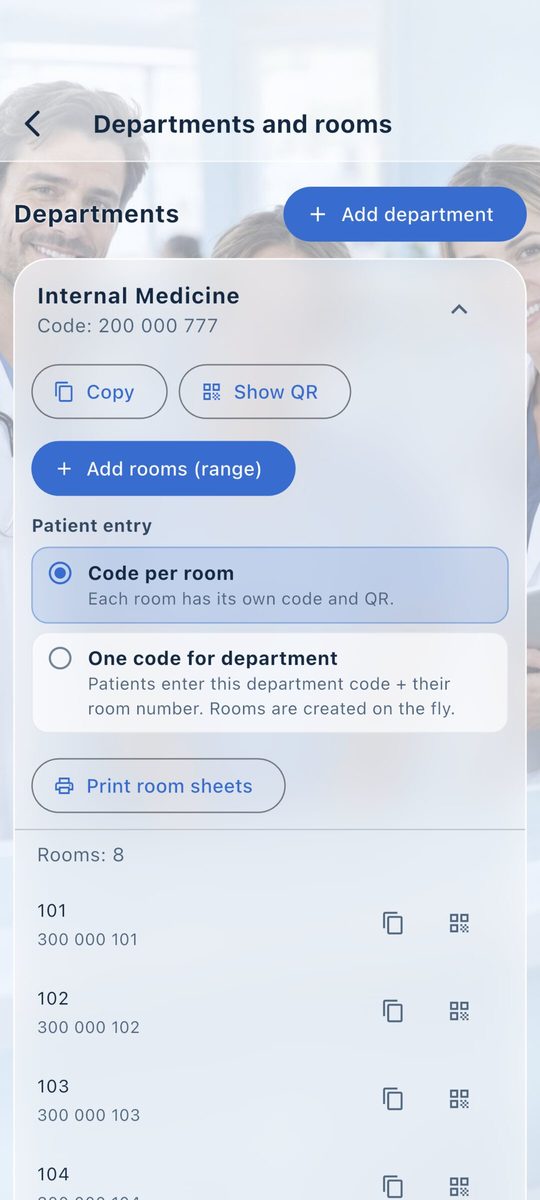
Hospital Alert needs no installation, which makes it one way to add calling to a temporary ward. The administrator registers the hospital in the app, creates a department and its rooms, and prints the QR sheets on any printer. For a ward where beds move often, there is an option of one code for the whole department plus the room number instead of a code per room. Patients scan the code with their phone camera and get emergency and regular call buttons in the browser; staff receive calls in the app and in the web version on a computer, and a call nobody accepts is passed on to the next people in the chain the administrator has set. Before you rely on it, run test calls from every bed. Step by step: the pilot checklist; how the patient side works: QR code nurse call.
Frequently asked questions
What is a temporary nurse call system?
It is any setup that lets patients call staff for a limited time where the permanent system is missing or out of service — for example in a surge ward, a tent or field hospital, rooms being rewired, or a ward whose system has failed. It can be a portable wireless kit, phones, tablets or a mix.
Is there a portable nurse call system?
Yes. Portable systems usually consist of wireless call buttons and a receiver, pager or phone that staff carry, and they can be moved from ward to ward. Check the radio range in every room and toilet, how batteries are monitored and who carries the receiver at night.
What should we do if the nurse call system stops working?
Tell staff and patients at once, increase rounds, give patients who cannot call for themselves closer observation, and set up a temporary way to call — portable buttons, phones or another channel — until the system is repaired. Agree with your supplier in advance how fast they respond to a ward that is down.
How do patients call staff during renovation?
Plan it before the work starts: which rooms lose their call points and for how long, which temporary call method each room gets, and how it is tested. If rooms cannot be covered safely, they may need to close while the work is done.
Sources
- ASPR TRACIE — Considerations for the Use of Temporary Surge Sites for All-Hazards Incidents, created February 2020, updated November 2024
- ASPR TRACIE — Alternative Care Sites: The Federal Experience in New York City, 2020
- ASPR TRACIE — Telehealth in Alternate Care Sites: Ensuring Patient Care and Staff Safety in Massachusetts, 2020
- District Municipality of Muskoka — Report HS-6-2025-4, Single Source Purchase Approval for the Nurse Call System Replacement at the Pines, 19 June 2025
- U.S. Department of Veterans Affairs — Specification 27 52 23, Nurse Call and Code Blue Systems, December 2020
How this article was prepared
Written by the Hospital Alert team with the help of AI tools. Everything we say about the app was checked against the app itself; facts from outside sources are linked above. This article is general information, not medical advice. Found a mistake? Write to team@hospitalalert.online.