Running a ward
Nurse call installers: who installs and services the system
A nurse call system is usually installed and serviced by a contractor the manufacturer has authorised, with technicians trained on that make and model. The job covers design, cabling, devices, programming, a test of every call point, staff training and as-built drawings. Before you sign, agree how fast the installer will come out to repair a fault.

Nurse call systems are usually installed and serviced by a contractor that the manufacturer has authorised, with technicians trained on that make and model. A good installation is more than fixing buttons to the wall: it includes design, cabling, programming, a test of every call point, training for each role and drawings of what was actually built. This guide uses two detailed US federal specifications — from the Department of Defense and the Department of Veterans Affairs (VA) — to show what to ask an installer and what to agree on before the first cable is pulled. For the price side, see what makes up the cost of a nurse call system.
Who installs nurse call systems
The VA specification treats the nurse call system as a critical service and its code blue functions as life safety. On who may install it, the two specifications ask for:
- An authorised contractor. The Defense specification asks for an authorised vendor and service organisation for the manufacturer, with at least five years of similar projects covering design, integration, installation, testing, training and maintenance. The VA asks for at least three years as an authorised distributor and service organisation, and for the contractor to pass on the manufacturer's warranty.
- Technicians trained on this system. Both ask that the people doing the work be trained or certified by the manufacturer on the make and model being installed. The VA wants written proof of current training, including the certificate from the manufacturer's installation school, before work starts, and asks the contractor to display its national, state and local licences.
- One manufacturer for the core. The Defense specification asks for standard products from a single manufacturer, designed to work together as one system.
- A service organisation nearby. The Defense specification asks for factory-authorised support on site within a set window from the call — four hours is the default its notes call generally appropriate.
If you search for "nurse call installers near me", start with the manufacturer: ask for its authorised dealers in your area, then check each one against the list above.
What the job includes
- Survey and design. Which rooms, beds, bathrooms and showers need call points; where the corridor lights, consoles and equipment cabinets go; which other systems the nurse call must link to. More on what each link costs in IP nurse call vs wired.
- Cabling and equipment. Cable pulled without damage and within the manufacturer's pulling tension; head-end equipment, power supplies and backup in a cabinet; devices at the beds, in bathrooms and above doors.
- Special areas. In behavioural health areas the Defense specification asks for tamper-proof screws, push-button devices, ceiling speakers, the ability to limit calls from patient devices and the ability to mute calls at the master station.
- Programming. Rooms and beds, call types and priorities, who receives which call, tones and lights.
- Testing and acceptance — see below.
- Training and handover. Training for each role, scheduled around shifts, with a refresher later on (the number of sessions is in the cost guide); operation and maintenance manuals, a spare parts list and as-built drawings.
How acceptance testing works
The VA specification asks for a test of the first 30–40% of the installation before any further work, then a full pretest by the contractor, then an acceptance test witnessed by a VA representative. That test runs on a go/no-go basis, and equipment is tested item by item until 100% of the system has been checked.
The Defense specification asks for a written acceptance test plan, then an operational test to show the system works as UL 1069 defines it:
- a call is placed from every station that can make one, and the right sequence is observed;
- every call type and priority is shown for stations that can place more than one;
- routing, volume and freedom from noise are checked;
- a power outage is simulated to show the system running on battery backup.
Final acceptance counts only after 30 consecutive days of operation without a major malfunction (UFGS 27 52 24). If your hospital stays open during the work, agree how patients will call while their rooms are being rewired — options are in temporary nurse call.
Service after handover
Ask about service before you sign, not when the first button fails. The VA specification gives a useful benchmark for its two-year guarantee period:
| What to agree | What the VA specification asks |
|---|---|
| Routine faults | One pillow speaker, patient station, emergency station, master station or dome light out of order: on site and fixed within one working day during the normal working week |
| Critical areas | In areas such as intensive care, a routine fault is treated as an emergency |
| Emergency faults | A whole ward, distribution point or code system down: within four hours of the report |
| Stand-in equipment | If a failure cannot be fixed within those four hours, the contractor provides alternate nurse call equipment, working within 20 hours after that; if a ward-level fault lasts more than a working day, compatible substitute equipment until the repair is done |
| Preventive visits | On site for at least eight hours once every 12 weeks for preventive maintenance and cleaning |
| Records | A monthly summary of the work done and a log for each item of equipment, including the cause of every emergency call-out |
Also ask who installs software updates and security patches, and whether an update interrupts calls: the Defense specification asks for changes on a working system without interruption. Inspections during the warranty and running costs over five years are covered in the cost guide.
Questions to ask an installer
- Are you authorised by the manufacturer for this system, and can we see your technicians' training records?
- Can we speak to two hospitals where you installed the same system?
- What is in your acceptance test plan, and may our staff witness it?
- How will patients call during the work if the building stays open?
- What are your response times for a routine fault and for a ward that is down, including nights and weekends?
- What will service, licences and updates cost each year for the next five years?
An option that needs no installer
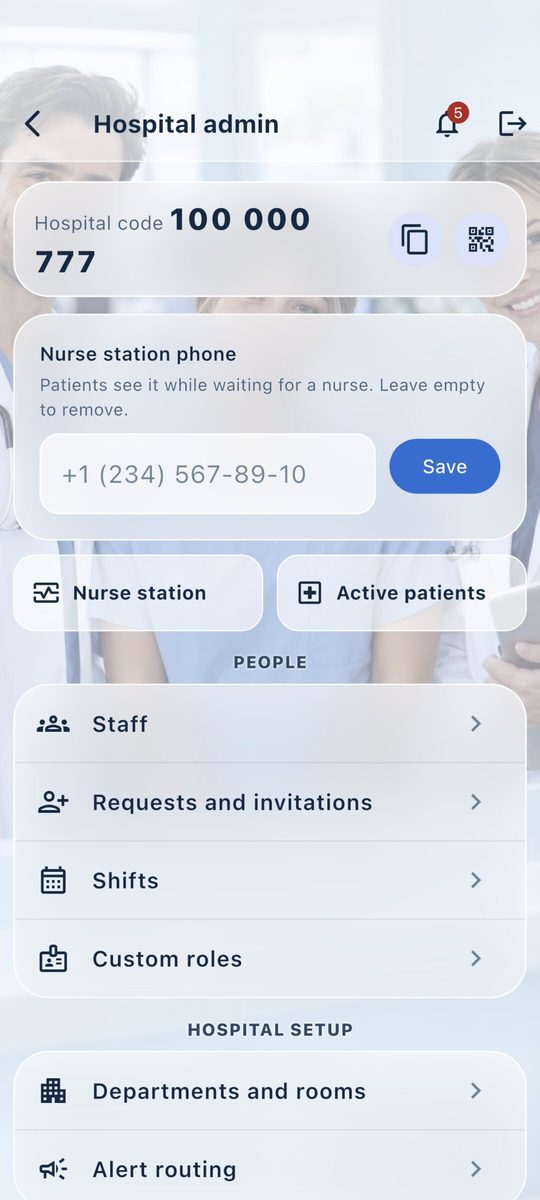
Hospital Alert takes a different approach: there is nothing to install in the walls. The administrator registers the hospital in the app, creates departments and rooms, prints the QR sheets on the hospital's own printer and invites the nurses. Patients scan the code at the bed and call from their own phones; staff get calls in the app and in the web version at the nurse station. The testing rule still applies: during a pilot, run test calls from every room on day and night shifts and check that each call is heard on every phone and computer assigned to the department. Step by step: the pilot checklist.
Frequently asked questions
Who installs nurse call systems?
Usually a communications contractor that the manufacturer has authorised to sell, install and service its system. US federal specifications ask that the contractor's staff be trained or certified by the manufacturer on the make and model being installed, and that they show proof before work starts.
How do I find a nurse call installer near me?
Start with the manufacturer of the system you have or plan to buy and ask for its authorised dealers in your area. Then ask each one for proof of training on that system, licences, references from similar hospitals and its service terms, including how fast a technician reaches your site.
How long does a nurse call installation take?
It depends on the size of the building, whether it is new or in use and how many integrations there are. In a hospital that stays open the work is often done in phases, and the Defense specification allows acceptance tests phase by phase. It counts final acceptance only after 30 consecutive days of operation without a major malfunction.
What should a nurse call service contract include?
Response times for routine and emergency faults, who you call at night and at weekends, a log of every repair, regular inspections, software updates and security patches, spare parts, refresher training, and a list of yearly costs. An optional clause in the Defense specification asks for a proposal for running costs over five years.
Sources
How this article was prepared
Written by the Hospital Alert team with the help of AI tools. Everything we say about the app was checked against the app itself; facts from outside sources are linked above. This article is general information, not medical advice. Found a mistake? Write to team@hospitalalert.online.