Nurse call without wiring
IP nurse call system: how it differs from traditional nurse call
An IP nurse call system is usually still cabled to every room, but its stations, consoles and controllers talk over a data network, and gateways pass calls to phones and other hospital systems. A US Defense specification asks for this network to be separate from the hospital's own and for basic calling to continue if the hospital network fails.

An IP nurse call system is usually still cabled to every room. What changes is what runs through the cable: instead of dedicated nurse call wiring between each room and a central controller, the room stations, corridor lights, consoles and controllers exchange calls as data over a network. That makes it easier to pass calls on to staff phones and to link the nurse call system with other hospital systems — and it puts the system in the hands of the IT and cybersecurity teams as well as the electricians. This guide explains what changes, what US federal specifications ask of the network, and which questions to ask before you choose. For the parts of a nurse call system in general, see what a nurse call system is.
Traditional wired and IP: what is actually different
Both kinds start the same way: a button at the bed, a pull cord in the bathroom, a light above the door and a console at the nurse station. The difference is behind the wall.
| Traditional wired | IP (networked) | |
|---|---|---|
| What the cable carries | Signals over cabling made for the nurse call system | Data packets over network cabling and switches in the system's own cabinet |
| Where calls show | Corridor lights, the master station and duty stations | The same, plus wireless phones, pagers, computers and other systems through gateways |
| Who looks after it | Mainly the electrical or facilities team | Facilities plus IT and cybersecurity: updates, patches, network monitoring |
If the question is rather whether to install a wired system at all or let patients call from their own phones, see wired nurse call vs calling from the patient's phone.
Separately from how calls travel, systems differ in what they offer at the bedside. A tone-visual system tells staff about a call with tones, lights and text displays. An audio-visual system adds two-way voice, so the nurse can talk to the patient from the station before walking to the room (UFGS 27 52 24).
What US federal specifications ask of the network
The US Department of Defense and the Department of Veterans Affairs publish detailed specifications for the nurse call systems in their hospitals. They are written for those agencies' own buildings, but they show what a careful buyer can ask for.
- A network of its own. The Defense specification asks for a separate, dedicated nurse call network for all basic nurse call functions and, where integrations are needed, gateways through the facility network. The VA specification describes the nurse call system as a standalone network of its own equipment and wiring, and does not accept using the telephone cable system to carry nurse call signals.
- Calling continues when the hospital network fails, every device is supervised, and there is backup power. These requirements for the controller and the console are covered in what the nurse call station does; for backup power, the VA specification asks for at least 30 minutes, and acceptance tests simulate a power outage.
- Updates without downtime. Programming and firmware changes must happen on a working system without interrupting it, roll back if an update fails, and security patches must be tested before they are installed (UFGS 27 52 24).
- Room to grow. The Defense specification lets the buyer ask for capacity for, say, 25% more stations without new trunk cabling, and for any room to be changed without the manufacturer reprogramming the system.
Why the standard matters for a networked system
In the United States, UL 1069 is the standard for hospital signaling and nurse call equipment, and facilities look for systems listed to it to show compliance with the NFPA 99 Health Care Facilities Code (UL Solutions, 2020). A networked system makes it tempting to plug in more and more, but the Defense specification warns that connecting to an existing system falls outside the new system's UL 1069 listing and may need middleware, and that linking the master station to a VoIP phone network is an integration beyond the basic UL 1069 functions. Ask the supplier what stays inside the listing once everything is connected.
What "smart" nurse call usually means
"Smart" is a sales word, not a standard. In practice it describes what the system can link to. The Defense specification lists the integrations a hospital may choose, including:
- wireless phones and other personal devices staff carry, and radio paging;
- staff assignment, so a call goes to the nurse responsible for the bed;
- admit, discharge and transfer, and electronic health records;
- bed exit alarms, infant protection and equipment monitoring;
- real-time location services;
- room lighting and television controlled from the pillow speaker, and shade control.
The same document adds a warning to the list: each system integrated adds cost and makes the cybersecurity approval harder. Decide which integrations solve a real problem on your wards. How calls reach staff phones is covered in nurse pager or smartphone.
Wi-Fi in a nurse call system
A "Wi-Fi nurse call system" can mean one of two things. Either calls from wired stations are sent to staff smartphones over the hospital Wi-Fi, or call buttons and pendants themselves are wireless. In both cases the radio becomes part of the path a call travels, so coverage in every room, bathroom and stairwell needs testing. For systems that need no new cabling at all, see four wireless nurse call options.
Questions to ask your IT team and the supplier
- Does the nurse call system have its own network, or does it share switches with the hospital network?
- What still works if the hospital network, the server or a gateway goes down: lights, tones, the console, staff phones?
- How long does the backup power last, and when was it last tested?
- Who installs security patches, how are they tested, and does an update interrupt calls?
- Which integrations do we really need, and which stay inside the system's UL 1069 listing?
- How does the system report a failed station, and who receives that report at night?
Where Hospital Alert fits
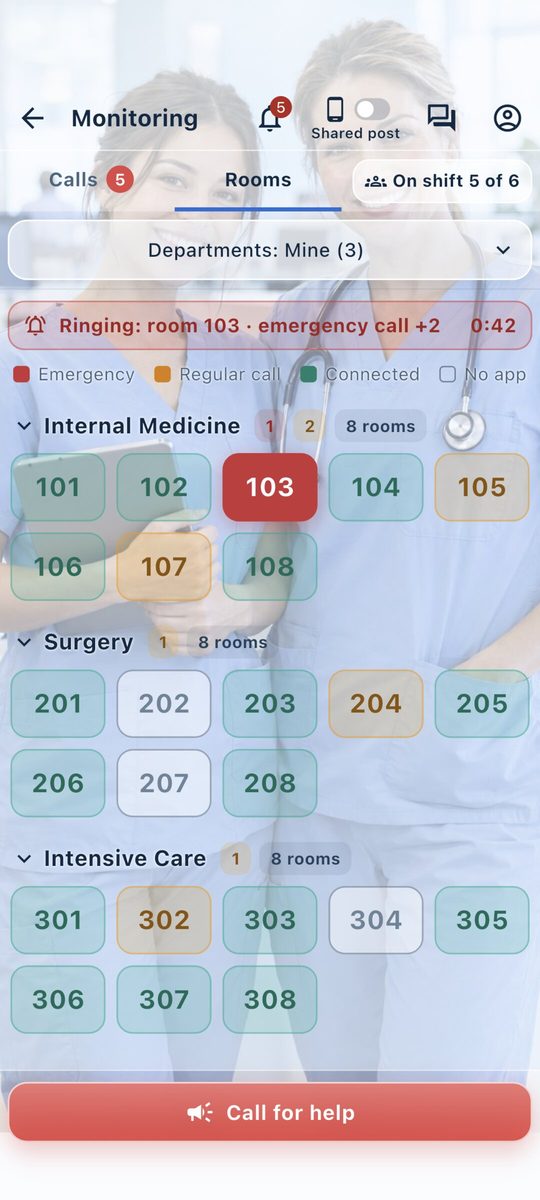
Hospital Alert is not an IP nurse call system and does not run on a dedicated nurse call network. Patients call from their own phones by scanning a QR code at the bed, so the call travels over the internet, and staff receive it in the app on their phones and in the web version on a computer at the nurse station. Nothing is installed in the walls. A ward can use it where there is no system at all, or alongside an existing one as a second channel: patients can choose the reason for the call from pictures and write a short message, and they see when a nurse has accepted the call. To try it in one department, see the pilot checklist.
Frequently asked questions
What is an IP-based nurse call system?
It is a nurse call system whose parts — room and bed stations, corridor lights, nurse consoles and controllers — exchange calls as data over a network, using the Internet Protocol. Calls can then be passed through gateways to wireless phones, pagers, computers and other hospital systems. In most installations it is still cabled to each room.
Can a nurse call system run on the hospital's normal network?
US federal specifications say no for the core. The Defense specification asks for a separate, dedicated nurse call network for all basic calling, with gateways where links to the facility network are needed, and the VA specification keeps the nurse call system separate from the telephone cabling. Check what your own code and authority require.
What is the difference between a wired and a wireless nurse call system?
In a wired system each call point is connected by cable to the controller and console. In a wireless system buttons and pendants send calls by radio, and calls can reach staff phones over Wi-Fi. A system can also mix both, for example wired stations at the bed and in bathrooms and wireless phones for staff.
What makes a nurse call system smart?
There is no standard definition. The word is often used to mean that the system routes calls to the assigned nurse's phone, shows why the patient is calling, and links to other systems such as bed exit alarms, staff assignment or location tracking. Ask for the list of links and what each one costs to set up and keep secure.
What happens to an IP nurse call system in a power cut?
It depends on the backup. The Defense specification asks for a battery or uninterruptible power supply that runs the system at full power for 15 minutes, and the VA specification asks for at least 30 minutes, plus a test that simulates a power outage before the system is accepted.
Sources
How this article was prepared
Written by the Hospital Alert team with the help of AI tools. Everything we say about the app was checked against the app itself; facts from outside sources are linked above. This article is general information, not medical advice. Found a mistake? Write to team@hospitalalert.online.