Nurse call without wiring
Wired nurse call vs calling from the patient's phone
Choose a wired nurse call system where rules require certified equipment and for patients who cannot use a phone: it does not depend on anyone's smartphone or internet connection. Calling from the patient's own phone by QR code costs little to start and adds messages and translation, but it only helps patients who can use a phone.
A hospital that already has a wired nurse call system, or is pricing one for a new ward, often asks whether patients could simply call from their own phones. The two are not the same kind of tool. This page compares them criterion by criterion and says plainly where the wired system is the better choice.
How each one works
A wired nurse call system is cabled into the building. A button or pillow speaker at the bed, a pull cord in the bathroom and a light above the door are connected to a nurse station console; many systems also send calls to staff phones or pagers. The US Department of Defense guide specification UFGS 27 52 24 describes these parts in detail, from water-resistant pull cords in wet areas to routing calls by room, priority and staff assignment. In newer installations the same parts exchange calls as data over a network; see IP nurse call system vs traditional nurse call.
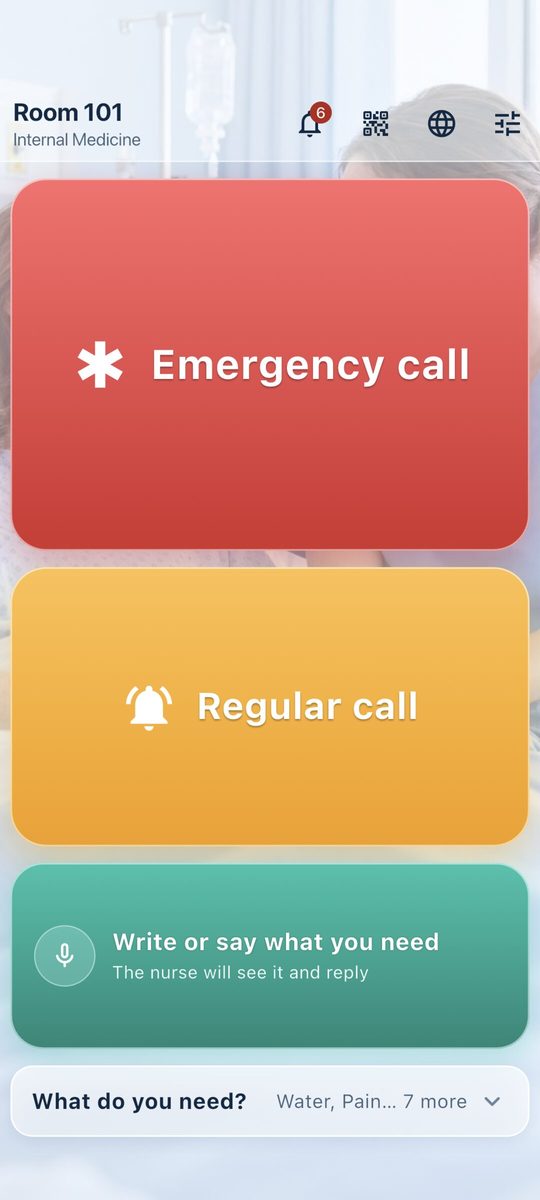
Calling from the patient's phone needs no devices in the room. A sheet with a QR code hangs at the bed; the patient scans it, and a call screen opens in the phone's browser. In Hospital Alert the alert goes to the nurses' phones and to the nurse station, and the patient sees each step until a nurse is with them. Our guide to QR code nurse call shows the screens.
Side-by-side comparison
| Criterion | Wired nurse call system | Call from the patient's phone (QR, e.g. Hospital Alert) |
|---|---|---|
| Cost to start | Devices, cabling, installation, design, testing and staff training; see what makes up the price | Hospital Alert is free for hospitals today; the hospital prints QR sheets on its own paper and uses staff phones or a computer |
| Installation | Cable to every bed, bathroom and door light; building work in rooms that may be occupied; acceptance tests before use | No cabling: create rooms in the app, print the sheets, hang them at the beds |
| What the patient needs | The strength and awareness to press a button or pull a cord — no phone | A smartphone (to scan the QR code or type the room code), an internet connection, a charged battery and the ability to use it |
| If something fails | The guide specification requires supervised devices and wiring, failure reports to the console, and battery backup or a UPS for at least 15 minutes at full power | No call if the patient's phone is flat or offline; delivery to staff depends on the network and phone settings |
| Call log and reports | The guide specification includes an optional call logging workstation that stores call logs and prepares reports | A live call feed at the nurse station; the Hospital Alert site does not describe call reports, so if you need them, ask team@hospitalalert.online |
| Rules | In the US, healthcare facilities look for compliance with UL 1069; in Germany, DIN VDE 0834-1 applies | Hospital Alert is not certified under UL 1069 or DIN VDE 0834 and is not a medical device |
| What the nurse learns before going | The room, the type of call and, with audio stations, the patient's voice | Emergency or regular call, a picture of a common need, or a short message by text or voice, translated automatically |
| Upkeep | Service, spare parts, periodic testing | Updates to the app; staff phones charged and set so alerts are heard |
Where a wired system is clearly better
- Patients who cannot use a phone. People in intensive care, after sedation, very weak, confused or without a smartphone may still be able to press a button or pull a cord — if it is within reach. Placement matters: in a small pilot study, 11 of 37 hospitalised patients aged 70 and over could not use their call bell, seven of them because it was out of reach (Duffy et al., 2005).
- Bathrooms. A pull cord within reach on the toilet or in the shower works when the patient has no phone with them.
- Independence from the patient's phone. A wired button does not care about battery, mobile signal or Wi-Fi.
- Built-in safety checks. UFGS 27 52 24 requires the system to supervise call devices and their wiring and report a failed station, and to keep running on battery backup when mains power fails.
- Calls that must be answered in the room. The same specification requires higher-priority calls to be cancelled only at the station in the room they came from, so someone has to go there.
- Rules that require listed or certified equipment. If the authority that inspects your building expects a UL 1069 listed system or one built to DIN VDE 0834, a phone app cannot take its place.
Where calling from the phone is stronger
- No cabling and no hardware in rooms. A ward with no system, an old building or a temporary ward can start with printed sheets. For wards without wiring, see four wireless options.
- The nurse knows what the patient needs. In a Norwegian study, nurses said that not knowing why a patient is calling is stressful, and that seeing the reason helps them decide what to do first (Klemets & Toussaint, 2016). In Hospital Alert the patient can pick a picture of a common need or send a short message by text or voice.
- Different languages. Messages between patient and staff are translated automatically; in the browser version this is done by a third-party AI service, so patients should not write personal or medical details in the chat.
- The patient sees what is happening. Accepted, on the way, with the patient — instead of waiting without knowing whether the call was seen.
- Escalation without new equipment. If nobody accepts a call, it goes on to the next people in the chain set by the administrator.
Can you use both?
Yes, and in a building with a wired system this is the sensible way to use a phone-based app: as an extra channel for patients who can use a phone, while the wired buttons and pull cords stay in place. Hospital Alert does not connect to wired nurse call systems, so staff watch two channels. Agree who answers each one on every shift before you start.
The safest way to decide is a short trial. Keep the existing system running, add QR sheets in one department for a week, run test calls on day and night shifts, and ask nurses and patients what helped. Our pilot checklist lists the steps.
Questions to ask before you choose
- Do the rules for your building require a listed or certified nurse call system?
- How many of your patients cannot use a smartphone, even on a good day?
- Do bathrooms and showers need a way to call?
- How reliable are Wi-Fi and mobile coverage in every room, and are staff phones set so alerts are heard?
- Do you need call reports for audits or quality reviews?
- Who will maintain the system, and what does upkeep cost over its life?
Frequently asked questions
Is a wired nurse call system more reliable than a phone app?
For the patient, usually yes: a wired button does not depend on the patient's battery, mobile signal or Wi-Fi, and specifications such as UFGS 27 52 24 require supervised wiring and battery backup. A phone app depends on the patient's phone, the network and the staff phones' settings.
Can patients call a nurse from their own phone instead of a call button?
Patients who can use a smartphone can: they scan a QR code at the bed and a call screen opens in the browser. Patients who are very weak, confused, sedated or without a phone cannot, so the ward still needs a physical way to call or regular checks.
Can a QR nurse call app work alongside an existing wired system?
Yes, as a separate channel: patients who can use a phone get messages, pictures of common needs and translation, while the wired buttons stay in place. Hospital Alert does not connect to wired nurse call systems, so staff watch two channels and need a clear routine.
Which option is cheaper?
Calling from the patient's phone is cheaper to start: Hospital Alert is free for hospitals today and needs printed QR sheets plus staff phones or a computer. A wired system means devices, cabling, installation, testing and upkeep; our cost guide explains what drives that price.
Sources
- U.S. Department of Defense (USACE / NAVFAC / AFCEC) — UFGS 27 52 24, Nurse Call System, November 2020 (references updated July 2026)
- UL Solutions — Nurse Call and Emergency Call Systems (UL 1069, UL 2560, NFPA 99), 2020
- DIN Media — DIN VDE 0834-1:2026-08, Call systems in hospitals, nursing homes and similar institutions
- Duffy et al. — Ability of hospitalized older adults to use their call bell: a pilot study in a tertiary care teaching hospital, Aging Clinical and Experimental Research, 2005
- Klemets & Toussaint — Does revealing contextual knowledge of the patient's intention help nurses' handling of nurse calls?, International Journal of Medical Informatics, 2016
How this article was prepared
Written by the Hospital Alert team with the help of AI tools. Everything we say about the app was checked against the app itself; facts from outside sources are linked above. This article is general information, not medical advice. Found a mistake? Write to team@hospitalalert.online.