Nurse call without wiring
What is a nurse call system? Parts, types and how it works
A nurse call system lets patients call staff for help: they press a button at the bed or pull a cord in the bathroom, and staff see which room is calling on a light above the door, a nurse station screen or their phones. Systems are wired, wireless or networked; some take calls from the patient's phone.

This guide covers what a nurse call system is made of, how a call travels from the bed to the nurse, which types exist and which rules apply. For how it all began, see our history of the nurse call.
What a nurse call system does
A nurse call system connects every bed, bathroom and room with the staff. The patient presses a button or pulls a cord; staff hear a tone and see which room is calling and how urgent it is. As a 2020 study points out, the whole system depends on the patient noticing that something is wrong and being able to call (Dugstad et al., 2020).
The stakes are real: the World Health Organization names falls as the most frequent adverse event in hospitals, and in four US hospitals the units whose patients used the call light more often had fewer falls (Tzeng et al., 2012) — a link, not proof of cause.
The parts of a nurse call system
Manufacturers use different names, but two US federal specifications — from the Department of Defense and the Department of Veterans Affairs (VA) — list the same building blocks:
| Part | Where | What it does |
|---|---|---|
| Call button on a cord or pillow speaker | In the patient's hand | The patient presses it to call. A pillow speaker can also control the lights and TV; there are light-pressure, squeeze-bulb and breath-operated versions. |
| Pull cord | Toilet and shower | Pulling it sends an emergency call. |
| Patient station | Wall by the bed | A lamp that confirms the call, a reset button and a socket for the cord; audio versions add a speaker and microphone. |
| Staff and code buttons | In the room | Staff call a colleague, raise the alarm or call the code team. |
| Dome and corridor lights | Above the door, in the corridor | Show which room is calling and, by colour and flashing, what type of call it is. |
| Master station | Nurse station | Lists calls by priority and room; in audio systems the nurse can talk to the patient from it. |
| Staff devices | Carried by staff | Pagers, wireless phones and other personal devices receive calls and text messages. |
| Cancel (reset) button | In the room | Clears the call once staff have come. |
How a call travels, step by step
- The patient calls. They press the button on the cord or pull the cord in the bathroom.
- The system shows where the call comes from and how urgent it is. The light above the door comes on, a tone sounds, and the master station shows the room and the type of call. The most urgent call comes first.
- The call can also reach staff away from the desk — on pagers or phones, where the system has them.
- The nurse answers — over the intercom in an audio-visual system, or by going to the room.
- The call is cleared in the room. Under the VA specification, any call can be cancelled only where it was made; under the Defense one, any call except a routine one. So the light stays on until someone has actually come to the room.
- If nobody answers, the system passes the call on. In the VA specification, a call not answered within a set time goes to back-up staff chosen by the shift supervisor.
Types of nurse call systems
For a ward with no wired system, see four options for nurse call without wiring.
| Type | How it works | Keep in mind |
|---|---|---|
| Tone-visual (wired) | Buttons and cords wired to lights, tones and text displays; no two-way voice | Cabling in every room; the nurse learns what is needed only on arrival |
| Audio-visual (wired) | Adds two-way voice between the room and the nurse station | More equipment in each room |
| Wireless | Buttons, pendants and sensors send calls by radio; staff receive them on smartphones | Staff need training: in a Norwegian study more than a third named lack of prior knowledge as a barrier |
| Networked (IP) | The system runs on its own data network; gateways pass calls on to wireless phones, pagers and computers | Both US specifications keep the system's core separate from the hospital's general network; the Defense one warns that every link to another system adds cost and cybersecurity work |
| Patient's own phone (QR code) | The patient scans a code at the bed and calls from their own smartphone; staff get the call in an app | Only for patients who can use a phone; we found no peer-reviewed studies of it |
Five Norwegian care homes that adopted wireless systems gave residents wearable call buttons, installed sensors for those who cannot call and moved staff calls onto smartphones (Dugstad et al., 2020). In hospitals, clinical staff carry smartphones that receive nurse calls (Howell & Knight, 2024).
Standards and rules
In the United States, UL 1069 — the Standard for Hospital Signaling and Nurse Call Equipment — is meant to make sure every call for assistance reaches the nurse station. Healthcare facilities look for UL 1069 compliance to show compliance with the NFPA 99 code; UL 2560 covers emergency call systems in assisted and independent living (UL Solutions, 2020). The Defense specification requires UL 1069 and warns that linking a new system to an existing one falls outside the new system's UL 1069 listing.
In Germany, DIN VDE 0834-1 sets requirements for the equipment, planning, installation, inspection and operation of call systems in hospitals and nursing homes; its current edition is dated August 2026. Rules differ by country: ask the authority that inspects your building before you buy or change anything.
Questions to ask before you choose
The codes and standards behind these questions, and a walk-through for testing a system on the ward, are in nurse call system requirements.
- Who will call, and with what? A standard button, a pull cord, a light-pressure or breath switch, or a phone? Some patients cannot call at all; for them, wireless systems can add sensors.
- Where must calls show up? Only at the nurse station, or also on duty stations and staff phones?
- Who gets a call nobody answers? Ask how long the system waits and who chooses the back-up staff.
- Can staff learn what the patient needs before walking over? In a scenario study, nurses torn between the calling patient and the one in front of them found not knowing the reason stressful; the authors conclude that seeing it helps them decide more accurately (Klemets & Toussaint, 2016).
- Which rules apply? If your building requires certified equipment, for example listed to UL 1069, choose among such systems; anything else can only be an extra way to call.
- How will you know it works? The specifications ask the system to report its own faults, and the VA one describes reports that log calls and response times. Someone still has to read them and run test calls.
Where a phone-based app fits
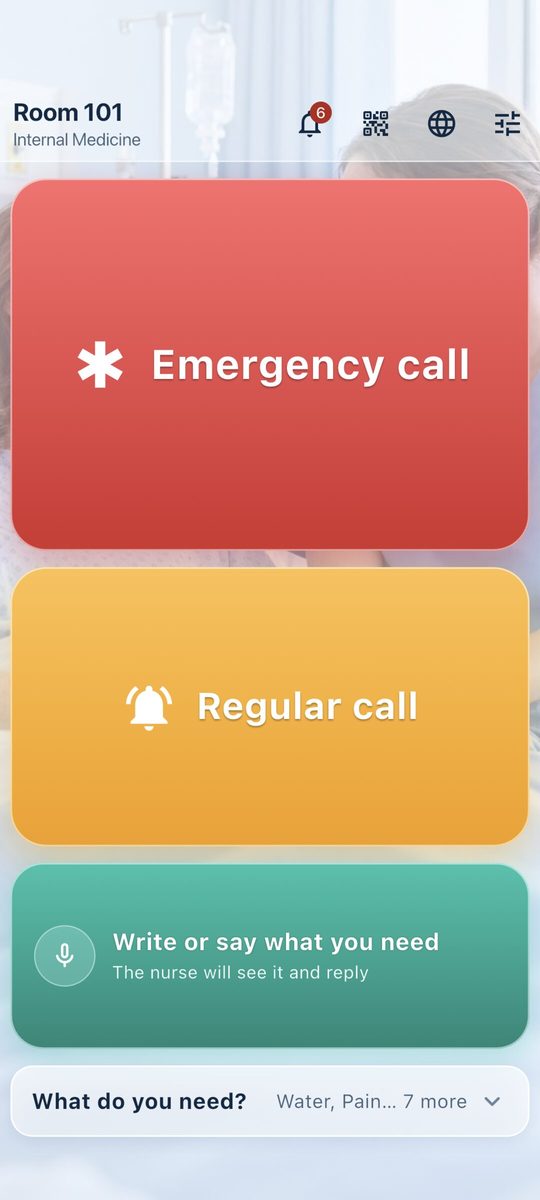
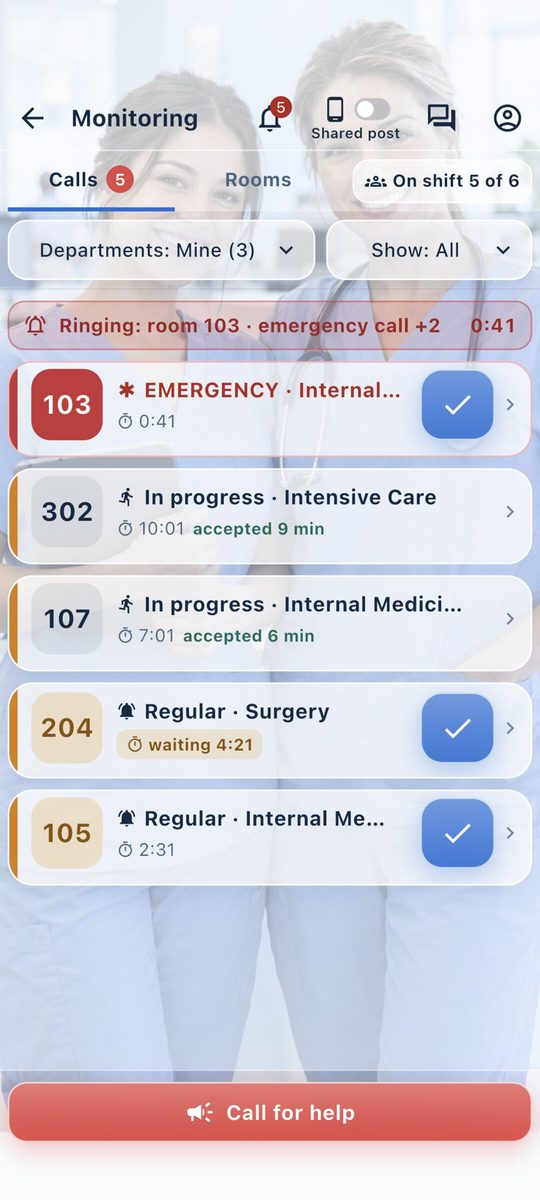
An app on the patient's phone has no lights or cords, but it gives patients another way to call. Hospital Alert is one example: the patient scans the QR code at the bed, a call screen opens in the phone's browser, and from there they can make an emergency or a regular call, pick a common need from pictures or write a short message. Nurses get the alert on their phones and at the nurse station; the patient sees whether the call was accepted and whether a nurse is on the way. If nobody accepts the call, it goes along a chain set by the hospital administrator. It is free for hospitals today.
Frequently asked questions
What does the light above a patient's door mean?
It is the dome light of the nurse call system. It shows that someone in that room has called, and its colour and flashing show the type of call — for example routine, staff assist, emergency or a code call. Colours and call names vary from one facility to another, so ask the ward which signal means what.
Which standards apply to nurse call systems?
In the United States, healthcare facilities look for compliance with UL 1069, the standard for hospital signaling and nurse call equipment, to show compliance with the NFPA 99 code; UL 2560 covers emergency call systems in assisted and independent living. In Germany, DIN VDE 0834-1 covers call systems in hospitals and nursing homes. Check the rules of your own country.
Can a nurse call system be wireless?
Yes. In wireless systems, buttons, pendants and sensors send calls by radio, and staff receive them on pagers or smartphones; Norwegian care homes, for example, already use them. Whether a wireless system meets the rules for your building depends on the country and the type of facility, so ask the authority that inspects it before you change anything.
Can patients call a nurse from their own phone?
Yes, if the hospital uses a QR-code system: the patient scans a code at the bed and calls staff from their own smartphone; some of these systems open in the phone's browser, so nothing has to be installed. It works only for patients who have a smartphone and can use it, so the room still needs a button, a cord or another way to call for help.
Sources
- U.S. Department of Defense (USACE / NAVFAC / AFCEC) — UFGS 27 52 24, Nurse Call System, November 2020 (references updated July 2026)
- U.S. Department of Veterans Affairs — Specification 27 52 23, Nurse Call and Code Blue Systems, December 2020
- UL Solutions — Nurse Call and Emergency Call Systems (UL 1069, UL 2560, NFPA 99), 2020
- DIN Media — DIN VDE 0834-1:2026-08, Call systems in hospitals, nursing homes and similar institutions
- Dugstad et al. — Nursing staff's evaluation of facilitators and barriers during implementation of wireless nurse call systems in residential care facilities, BMC Health Services Research, 2020
- Howell & Knight — Quieter Nurse Call System to Reduce Alarm Noise in Hospitals, Studies in Health Technology and Informatics, 2024
- Klemets & Toussaint — Does revealing contextual knowledge of the patient's intention help nurses' handling of nurse calls?, International Journal of Medical Informatics, 2016
- Tzeng et al. — The contribution of staff call light response time to fall and injurious fall rates: an exploratory study in four US hospitals using archived hospital data, BMC Health Services Research, 2012
- World Health Organization — Patient safety fact sheet, 2023
How this article was prepared
Written by the Hospital Alert team with the help of AI tools. Everything we say about the app was checked against the app itself; facts from outside sources are linked above. This article is general information, not medical advice. Found a mistake? Write to team@hospitalalert.online.