Running a ward
Nurse call system requirements: a checklist for hospitals
A nurse call system has to let every patient call from wherever they can be alone — the bed, the toilet, the shower — and get that call to staff who will hear it. Published specifications fill in the details: separate call types, a call that stays on until staff reset it at the patient, forwarding when nobody answers, fault alarms, backup power, a log of calls, and regular tests.

A nurse call system has to let every patient call for help from wherever they can be alone — the bed, the toilet, the shower — and get that call to staff who will hear it and come. Everything else is detail, but the detail is what you check: separate call types, a call that stays on until a nurse resets it at the patient, forwarding when nobody answers, fault alarms, backup power, a log of calls and regular tests. This checklist is for the administrator, head nurse or estates manager who has to sign off on whether a ward's system does all that. It draws on two public documents — the US Department of Veterans Affairs (VA) nurse call specification and the NHS guidance on bedhead services, HTM 08-03 — and on US federal rules. Who installs the system and how acceptance tests run are covered in our guide to nurse call installers.
Which rules apply to you
Start here, because the answer changes by country and by type of facility:
- US nursing homes. Federal rules require a call system that relays the call directly to a staff member or to a central staff work area from each resident's bedside and from toilet and bathing facilities (42 CFR 483.90(g)). The rule gives no response time in minutes. CMS guidance for inspectors says it is met only if every part of the system works — not switched off at the nurses' station, loud enough to hear, lights above the doors working — and calls are being answered; slow answering is looked at under the nursing staffing requirements (42 CFR 483.35).
- US hospitals. NFPA 99, the Health Care Facilities Code, applies where it has been adopted; according to UL, healthcare facilities look for equipment listed to UL 1069, the standard for hospital signaling and nurse call equipment, to show compliance. Your state may also have adopted design guidelines for hospital buildings, such as the FGI Guidelines; ask your state health department which edition applies. Assisted living is different — see UL 2560 for assisted living.
- England. HTM 08-03 describes the ability for patients to summon help, and for staff to call each other, as an essential life-safety component of bedhead services.
We have not reproduced the text of NFPA 99 or UL 1069. Ask your manufacturer which edition its listing covers, and check which edition your authority has adopted.
The checklist: 12 things to check
- A call point wherever a patient can be alone. Every bed, toilet, bathroom and shower. The VA list of ways to start a call includes the patient station, pillow speaker, bed push button, bed controls, and pull cords or push buttons in toilets and showers. Bathroom details are in nurse call pull cords.
- Patients who cannot press a button. HTM 08-03 calls on managers to assess patients for disability and make sure they can use the call devices; for patients who cannot use their hands it mentions air-operated call units. It also recommends symbols, and attention to language, so patients understand the device.
- Separate call types. The VA specification asks for distinct routine, staff assist and emergency calls (plus code blue where fitted), each with its own light pattern and tone. HTM 08-03 gives emergency and cardiac calls different tones and recommends colours for the buttons — amber for patient calls, red for emergency, blue for cardiac. More in emergency vs routine calls.
- The patient can see the call went through. HTM 08-03 recommends a reassurance lamp that lights within sight of the patient.
- The call stays on until staff reset it at the patient. Both documents allow a call to be cancelled only at the patient's location — at the calling station (VA) or at its reset unit (HTM 08-03). In patient bathrooms HTM 08-03 places the reset unit near the door, so staff come in even if the cord was pulled by accident.
- One call never hides another. HTM 08-03 recommends that a call already in progress should never block a new one, resetting one call should not cancel others, and an emergency should not be masked by a routine call on a shared light.
- Calls are shown in a sensible order. At the VA master station, calls stack by priority and waiting time, the nurse can answer them in any order, and can forward a call to a colleague.
- An unanswered call moves on. The VA specification forwards a call not answered within a programmable time to backup staff named by each shift supervisor. In HTM 08-03, where staff work from several local bases, a call left unanswered after a delay of up to 15 seconds sounds at the other bases, and emergencies sound at all of them at once. Where staff cover a neighbouring ward at night, it advises transferring that ward's calls to them.
- Staff can hear it. HTM 08-03 recommends a call tone at least 5 dB above background noise, repeated where staff often are, such as the ward sister's office, the ward kitchen and utility rooms.
- Faults raise their own alarm. The VA specifies a trouble panel, including at the nurse station, that continuously monitors the equipment, power supplies, lights and connecting lines, and sounds and shows an alarm when something fails. HTM 08-03 recommends an "equipment fault" light that stays on until the fault is fixed.
- Power cuts don't stop calls. The VA specification calls for a battery or UPS that keeps the whole system running normally for at least 30 minutes.
- Calls are logged, tested and maintained. HTM 08-03 recommends that the system log all calls and events and produce history reports; the VA lists calls, alarms, response times and staff assignments, with access limited by password to supervisors. Before handover, HTM 08-03 calls for witness testing with recorded results; after it, regular testing and maintenance to the manufacturer's recommendations, and training for every member of staff who uses the system.
How to run the check on a ward
Walk the ward with the nurse in charge and someone from maintenance. In each room, make a call from every device — the bed, the chair, the toilet, the shower — and note whether it shows above the door, at the nurse station and on staff phones or pagers, and whether you can reset it anywhere other than at the patient. Make one emergency call and leave one routine call unanswered to see who gets it next. Ask maintenance when the last test was, where the results are kept, and what happens to calls during a power cut. Anything you can't check off goes on a list with an owner and a date.
Use the same walk-through when you compare systems before buying one. People search for the best nurse call system, but there is no single best one: the right system meets the rules that apply to your building and passes these checks on your wards. The questions to put to vendors are in our guide to what a nurse call system is, under “Questions to ask before you choose”. Before you decide, ask a hospital that already uses the system what it is like on the ward — nurses ask each other the same thing. In a 2006 thread on the German nursing forum krankenschwester.de (about 13,000 views, 40 replies), a nurse asked which hospitals had a central patient call, where a call desk asks the patient what they need and passes it on to the ward. Replies from nurses who knew such systems said they saved walks and let staff bring what was wanted on the first trip. One nurse added that it rarely worked with older or confused patients, another that it was no substitute for going to the room when a patient was in real trouble. A member who had worked with such a system and had also spent a long time as a patient in a three-bed room found it humiliating to ask out loud for a bedpan, and said patients with hearing problems could hardly understand the voice at the other end.
How this looks in Hospital Alert
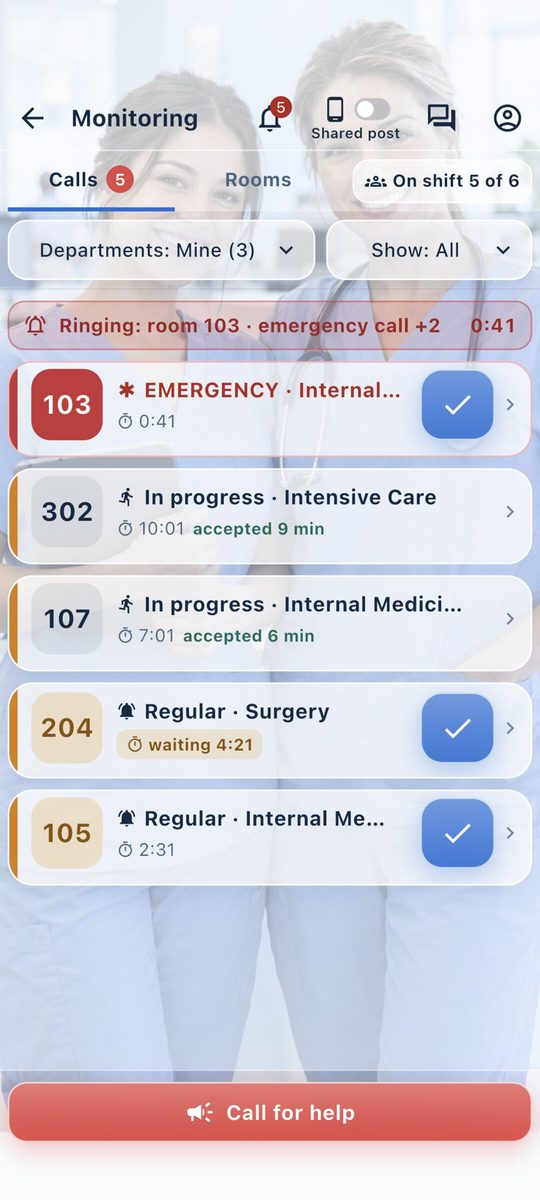
Hospital Alert is a free app in which patients call staff from their own phones. It is not a listed nurse call system, but if you use it alongside one, the same questions apply. Here is what the administrator can set up and check:
- Call points. The administrator creates departments and rooms and prints a QR sheet for each room to place at the beds; a patient scans the code and the call screen opens in the phone's browser.
- Call types. The patient has two buttons, emergency and regular.
- Who gets the call. Staff have roles — nurse, head nurse, doctor, on-call doctor, administrator and custom roles — and mark themselves on or off shift; off shift, calls don't come to that phone.
- Forwarding. The administrator sets up the alert chain: if nobody accepts a call, the alert moves on to the next people in the chain automatically.
- Being heard. On Android, the alarm check plays a test alarm and warns about alarm volume and battery saving. The nurse station screen warns when it has lost the connection to the server and new calls may not appear.
- Records. The administrator has an activity log: what happened, by which role and when. There is no response-time report like the one the VA describes.
- Testing. Run test calls from every room on day and night shifts, as in the pilot checklist.
Frequently asked questions
What are the requirements for a nurse call system?
In short: a call point at every bed and in every toilet, bathroom and shower; distinct call types such as routine and emergency; calls that stay on until staff reset them at the patient; forwarding to backup staff when nobody answers; fault alarms and backup power; a log of calls; and testing before handover and regularly after that. The exact rules depend on your country, your type of facility and the codes your authority has adopted.
What does NFPA 99 require for nurse call?
NFPA 99, the Health Care Facilities Code, is the US code; according to UL, healthcare facilities look for nurse call equipment listed to UL 1069 to show they comply with it. We have not reproduced either text here. Read the edition your authority having jurisdiction has adopted, and ask the manufacturer for proof that the system is listed to UL 1069.
Is a nurse call system required by law?
For US nursing homes, yes: federal rules require a system that relays calls to staff from each resident's bedside and from toilet and bathing facilities. For hospitals, it depends on the building codes and standards adopted where you are. In England, HTM 08-03 is the guidance for bedhead services in healthcare buildings, including nurse call.
Do nursing home call light regulations set a response time?
Not the federal one. The federal rule for US nursing homes, 42 CFR 483.90(g), says where a resident must be able to call from — each bedside and the toilet and bathing facilities — but gives no response time in minutes. CMS guidance tells inspectors the rule is met only if every part of the system works and calls are being answered. We have not reviewed state rules: ask your state survey agency, and ask the facility what target it sets.
How often should a nurse call system be tested?
HTM 08-03 asks for witness testing with recorded results before handover, then regular testing and maintenance according to the manufacturer's recommendations and experience over time. It does not set one interval for every system, so put the manufacturer's schedule into your maintenance plan and keep the records. In the US, the codes your authority has adopted and your manufacturer set the schedule; we have not reproduced them here.
Can a smartphone app meet nurse call requirements?
Not on its own. An app like Hospital Alert is not listed to UL 1069 and has no pull cord in the bathroom. It can be an extra way for patients who can use a phone to call staff, alongside the call system your rules require.
Sources
- U.S. Department of Veterans Affairs — Specification 27 52 23, Nurse Call and Code Blue Systems, December 2020
- NHS England — Health Technical Memorandum 08-03: Bedhead services, 2013
- 42 CFR § 483.90 — Physical environment (long-term care facilities), paragraph (g) Resident call system
- CMS — State Operations Manual, Appendix PP: Guidance to Surveyors for Long Term Care Facilities (F919, §483.90(g) Resident call system), Rev. 232, 2025
- UL Solutions — Nurse Call and Emergency Call Systems
- krankenschwester.de — forum thread “Zentraler Patientenruf” (central patient call), 2006 (in German)
How this article was prepared
Written by the Hospital Alert team with the help of AI tools. Everything we say about the app was checked against the app itself; facts from outside sources are linked above. This article is general information, not medical advice. Found a mistake? Write to team@hospitalalert.online.