Running a ward
Emergency nurse call vs routine call: how priorities work
Nurse call systems rank calls by urgency. A US federal specification uses four levels: code calls such as a cardiac arrest, then emergencies such as a bathroom pull cord or a staff assist, then priority patient calls, then routine requests. Each level has its own colour, tone and flash pattern, and the most urgent call shows first.

Not every call on a ward is equally urgent. A request for water, a patient who has fallen in the shower and a cardiac arrest all arrive through the nurse call system, and staff have to tell them apart at a glance. This guide explains how nurse call systems rank calls, who can make each kind, how staff see the difference and what changes when the call is an emergency.
The four priority levels
The US Department of Defense specification for nurse call systems sorts every call into a four-level priority matrix and asks each facility to agree the names and meanings of its call types (UFGS 27 52 24). It also suggests lamp colours, which each facility can change:
| Level | Call types | Lamp colour (suggested) |
|---|---|---|
| 1. Code | Code blue, code call | Blue or purple |
| 2. Emergency | Emergency, bed exit alarm, staff assist, failure alarm, medical device emergency alarm | Red |
| 3. Priority | Patient priority call, call cord disconnected, bed cable disconnected | Yellow or white |
| 4. Routine | Patient routine call, medical device routine alarm, voice intercom from staff and duty stations | Green |
Two rules follow from the levels. When several calls are active at once, the system processes them all but gives the highest priority precedence in tones and lights. And calls at level 3 and above can be reset or cancelled only at the device in the room where they were made — so an emergency light stays on until someone has actually come.
Who can make which call
- The patient in bed makes a routine call with the bedside button or pillow speaker. See nurse call button types.
- Anyone in a toilet or shower can pull the emergency cord or press the emergency button there. See nurse call pull cords.
- Staff use a staff emergency station or a staff assist call to bring colleagues into the room quickly.
- Staff use the code blue station, which has the single function of placing a code call, to summon the resuscitation team. The VA specification requires one press of the "Code Blue" button to page a predetermined group, with the room number and "Code Blue" in plain English on their pagers.
- The system itself raises calls when a bed exit alarm goes off, a device fails or a call cord is unplugged.
How staff tell calls apart
Each priority has its own tone and its own flash pattern on the lights above the door, in the corridor and at duty stations; the master station lists calls by priority level first and only then by the time they were placed. A nurse walking down the corridor should be able to tell an emergency from a request for water without reading a screen. For what the console at the desk shows, see the nurse call station; for the tones themselves and how to tell them apart, see call light sounds.
The level tells staff how urgent a call is, not why the patient is calling. Researchers in Belgium have tested software that assigns priorities using the patient's risk factors and the kind of call; in simulations based on data from three hospital departments, nurses reached calls sooner (Ongenae et al., 2014). That was a prototype, not a system in daily use.
Code blue, rapid response and the emergency button
These are easy to mix up:
- A code blue team is summoned after a cardiopulmonary arrest; what code blue means and who calls it.
- A rapid response team is called earlier, when a patient shows signs of imminent deterioration, usually on general medical or surgical wards. According to AHRQ's patient safety network, the strongest available evidence suggests rapid response systems slightly reduce unexpected cardiac arrests on wards but do not change overall in-hospital mortality (AHRQ PSNet, 2024).
- An emergency nurse call — the bathroom cord, a staff assist — brings staff on the unit to the room fast; they can then call the code or rapid response team if it is needed.
Some hospitals also let patients and families call the rapid response team directly; see what to do if the call button does not work.
The cost of too many emergencies
Priority only works if high-priority calls stay rare. Healthcare staff are typically exposed to hundreds of alarms per shift, possibly more than 1,000, and the result can be alarm fatigue — slower or weaker responses (Howell & Knight, 2024). If routine requests are sent as emergencies, or every device alarm is set to the emergency level, the red light stops meaning anything. Agree with your team which call types belong at which level, and review it when staff complain about noise.
Emergency and regular calls in Hospital Alert
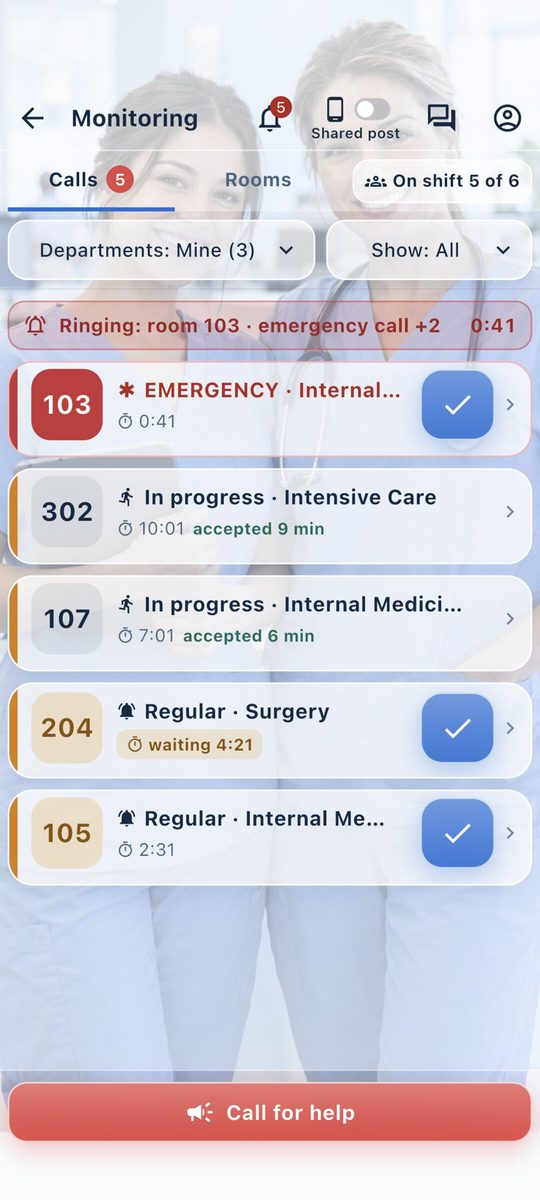
Hospital Alert, a nurse call app that patients open from a QR code at the bed, has two buttons: a red emergency button and a yellow regular one. One tap sends a regular call, three taps an urgent one, and holding the button sends a critical call with the highest priority; a short cancel window protects against accidental taps, and non-urgent questions go through a separate channel. By default an emergency call does not wait its turn: it goes to the ward nurses, the on-call doctor and the head nurse at the same time. A regular call that is not accepted moves up the chain — by default to the head nurse, then the on-call doctor. Each hospital sets up its own chain. Staff can also send a "Call for help" alert to colleagues — the app's version of a staff assist — at one of three levels: Need help, Doctor urgently, or Critical — all hands; the administrator chooses who receives each level. See the one-ward pilot checklist.
Frequently asked questions
What is an emergency nurse call?
It is a call the system treats as more urgent than a patient's routine request. In the US Defense specification the emergency level covers calls such as a staff assist, a bed exit alarm and failure alarms, and the bathroom pull cord is described as an emergency call device. Only code calls rank higher.
What is the difference between the emergency button and the call button?
The call button asks for help with everyday needs. An emergency button or cord raises a higher-priority call that shows in a different colour, with a different tone, ahead of routine calls. Ask staff on admission which buttons your room has and when to use each.
What is a code blue button?
It is a button for staff that summons the resuscitation team. In the US federal specifications it has one function, placing a code call, and the VA one requires the system to page a predetermined group with the room number and the words Code Blue at the press of one button.
Can a patient cancel an emergency call?
Usually not from the bed. Under the US Defense specification, calls at the priority level and above can only be reset at the device in the room where they were made, so the call stays on until a member of staff has come. Some phone-based apps give a short cancel window against accidental taps.
What is a staff assist button?
It is a button staff press in a patient's room to bring colleagues in quickly. A patient's emergency call asks for staff to come; a staff assist comes from staff already at the bedside who need more hands. In the US Defense specification it sits at the emergency level, below only code calls. It is not a duress or panic button for staff safety, which is a security alarm.
Sources
- U.S. Department of Defense (USACE / NAVFAC / AFCEC) — UFGS 27 52 24, Nurse Call System, November 2020
- U.S. Department of Veterans Affairs — Specification 27 52 23, Nurse Call and Code Blue Systems, December 2020
- AHRQ PSNet — Rapid Response Systems (primer, last reviewed 2024)
- Ongenae et al. — Probabilistic priority assessment of nurse calls, Medical Decision Making, 2014
- Howell & Knight — Quieter Nurse Call System to Reduce Alarm Noise in Hospitals, Studies in Health Technology and Informatics, 2024
How this article was prepared
Written by the Hospital Alert team with the help of AI tools. Everything we say about the app was checked against the app itself; facts from outside sources are linked above. This article is general information, not medical advice. Found a mistake? Write to team@hospitalalert.online.