Running a ward
Call light sound: what nurse call tones mean
A call light sounds a tone at the nurse station and corridor displays, and in many hospitals on staff phones too. The tone depends on the type of call: a routine call repeats slowly, a bathroom call faster, and staff emergency and cardiac calls use rapid two-note tones. Different tones let staff tell what is ringing without looking. The exact sounds depend on the system and the hospital's settings.

When a patient presses the call light, the sound is usually not made at the bedside. It plays at the nurse station, at displays along the corridor and, in many hospitals, on the phones or pagers staff carry. What it sounds like depends on the kind of call: a routine call chimes slowly, a bathroom call more often, and emergency calls use a fast two-note tone that is hard to ignore. This guide explains the usual tones, why they differ, why the sound is lower at night and what constant ringing does to staff. How calls are ranked is covered in emergency vs routine nurse calls.
What you hear on a ward
A basic call system works on the "follow the light" idea. The English guidance for hospital bedhead services, HTM 08-03, lists its parts: a button or cord for the patient, a lamp that tells the patient the call has been made, an indicator at the nurse station, lamps along the corridor that lead staff to the room, and an audible tone that sounds until the call is cancelled.
The same document suggests a sound pattern for each type of call, from the most urgent down:
| Type of call | Suggested tone in HTM 08-03 | What it usually means |
|---|---|---|
| Cardiac alarm | Two-note tone, on and off every quarter of a second | A resuscitation call |
| Staff emergency call | Two-note tone, on and off every half second | A nurse at the bed needs help now |
| Bathroom, shower or toilet call | A one-second tone, then three seconds of silence | A patient pulled the cord in the bathroom |
| Patient call | A one-second tone, then nine seconds of silence | A routine call from the bed |
US systems follow the same logic. The Veterans Affairs specification asks for at least routine, staff assist and emergency calls, plus code blue where it is installed, each with its own flashing pattern on the dome light and its own colour and tone at the master station. The Defense Department specification says call priorities are told apart "through unique tone signals" and light flash patterns, and when several calls are waiting, the highest priority sets the tone.
These documents describe tone patterns, not a single official sound. The actual chime, beep or melody comes from the maker of the system and the hospital's settings, which is why a "call light sound" on one ward can be quite different on the next.
Why routine and emergency calls sound different
A nurse in the middle of a dressing change has to decide whether to stop. If the sound alone says "routine call" or "staff emergency", that decision takes a second instead of a walk to the screen.
HTM 08-03 builds this in at several levels. Cardiac calls should have the highest tone frequency, then emergency calls. Higher-priority calls override lower ones, and lower-priority calls come back by themselves once the urgent call is cleared. Tones should sit between 500 and 1,000 Hz, and the call signal should be at least 5 dB above the background noise, so staff hear it whenever it goes off.
Sound is backed up by colour. In the English guidance the patient call button and its lamp are amber, the emergency nurse-call switch is red and the cardiac alarm switch is blue; the VA specification uses single, rapid, red and blue flashing dome lights for its four call types.
Why the call bell keeps ringing
A call is meant to be impossible to ignore until someone has seen the patient. The VA specification requires every call to stay displayed until staff clear it "ONLY from the initiating device location", which means in the room. HTM 08-03 says lamps stay on until the call is cancelled at the reset unit beside the patient, and that it should not be possible to cancel it anywhere else.
Silencing is allowed, but only for a moment. In the Defense Department specification the tone may be muted at a display, but it switches back on when another call arrives; the VA one makes a silenced code blue alarm sound again after a set time until the call is dealt with.
Quieter at night, but never off
Patients sleep near the nurse station, so the volume at the station can usually be turned down at night. HTM 08-03 asks for a switch at the nurse station to reduce the volume at night, with no "off" position. If the quiet setting is on, an emergency call overrides it. In rooms where staff gather, such as the ward office or kitchen, the guidance suggests it may be better not to lower the volume at night at all.
For US nursing homes the rule is blunt. CMS guidance to inspectors says the resident call system requirement is met only if every part works and calls are answered, and gives as examples of failure a system turned off at the nurses' station or a volume too low to be heard. With wireless systems, staff who answer calls must carry working devices and actually answer.
Call light fatigue: when the sound wears staff down
Call lights ring a lot. In a survey of 808 nursing staff in four US hospitals, each person estimated answering about 6.5 calls an hour, roughly one every nine minutes; 77% agreed the calls were meaningful, yet 53% felt answering them kept them from the critical parts of their job (Tzeng, 2010).
"Alarm fatigue" is the broader term. The Joint Commission used it in 2013 for medical device alarms such as monitors: clinicians exposed to constant signals become desensitized and may turn the volume down or the alarm off. That alert is not about nurse call, but the mechanism is the same; what it found and what hospitals were later required to do is in alarm fatigue in nursing. A 2024 paper on a quieter nurse call system notes that staff are typically exposed to hundreds of alarms per shift, possibly more than 1,000 (Howell & Knight; one author works for a nurse call maker).
The kind of sound matters too. In a Japanese pilot study, a trembling "tremolo" call tone was the easiest to notice but raised nurses' stress measures the most; a two-note chord (C6 and G#6), the next easiest to notice, proved less stressful when it replaced the tremolo on a real ward (Katagiri et al., 2026; one author is from a nurse call maker, and the study is small).
What helps, in practice:
- Keep urgent tones rare. If every call sounds like an emergency, staff stop hearing the real one.
- Send each call to the people who answer it. A tone on the assigned nurse's phone disturbs fewer people than a corridor speaker for everyone.
- Answer needs before the light goes on. AHRQ's fall prevention toolkit notes that hourly rounding reduces patients' need to use the call light, and so the number of unscheduled calls. When one patient calls far more than others, see frequent call light use.
- Do not solve it by silencing. A muted station is exactly what US inspectors treat as a failure, and a patient who is not answered will keep calling.
A sound checklist for new staff
- Which tone is a routine call, a bathroom call, a staff emergency and a cardiac call on this ward?
- What do the colours and flash patterns of the door and corridor lamps mean?
- Which calls also reach your phone or pager, and does it vibrate, ring or both?
- What changes at night: which areas get quieter and which do not?
- Where is the cancel button, and who may cancel a call?
Call sounds on staff phones: Hospital Alert
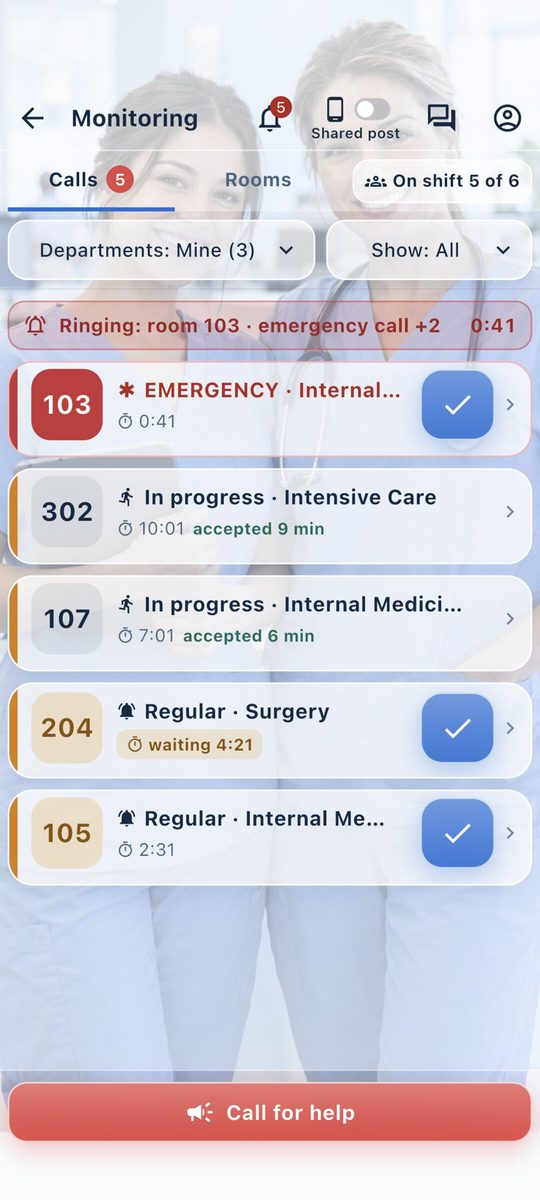
Hospital Alert is a free nurse call app: the patient calls from their own phone by scanning a QR code at the bed, and staff get the call in the app and at the nurse station on a computer. A new call arrives with sound and vibration.
- Emergency and regular calls use different sounds.
- Each alert type can have its own ringtone, chosen from the built-in set or from your own file.
- A full-screen alarm wakes the phone even when the screen is off or the phone is locked.
- A staff member who switches to "Off shift" stops getting calls on that phone, so people who are off duty are not woken.
- On Android, an alarm check plays a test alarm and warns about the alarm volume and battery saving settings.
To see it on a real ward, read nurse pager or smartphone or start with a free pilot in one department.
Frequently asked questions
What does a call light sound like?
Usually a short electronic tone or chime at the nurse station, repeated until someone answers, with a lamp above the patient's door. Older systems beep; newer ones may play different tones or melodies and also send the call to staff phones. A routine call repeats slowly; emergency calls repeat much faster, often with a two-note tone.
Why does the call bell keep ringing?
Because most systems keep a call active until a staff member cancels it in the patient's room. US federal specifications require calls to stay displayed until staff clear them at the device where they started, and the English guidance describes a tone that sounds until the call is cancelled. The ringing stops when someone comes to the bed.
What does a fast beeping nurse call mean?
In many systems a fast or two-note tone marks a higher-priority call: a bathroom call, a staff emergency or a cardiac call. The English guidance, for example, gives the cardiac alarm the fastest pattern. Tones and their meaning differ between hospitals, so new staff should ask for the ward's own list.
Can nurses turn off the call light sound?
They can usually silence or lower it, but not switch it off for good. A US Defense Department specification lets the tone be muted at a display but requires it to come back when another call arrives. The English guidance allows a quieter night setting with no off position, and an emergency call overrides it.
Can I download a hospital call bell sound?
This article does not offer sound files. The real tone is whatever the hospital's system plays, and it differs between makers and wards. If you are training staff, record or play the tones on your own ward's equipment so people learn the sounds they will actually hear.
Sources
- NHS England — Health Technical Memorandum 08-03: Bedhead services, 2013 (Table 2, paragraphs 5.28, 10.11, 10.21, 10.28, 10.70)
- U.S. Department of Veterans Affairs — Specification 27 52 23, Nurse Call and Code Blue Systems, December 2020
- U.S. Department of Defense (USACE / NAVFAC / AFCEC) — UFGS 27 52 24, Nurse Call System, November 2020
- CMS — State Operations Manual, Appendix PP: Guidance to Surveyors for Long Term Care Facilities (F919, §483.90(g) Resident call system), Rev. 232, 2025
- Tzeng — Perspectives of staff nurses of the reasons for and the nature of patient-initiated call lights: an exploratory survey study in four USA hospitals, BMC Health Services Research, 2010
- The Joint Commission — Sentinel Event Alert 50: Medical device alarm safety in hospitals, 8 April 2013
- Howell & Knight — Quieter Nurse Call System to Reduce Alarm Noise in Hospitals, Studies in Health Technology and Informatics, 2024
- Katagiri, Ohira & Sakurai — Development of easy-to-notice nurse call with low stress: a pilot study using heart rate variability, Environmental and Occupational Health Practice, 2026
- AHRQ — Preventing Falls in Hospitals toolkit, 3. Which fall prevention practices do you want to use? (Internet Archive copy, February 2025)
How this article was prepared
Written by the Hospital Alert team with the help of AI tools. Everything we say about the app was checked against the app itself; facts from outside sources are linked above. This article is general information, not medical advice. Found a mistake? Write to team@hospitalalert.online.