Running a ward
Frequent call light use: why a patient keeps calling
When a patient keeps pressing the call light, there is usually a need behind it that the team can find: help to the bathroom or getting up, not knowing when someone will come back, a need the button cannot explain, or wanting company. Log when and why they call, plan for those needs, and keep the light within reach.
Every unit knows the patient who is on the call light every few minutes, often when you are busiest. Staff call it call light abuse, and in the moment it can feel that way. But frequent calls usually point to a need the team can find and plan for. This guide is for nurses, aides and charge nurses: how to work out why this particular patient keeps calling, how to plan for it, and what to say to the patient and the family. It does not cover medical causes. Why patients press the call light in general, and how hourly rounding works, are covered in call lights in nursing.
Start with a log, not a label
"Frequent" means different things on different units, so begin with what is actually happening. For two or three shifts, note each call from this patient: the time, what they asked for, who answered and whether the need was met on that visit. A few lines on the shift report sheet are enough. Then look for patterns:
- The same need, again and again. The bathroom, a change of position, a drink, too hot or too cold — often at similar times of day.
- Busy times. In an observational study in four US nursing homes, calls peaked before and after meals (Ali & Li, 2020). Your log will show this patient's own peaks.
- Calls caused by waiting. In the same study, staff sometimes went into the room, asked the resident to wait and forgot to come back, so the resident had to press the light again (Ali & Li, 2020). If your log shows a call a few minutes after a visit, look at what was promised on that visit.
Pass the log on at shift report so the next shift does not start from zero.
Why one patient calls more than another
A few reasons are worth checking first:
- They cannot get up on their own. In a study of 944 neuroscience patients at a large US academic hospital, patients averaged 6.9 call bell requests a day: 7.7 for those who could not walk and 5.6 for those who could. Patients able to walk more than 250 feet made five fewer calls a day than those who could only move in bed. The authors suggest that mobility should be considered when nurses' workloads and patient assignments are planned (Capo-Lugo et al., 2020). A patient who needs help for every trip to the bathroom will call for every trip.
- They don't know when someone will come. A patient interviewed for a US study on call lights put it this way: "If you can't get to me, you could let me know" (Montie et al., 2017). Without that, pressing again is the only way to check.
- The button can't say what they need. Another patient in the same study described the cost: with a general button, the nurse has to come in to see what you need, leave, and come back — "three trips in here to take care of one problem" (Montie et al., 2017).
- They want company or reassurance. A study in a Swedish care home found a tension between using the call bell for social and existential needs and using it only for practical tasks (Stranz et al., 2022). A call "for nothing" may be a call for someone to be there.
- Something has changed. If a patient who rarely called starts calling all the time, or seems frightened, confused or unwell, don't treat it as behavior to manage — tell the charge nurse.
Planning around this patient's needs
Once you know the pattern, plan for it with the team instead of answering each call as a surprise:
- Offer help before they ask. If the log shows bathroom calls every couple of hours, offer help before that time comes.
- Keep within reach what they keep asking for — and the call light itself; see call light within reach.
- Say when someone will be back. AHRQ's scheduled rounding protocol ends each visit by telling the patient that a member of the nursing staff will be back in an hour. Then the patient does not need the light to find out.
- Keep the promise or hand it over. If you said "I'll be right back" and can't, ask a colleague to go or let the patient know.
- Write the plan down. Put what works for this patient — bathroom times, where things go, what settles them at night — into the care plan and shift report, so every shift does the same.
What to say to the patient
How you answer a call affects whether the light goes on again five minutes later:
- Acknowledge, then ask. "I saw your light — what do you need?" Then deal with as much as you can on that visit.
- Give a time, not "in a minute". "I'm with another patient; I'll be back by ten" is easier to wait for. If you can't come, say who will.
- Ask once more before you leave. AHRQ's protocol suggests: "Is there anything I can do for you before I leave? I have time while I am here in the room."
- Don't tell them to stop pressing. You want the call before they get out of bed, not after: in the nursing home study, residents whose calls went unanswered tended to stand up and try to help themselves (Ali & Li, 2020).
Talking with the family
Families often see the other side: a relative who says they pressed and waited, and staff who seem short with them. It helps to:
- Explain the plan. Tell them what the team is doing — regular bathroom offers, a set time for the next visit — so they can repeat it to the patient.
- Ask about routines at home. When the person usually needs the bathroom at night, what helps them settle, what worries them. That goes straight into the plan.
- Ask them to call rather than help the patient up. AHRQ's fall prevention practices ask patients and families to use the call light when the patient needs to get out of bed.
What not to do
US guidance for nursing home inspectors is clear about the shortcuts. It describes a resident whose call light was pinned out of reach at night because staff said he used it too much, as depriving him of care (more in call light within reach). It also says that involuntary seclusion may be used to discipline a resident for "repeatedly requesting care or services, using the call light", and lists placing a resident in an area without access to call lights as a form of it (CMS, Appendix PP, F600 and F603). These rules are written for nursing homes, but the point holds on a hospital unit too: taking away the way to call does not take away the need.
Knowing the reason before you go: Hospital Alert
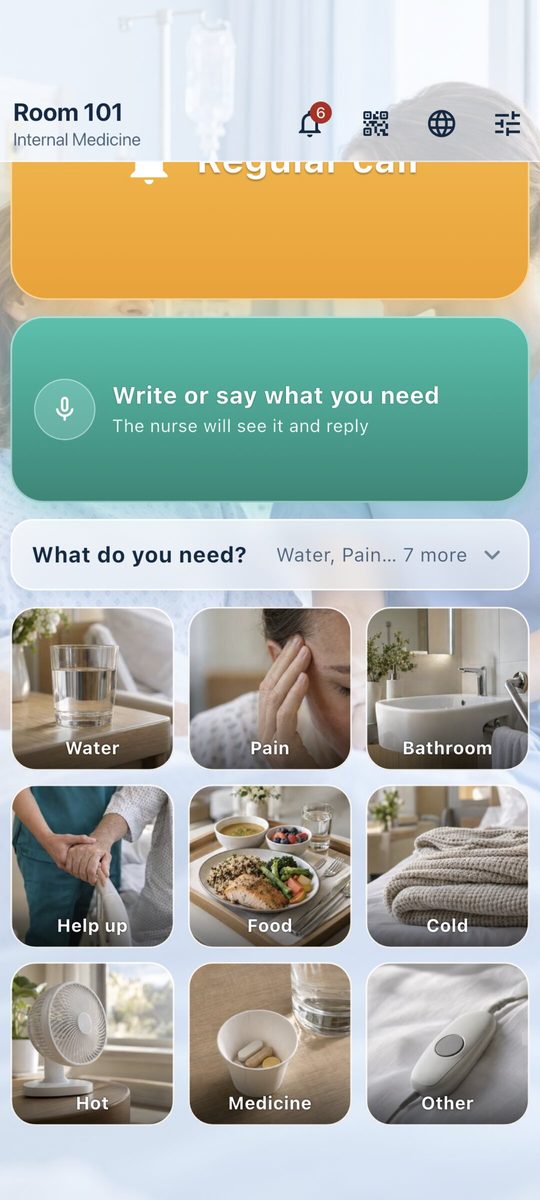
Hospital Alert is a free app for hospitals that lets patients call staff from their own phones by scanning the QR code at the bed. When calling, the patient can pick what they need from pictures — water, pain, bathroom, help up, food, cold, hot, medicine — or describe it in a short message, so the nurse sees the reason before walking over and can bring what is needed on the first trip. The patient sees that the call has been accepted and that a nurse is on the way. On the staff side, colleagues can see who accepted a call, and each call shows the time since it was made.
Frequently asked questions
How do you handle call light abuse?
Start by finding out what the calls are for. For two or three shifts, note the time and the request of each call and whether the need was met on that visit. The pattern is often practical: the bathroom, getting up, things out of reach, waiting for someone who said they would be back. Plan for those with the team instead of answering each call as a surprise.
What do you do when a patient keeps pressing the call light?
Answer it, ask what they need and deal with as much as you can on that visit. Before you leave, ask whether there is anything else and tell them when someone will be back. If the calls continue, keep a short log so the team can see the pattern, and tell the charge nurse if the patient seems frightened, confused or unwell.
Why do some patients use the call light more than others?
Often because they depend on staff for more things. In a study of 944 patients at a US academic hospital, patients who could not walk averaged 7.7 call bell requests a day against 5.6 for those who could. Not knowing when someone will come back, and wanting company, can also lead to repeat calls.
How do you reduce call light use for one patient?
Work from that patient's log. Offer help at the times they usually call, keep the things they keep asking for within reach, tell them when someone will be back and keep that promise or hand it over. Write what works into the care plan so every shift does the same. Do not try to cut calls by taking the light away or discouraging them from using it.
What should you say to a patient who keeps calling?
Acknowledge the call and ask what they need. Give a time rather than “in a minute”, and if you cannot come, say who will. Before leaving, AHRQ's rounding protocol suggests asking: “Is there anything I can do for you before I leave? I have time while I am here in the room.” Avoid telling them to stop pressing.
Sources
- Capo-Lugo et al. — Association between ambulatory status and call bell use in hospitalized patients: a retrospective cohort study, Journal of Nursing Management, 2020
- Montie et al. — Conduits to care: call lights and patients' perceptions of communication, Journal of Multidisciplinary Healthcare, 2017
- Stranz et al. — The call-bell in residential care homes: experiences of residents and staff, Journal of Aging Studies, 2022
- Ali & Li — Use of Notification and Communication Technology (Call Light Systems) in Nursing Homes: Observational Study, Journal of Medical Internet Research, 2020
- AHRQ — Preventing Falls in Hospitals toolkit, Tool 3B: Scheduled Rounding Protocol (Internet Archive copy, February 2025)
- AHRQ — Preventing Falls in Hospitals toolkit, 3. Which fall prevention practices do you want to use? (3.2 Universal fall precautions; Internet Archive copy, February 2025)
- CMS — State Operations Manual, Appendix PP: Guidance to Surveyors for Long Term Care Facilities (F600, F603), Rev. 232, 2025
How this article was prepared
Written by the Hospital Alert team with the help of AI tools. Everything we say about the app was checked against the app itself; facts from outside sources are linked above. This article is general information, not medical advice. Found a mistake? Write to team@hospitalalert.online.