For patients and families
Hospital call bell: what happens when you press it
In a typical wired system, pressing the hospital call bell lights a lamp by your bed and a light above your door, and the nurse station screen shows your room. Some hospitals also send the call to staff phones or pagers. A nurse answers over a speaker or comes to the room. Systems differ, so ask how yours works.

The call bell is the button on a cord at your bed that calls a nurse or another member of staff. Here is what happens after you press it, why you may have to wait and what to check on your first day. This is general information for patients and families, not medical advice.
What happens when you press the call bell
Call bell systems differ from one hospital to another. In a typical wired system, as two US federal specifications describe it (Department of Veterans Affairs and Department of Defense), this is what happens:
- A small lamp by your bed lights up. That tells you the call has gone through.
- The light above your door comes on, and staff in the corridor see which room is calling.
- Your room appears at the nurse station and a tone sounds there. In some hospitals the call also reaches staff phones or pagers, so a nurse away from the desk sees it too.
- A nurse answers. In some systems a nurse may first speak to you through the speaker by your bed; in others, someone comes straight to the room.
The technical side — the parts of the system and its types — is in what a nurse call system is and how it works. If the lamp does not light up or nobody comes, see what to do when the call button is not working.
Why you may have to wait
Your call is one of many. In a survey of 808 nursing staff in four US hospitals, staff said each of them answered six to seven calls an hour; the most common reasons were help with the toilet, pain medicine and problems with an IV drip (Tzeng, 2010). In a study of 944 neuroscience patients at one large US academic hospital, patients pressed the bell 6.9 times a day on average, and those who could not walk pressed it more often (Capo-Lugo et al., 2020).
When several calls come in together, both US specifications put the most urgent first: an emergency in another room comes before a routine call. A nurse who is with another patient must also decide whether to leave that patient. In a scenario study in Norway, nurses found it stressful not to know why a patient was calling; the authors conclude that knowing the reason helps nurses decide more accurately whether to leave the patient they are with (Klemets & Toussaint, 2016).
Answering is only the first step. A study of call bells on one US hospital unit described three linked parts: answering the call, passing on what the patient asked for and following it through (Deitrick et al., 2006). If you asked for something and it has not come, ask again.
When to press it, and when to do something else
Press the call bell whenever you need a member of staff. A patient factsheet from University Hospital Southampton lists when to use it: you need help to move, to get to the toilet or to get in or out of bed, you feel unwell, or something you need is out of reach. It adds: “Please don’t ever feel that you can’t or shouldn’t use your call bell.”
- Say what you need. If a nurse answers over the speaker, say it in a few words: “I need help getting to the toilet” or “my drip is beeping”. Then the nurse knows why you are calling before deciding whom to go to first.
- Say if it is urgent. Use the word “urgent” and say why. In the bathroom, use the pull cord: in both US specifications it sends an emergency call.
- Do not wait if it is an emergency and nobody answers. Call out, send a roommate or visitor to the nurse station or phone the station. All the steps are in our guide to a call button that is not working.
- Tell staff if you cannot use the bell. If it is out of reach, broken or too hard to press, say so: an NHS falls guide notes that staff may find another way for you to alert them (University Hospitals Sussex, 2023).
What to check on the first day
A call bell helps only if you can reach it and know how it works, and that is not always the case. In a pilot study at a teaching hospital, 11 of 37 patients aged 70 or older could not use their call bell: seven because it was out of reach and four because they did not know how to use it (Duffy et al., 2005). In one district general hospital, over a third of inpatients could not work out on their own what the call bell was for and how to use it (Chadwick & Hearn, 2013).
So on the first day, ask the nurse to show you the call bell and the cord in the bathroom, and check that you can reach the bell from the bed. Ask what the lights and tones mean on this ward: colours and call names differ between hospitals. Relatives can help too: the Sussex guide asks family and friends to make sure the call bell, walking aid and glasses are within reach before they leave.
Where an app on the patient's phone fits
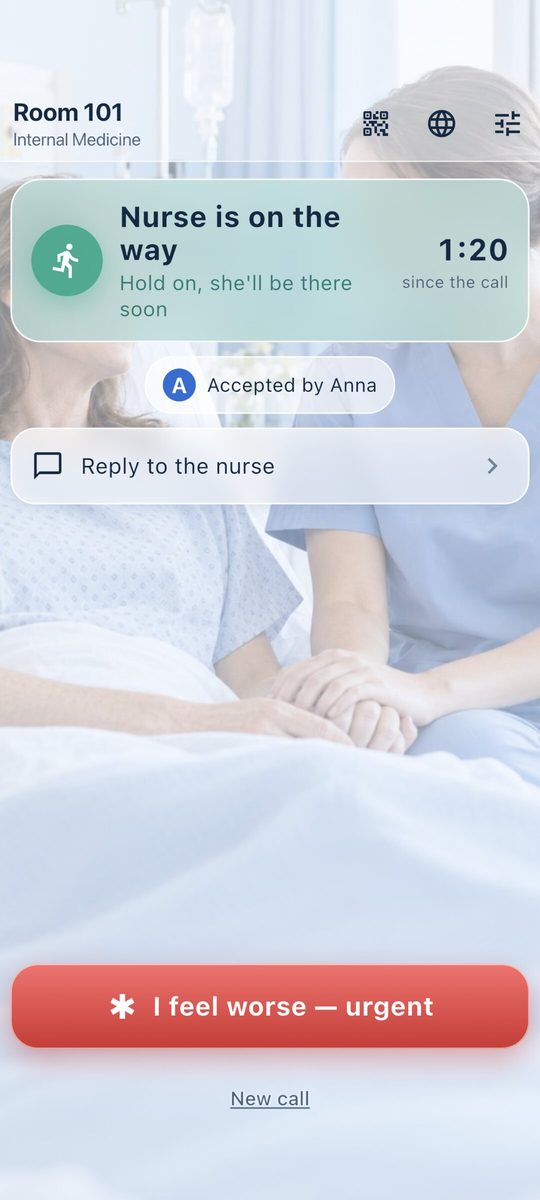
Some hospitals add a second way to call: a QR code at the bed that opens a call screen on the patient's own phone. Hospital Alert, which is free for hospitals, works this way: the patient scans the code, and the call screen opens in the browser — nothing to install, no name, e-mail or phone number.
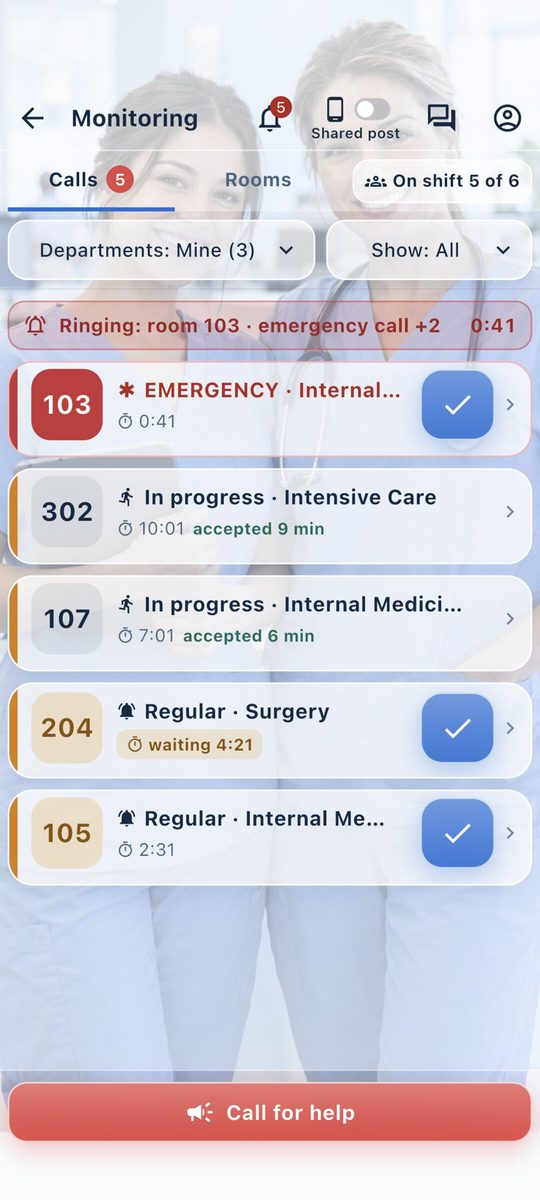
The patient chooses an emergency or a regular call, can pick a common need from pictures or write a short message, and then sees each step: the alert was sent, a nurse accepted it (staff appear under pseudonyms), the nurse is on the way. Nurses get the alert on their phones and at the nurse station; if nobody accepts it, it goes further along a chain set by the hospital. The details are in how a QR code nurse call works.
Frequently asked questions
Can I switch the call bell off myself?
It depends on the system. In the US Veterans Affairs specification, every call stays on until staff clear it at the bed or bathroom where it was made; the US Defense specification allows all but routine calls to be cleared only in the room where they were made. If you no longer need help, tell the nurse who comes.
Is it all right to press the call bell for small things?
Yes. A factsheet from University Hospital Southampton lists needing something that is out of reach among the reasons to press it, and says patients should never feel they can't or shouldn't use it. When the nurse answers, say what you need, so they know why you are calling.
Does the call bell go to my own nurse?
It depends on the hospital. The call shows up at the nurse station and, where the hospital has them, on staff phones or pagers. Some systems send calls by room assignment, and a call nobody answers can be passed on to back-up staff.
Can the nurse hear me when I press the call bell?
Only in some systems. Audio systems have a speaker and microphone by the bed, so a nurse at the nurse station can talk to you and ask what you need. Simpler systems have only lights and tones, and the nurse learns what you need on arrival. Ask which kind your ward has.
Sources
- University Hospital Southampton NHS Foundation Trust — Please use your call bell (patient factsheet, reviewed July 2023)
- University Hospitals Sussex NHS Foundation Trust — Falls prevention in hospital: a guide for patients, their families and carers (adapted from HQIP / Royal College of Physicians), December 2023
- U.S. Department of Veterans Affairs — Specification 27 52 23, Nurse Call and Code Blue Systems, December 2020
- U.S. Department of Defense (USACE / NAVFAC / AFCEC) — UFGS 27 52 24, Nurse Call System, November 2020 (references updated July 2026)
- Tzeng — Perspectives of staff nurses of the reasons for and the nature of patient-initiated call lights: an exploratory survey study in four USA hospitals, BMC Health Services Research, 2010
- Capo-Lugo et al. — Association between ambulatory status and call bell use in hospitalized patients: a retrospective cohort study, Journal of Nursing Management, 2020
- Klemets & Toussaint — Does revealing contextual knowledge of the patient's intention help nurses' handling of nurse calls?, International Journal of Medical Informatics, 2016
- Deitrick et al. — Dance of the call bells: using ethnography to evaluate patient satisfaction with quality of care, Journal of Nursing Care Quality, 2006
- Duffy et al. — Ability of hospitalized older adults to use their call bell: a pilot study in a tertiary care teaching hospital, Aging Clinical and Experimental Research, 2005
- Chadwick & Hearn — A cry for help: time to re-think the patient call bell in an ageing population, British Journal of Hospital Medicine, 2013
How this article was prepared
Written by the Hospital Alert team with the help of AI tools. Everything we say about the app was checked against the app itself; facts from outside sources are linked above. This article is general information, not medical advice. Found a mistake? Write to team@hospitalalert.online.