For patients and families
Hospital call button not working? How to get a nurse's attention
If the hospital call button does not work or nobody comes, press it again and call out, ask a roommate or visitor to go to the nurse station, or phone the station directly. If you think it is an emergency, use the emergency route your hospital gives patients. Report a broken button so that it gets repaired.

You press the call button and nothing happens: the light does not come on, nobody answers, or a long time passes and no nurse comes. Buttons break, cords slip out of reach, and staff are sometimes busy with another patient. This guide lists practical steps to get the attention of hospital staff — for patients and for the people who visit them. It is general information, not medical advice.
What to do right now if the call button does not work
- Press the button again and call out. Say “Nurse!” or “I need help”. Staff walking past the room may hear you even if the signal did not get through.
- Ask someone nearby. A roommate, a visitor or anyone in the corridor can walk to the nurse station and tell the staff which room and bed need help.
- Phone the nurse station. Many wards have a direct phone line. If you have the number, call it from your mobile; a relative at home can call it too.
- Use the hospital's other way to call, if there is one. Some hospitals put a QR code at the bed that opens a call screen on the patient's own phone (see below).
- Ask for the nurse in charge. If calls keep going unanswered, talk to the nurse in charge of the shift or to the ward manager.
If you think it is an emergency
Do not wait for the call light to be answered. Call out for help and send anyone nearby to the nurse station. Then use the emergency route your hospital gives patients: in some hospitals it is an internal emergency number or a rapid-response line for families, and rules differ on whether and when patients should call the public emergency number.
Because these rules differ from hospital to hospital, find them out on the first day — not at the moment you need them.
How to call a nurse in hospital if no one comes
Keep asking. The Joint Commission's Speak Up leaflet, written for patients, encourages them to speak up “if something doesn't seem right” and if they are not getting their medicine or treatment when they should. The same leaflet says family members and friends can help by asking questions and writing down important information and instructions. Whether a family member can stay overnight in hospital depends on the hospital and the unit.
Involving patients is part of how hospitals keep care safe: the World Health Organization notes that patient engagement, if done well, can reduce the burden of harm by up to 15%. Asking again, politely and clearly, is part of that engagement.
Some hospitals have a direct line for patients and families
A few hospital systems run programs that let patients and relatives call a response team themselves. They are examples, not a standard: many hospitals have nothing like this, and the names differ.
| Program | Where | What it is for |
|---|---|---|
| Condition H (Condition Help) | UPMC hospitals, USA | An emergency when you cannot get the attention of staff, a change in the patient's condition that the team is not recognizing, or a breakdown in communication. Patients get the number for their location at admission. |
| Condition HELP | Children's Hospital of Pittsburgh (UPMC), USA | Parents can call a phone number 24 hours a day, 7 days a week, if they feel their child's immediate health is endangered or their concerns are not being addressed. |
| Martha's Rule | England (NHS) | Families can request a rapid review from an independent medical team if they are concerned that a worsening condition is not being responded to. |
At Children's Hospital of Pittsburgh, a review of the first 42 Condition HELP calls found that every one of them was rooted in a breakdown in communication between the family and the caregivers (Dean et al., 2008; hospital report republished by the Josie King Foundation, a partner of these programs). In England, the government says Martha's Rule is in place for inpatients in every acute hospital, and NHS data show more than 2,100 calls that required changes in a patient's treatment.
What to ask when you are admitted
One of the strategies in the hospital guide of the US Agency for Healthcare Research and Quality (AHRQ) is better communication between patients, families and staff from the point of admission. A few questions on the first day are easier than searching for answers at night. Ask the nurse:
- How do I call you from this bed? Where is the button, and what should I do if it does not work?
- What is the nurse station's phone number? Save it in your phone and give it to a family member.
- Who is in charge on each shift, and how can I reach them if calls go unanswered?
- Is there a line that patients or families can call for urgent help — a program like Condition H or Martha's Rule?
- What is the emergency route here: an internal number, a special button or the public emergency number?
- Can I get an interpreter if I do not speak the local language? The Speak Up leaflet names this among the reasons to speak up.
If the call button is broken: report it
A broken button is not only your problem: the next patient in that bed will rely on it too. Tell the nurse straight away which button does not work — at the bed or in the bathroom — and ask how to call until it is repaired: moving to another bed, a portable button or bell, or more frequent checks by the staff. What is possible depends on the hospital.
If nothing changes, tell the ward manager or the hospital administration; if the hospital has a patient relations or patient advocate office, it can help too. Keep it factual: the room, the bed, when you noticed the problem and whom you told.
If the hospital uses Hospital Alert
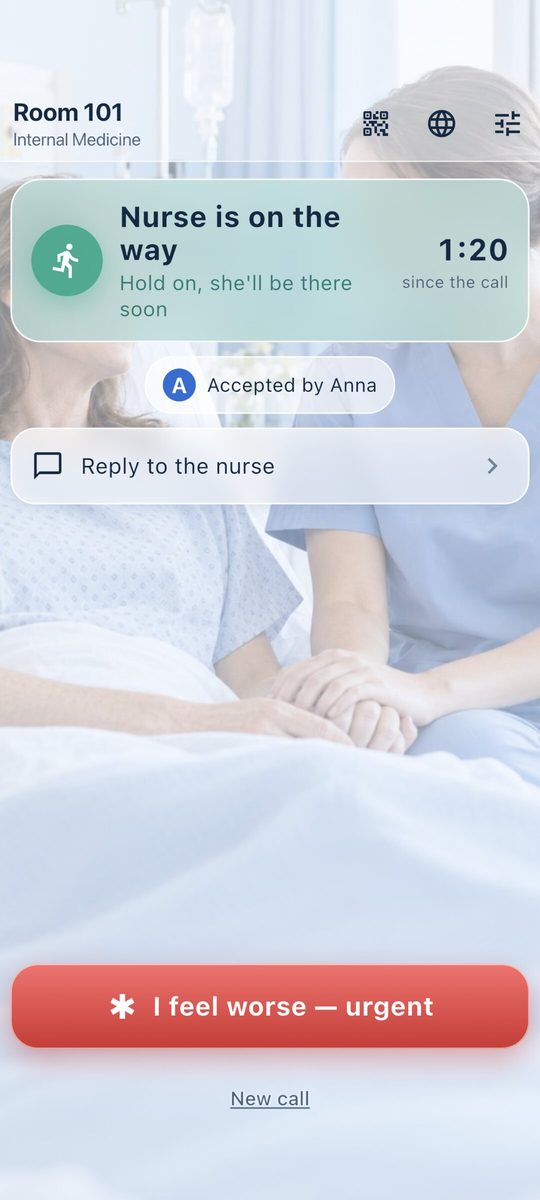
Hospital Alert is a free app for calling hospital staff. If your hospital uses it, there is a sheet with a QR code at the bed. Point your phone camera at it and a call screen opens in the browser: nothing to install, and no name, e-mail or phone number needed. You choose an emergency (red) or a regular (yellow) call, can pick a common need from pictures or write a short message, and then see each step: the alert was sent, a nurse accepted it (you see the nurse's pseudonym), the nurse is on the way.
If you feel worse while waiting, press “I feel worse — urgent”: the button sends an urgent alert to staff, and you do not need to cancel the previous call yourself. If the hospital has entered it, the nurse station phone number is shown while you wait. If nobody accepts the call, it goes further along a chain that the hospital sets up.
Frequently asked questions
What should I do if the hospital call button does not work?
Press it again and call out loud, then ask a roommate, a visitor or anyone in the corridor to go to the nurse station. If you have the station's phone number, call it. Tell the staff that the button is broken so that it can be repaired, and ask how you should call them until then.
Is it okay to keep calling if the nurse does not come?
Yes. Nurses may be busy with another patient, but your call still needs an answer. The Joint Commission's Speak Up program encourages patients to speak up when something does not seem right. Say clearly what you need, and if delays keep happening, ask to talk to the nurse in charge of the shift.
How can a family member get help for a patient in hospital?
A relative can go to the nurse station, phone it, or ask for the nurse in charge. Some hospitals also run a line that patients and families can call for urgent help, such as Condition H in UPMC hospitals or Martha's Rule in England. Ask on the first day whether your hospital has one.
What if I think it is an emergency?
Do not wait for the call button to be answered. Call out for help, send anyone nearby to the nurse station and use the emergency route your hospital gives patients: an internal emergency number, a family rapid-response line or the public emergency number. Ask at admission which one applies here.
Sources
- The Joint Commission — Speak Up About Your Care (copy published by the NIH Clinical Center, reviewed April 2025)
- AHRQ — Guide to Patient and Family Engagement in Hospital Quality and Safety
- World Health Organization — Patient safety (fact sheet, 11 September 2023)
- Josie King Foundation (program partner) — Condition Help (Condition H), UPMC
- Josie King Foundation (program partner) — Children's Hospital Patient Safety Program Improves Caregiver/family Communications (reprint from ScienceDaily, 18 June 2008)
- Dean et al. — Condition HELP: a pediatric rapid response team triggered by patients and parents, J Healthc Qual, 2008
- GOV.UK — Martha's Rule extended to all maternity services, 24 June 2026
How this article was prepared
Written by the Hospital Alert team with the help of AI tools. Everything we say about the app was checked against the app itself; facts from outside sources are linked above. This article is general information, not medical advice. Found a mistake? Write to team@hospitalalert.online.