For patients and families
Can visitors stay overnight in hospital? Rules and tips
It depends on the hospital. In the US, federal rules (42 CFR 482.13(h)) require hospitals to have written visitation policies and to let patients choose their visitors, but they give no right to stay overnight: each hospital and unit sets that. Some states add their own visitation laws. Ask the unit about its overnight policy and what applies in your state.
Whether you can stay the night with someone in the hospital is up to the hospital, and often up to the unit. In the US, federal rules make hospitals write down their visitation policy and let patients choose their visitors, but no federal rule gives a visitor the right to stay overnight. Some states add their own visitation laws. In England, regulations require hospitals to make visits to inpatients possible unless there are exceptional circumstances, again without promising a bed for the night. This article sets out what those rules actually say, what to ask the unit and how a family member gets a nurse at night. It is general information, not legal advice: each hospital's policy can differ, so check with the unit.
What US federal rules say about visitors
42 CFR Part 482 sets the conditions a hospital must meet to take part in Medicare and Medicaid, and section 482.13 covers patients' rights. Paragraph (h), “Patient visitation rights”, says a hospital must have written visitation policies and procedures, including any “clinically necessary or reasonable restriction or limitation” it may need and the reasons for it. The hospital must also:
- tell each patient, or their support person where appropriate, about their visitation rights and any clinical limits on them;
- tell the patient they may receive the visitors they choose, such as a spouse, a domestic partner, another family member or a friend, and that they can withdraw that consent at any time;
- not restrict visits on the basis of race, color, national origin, religion, sex, gender identity, sexual orientation or disability;
- make sure all visitors enjoy full and equal visitation privileges, consistent with the patient's wishes.
That is the whole federal standard. It is about who may visit and on what terms, not about hours or beds. Whether a visitor may stay overnight, how many people may stay and where they sleep is set by each hospital's own policy.
Some states go further. Florida, for example, requires hospitals and other facilities to have visitation policies that set the permitted length of visits and number of visitors, and lets a patient designate an essential caregiver, such as a family member or friend, whom the provider must allow to visit in person for at least 2 hours a day on top of other visits (Florida Statutes, section 408.823). That still is not a right to stay overnight. Ask the hospital which rules apply in your state.
In England: Regulation 9A and John's Campaign
In England, Regulation 9A of the Health and Social Care Act 2008 (Regulated Activities) Regulations 2014, which the Care Quality Commission (CQC) enforces, says that, unless there are exceptional circumstances, people whose hospital care involves an overnight stay “must be facilitated to receive visits”. Patients who attend hospital without staying overnight must be able to bring a family member, friend or other supporter with them. CQC's guidance asks providers to start from the assumption that visiting is possible and to use the least restrictive precautions. The regulation is about visiting, not about sleeping on the ward.
For people with dementia, John's Campaign asks acute hospitals to welcome family carers “as partners in care, outside normal visiting hours”. The campaign says that by mid-2018 every acute NHS trust in England had made its Carers Welcome pledge, and that many hospitals issue carers' passports or cards that set out the access a family carer is given. If you care for someone with dementia, ask the ward whether it has such a pass.
Can family stay overnight in the ICU?
Ask the ICU itself. Federal rules allow clinically necessary or reasonable limits on visitation, as long as they are written into the hospital's policy and explained. An intensive care unit may have different visiting hours, a limit on the number of people at the bedside or no overnight guests at all, even if the regular floors in the same hospital allow them. Maternity and children's units can also have their own rules.
What to ask before the first night
- Can someone stay overnight, and how many people? Can you take turns with other family members?
- Where can you sleep, and do you need a visitor badge or pass after hours?
- What is the phone number of the nurse station on this unit? Save it on your phone.
- How do you call staff from this bed, and what should you do if the call light does not work?
- Who is the charge nurse at night, if a call goes unanswered?
Getting a nurse at night as a family member
Staying with someone helps them, but you are not their nurse. If the patient is in pain, needs to use the bathroom and should not get up alone, the IV bag is empty or anything worries you, call. Do not wait for the next check, and do not try to do what the nursing staff should do.
- Press the call light. Visitors can use it too.
- If nobody comes, go to the nurse station or phone it. Say the room, the bed and what is happening.
- If you think it is an emergency, call out for help and ask anyone in the corridor. Do not wait for the call light to be answered.
If the call light does not work or calls go unanswered, see Hospital call button not working? How to get a nurse's attention.
If the hospital uses Hospital Alert
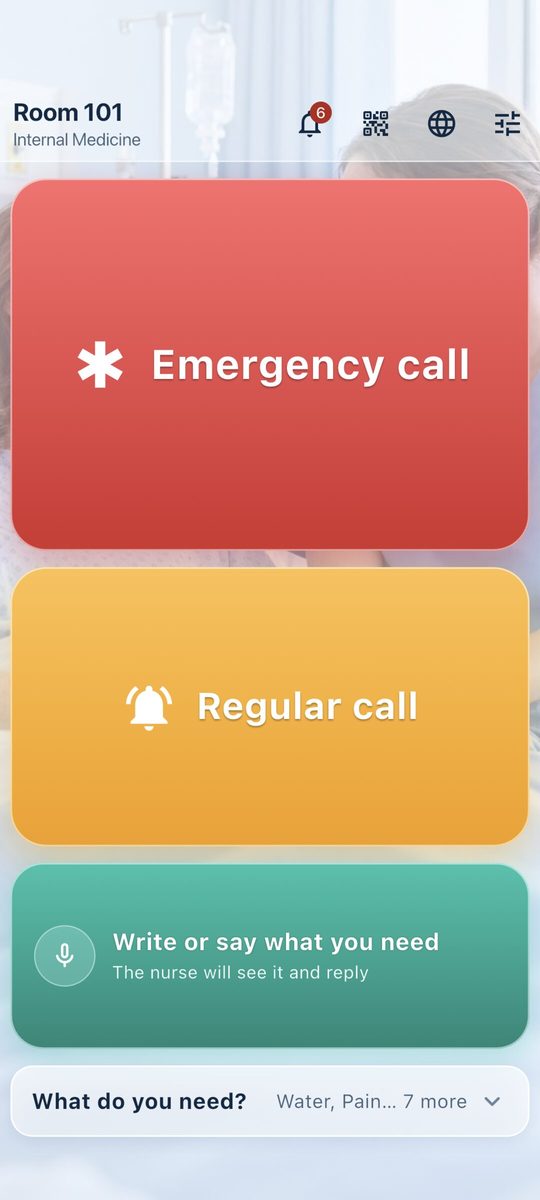
Hospital Alert is a free app for calling hospital staff. Where it is set up, there is a sheet with a QR code at the bed, and anyone at the bedside can call from their own phone, including a family member staying the night. Point the camera at the code and a call screen opens in the browser: nothing to install, and no name, e-mail or phone number needed. You choose an emergency (red) or a regular (yellow) call, can pick a common need from pictures or write a short message, and then see each step: the alert was sent, a nurse accepted it (you see the nurse's pseudonym), the nurse is on the way. If the patient gets worse while you wait, “I feel worse — urgent” sends an urgent alert. If nobody accepts the call, it goes further along a chain that the hospital sets up. More in QR code nurse call.
Frequently asked questions
Can family stay overnight in the hospital?
That is the hospital's decision. US federal rules require a written visitation policy and let the patient choose who visits, but they do not say anyone may stay overnight. Ask the unit whether overnight guests are allowed, how many, and where they can sleep. Policies can differ between hospitals and between units.
Can family stay overnight in the ICU?
Ask the ICU directly. US federal rules let hospitals place clinically necessary or reasonable restrictions on visitation, as long as the reasons are written in their policy and explained to the patient or support person. Intensive care units may use that room for their own rules, so the answer can differ from a regular floor in the same hospital.
Can a hospital stop me from staying with my parent?
A hospital can limit visits for clinical reasons that its written policy sets out, but it cannot restrict visits because of race, color, national origin, religion, sex, gender identity, sexual orientation or disability. If you are told you cannot stay, ask which part of the policy applies and whom you can talk to about it.
Can a visitor call the nurse for the patient?
Yes. Use the call light at the bed, go to the nurse station or phone it. If the hospital uses a QR code nurse call, a family member can scan the code at the bed with their own phone and call staff from the browser.
Sources
- eCFR — 42 CFR 482.13, Condition of participation: Patient's rights, (h) Patient visitation rights
- Cornell LII (e-CFR text) — 42 CFR 482.1, Basis and scope (Part 482: Conditions of participation for hospitals)
- Care Quality Commission — Health and Social Care Act 2008 (Regulated Activities) Regulations 2014, Regulation 9A: Visiting and accompanying in care homes, hospitals and hospices
- Florida Legislature — The 2026 Florida Statutes, section 408.823, In-person visitation
- John's Campaign — John's Campaign in Acute Care
How this article was prepared
Written by the Hospital Alert team with the help of AI tools. Everything we say about the app was checked against the app itself; facts from outside sources are linked above. This article is general information, not medical advice. Found a mistake? Write to team@hospitalalert.online.