Running a ward
Call light in nursing: what it is and how staff answer it
A call light is the patient's way to ask staff for help: pressing the button lights a lamp above the door and alerts the nurse station. Good call light practice means the button is always within the patient's reach, any staff member who sees the light answers it, and rounds check on patients before they need to call.

The call light is the simplest piece of equipment on a ward and one of the most important: for a patient in bed it is often the only way to get help. This guide is for nurses, nursing students and charge nurses. It covers what the call light and its dome light are, why patients press it, how response time is measured, what the HCAHPS survey asks, and what a ward can do so that every patient can call and every call gets answered. If you want to know what happens after a patient presses the button, see what happens when you press the hospital call bell.
What a call light is
"Call light" is the usual American name for the nurse call button and the lights it switches on; in the UK people more often say "call bell" — compare the US studies and the NHS leaflet cited here. In a typical wired system the patient presses a button on a cord or on the bed. A lamp confirms the call, a light comes on above the room door and in the corridor, a tone sounds, and the master station at the nurses' desk shows the room. US federal specifications for nurse call systems list these same parts — cord sets and pillow speakers, dome and corridor lights, and a master station that shows calls by priority (U.S. Department of Defense, UFGS 27 52 24). For the whole system, see what a nurse call system is and how it works.
Patients see it differently. In interviews with 30 hospital patients, the call light came across as more than a device: patients described it as their direct line to care (Montie et al., 2017).
What a nurse call dome light is
The dome light is the light in the corridor outside a patient's room that tells staff which room is calling. The US Department of Defense specification describes it as a light of several segments with a built-in tone, where each segment can light in any of several colours and the colours, patterns and flash rates are programmable. Dome lights must be visible along the whole corridor, and corridor lights, zone lights and duty stations repeat what the dome light shows, so staff further away can still spot the call and find the room (UFGS 27 52 24). The Veterans Affairs specification has room, corridor and intersection dome lights, and a call lights up all of those linked to the device it came from (VA 27 52 23).
What a colour means is not universal. Even these two federal specifications differ:
| Call | Department of Defense (UFGS 27 52 24) | Veterans Affairs (VA 27 52 23) |
|---|---|---|
| Routine patient call | Green | Single flashing |
| Priority patient call | Yellow or white | — |
| Staff assist | Red, at the emergency level | Rapid flashing |
| Emergency | Red | Red flashing |
| Code blue | Blue or purple | Blue flashing |
| Staff locator | — | Green flashing |
The Defense Department table also lets every colour be replaced by one "coordinated with facility". In its list of minimum call types, the VA one sets flash patterns, names colours only for emergency, code blue and staff locator calls, and leaves a blank line for the hospital's own call type. So new staff, agency nurses and students should learn the legend of their own ward rather than assume that green or white means the same everywhere.
Why patients press the call light
A survey of 808 nursing staff on 27 adult units in four US hospitals asked why patients call (Tzeng, 2010). The answers were practical:
- Help with the toilet — the leading reason.
- Pain medication.
- Problems with an intravenous line.
The same staff estimated that each of them answered six to seven calls an hour and reached a call within about four minutes. Their attitudes were split: 77% agreed the calls were meaningful, but 53% felt answering them kept them from the critical parts of their job, and junior staff tended to overlook the importance of answering. The author's conclusion was that answering calls should be treated as a priority, not an interruption. When one patient calls far more often than others, the useful question is why; see frequent call light use.
That matters because of falls. In data from 28 units in four Michigan hospitals, faster call light response and higher call light use were both linked to lower fall and injurious fall rates (Tzeng et al., 2012). The study shows an association, not proof that answering faster prevents falls, but the authors recommend monitoring response time as part of fall prevention.
Call light response time: what is actually measured
In the US federal specifications a call is cleared in the room it came from: the VA one keeps every call on display until staff cancel it at the device where it started, and the Defense Department one requires this for all calls above routine (VA 27 52 23; UFGS 27 52 24). The same Defense Department specification describes a call logging workstation that stores call records and prepares reports. In the Michigan fall study, response time taken from the four hospitals' own call light tracking reports ran from the call to its cancellation in the patient's room: for routine calls, three hospitals averaged a little over three minutes, the fourth more than 17 minutes (Tzeng et al., 2012).
The number has a blind spot: it shows when someone reached the room and pressed cancel, not whether the patient got what they asked for. In an observational study in four US nursing homes, staff cancelled 10% of the call lights (20 of 201) without helping straight away because of workload, and more than 3% of the time forgot to come back. Half the time they took longer to respond than the administration expected (Ali & Li, 2020).
To make the figure useful:
- Look at the long waits, not just the average. Response times are skewed — the Michigan researchers grouped them into ten bands for that reason — and an average does not show how many patients waited a long time.
- Break it down by time of day. In the nursing home study calls peaked before and after meals.
- Check what happened after the cancel. On rounds, ask patients whether they got the help they called for.
Reach is a nursing task
A call light only works if the patient can reach it and knows what it is. Small studies of older inpatients found call bells left out of reach and patients who did not know how to use them (Duffy et al., 2005; Chadwick & Hearn, 2013) — the patient's side of this is covered in our article on the hospital call bell. For staff, the lesson is that reach is a nursing task, not the patient's job — what counts as "within reach", when to check it and what to do when a patient cannot press the button is set out in call light within reach.
The NHS falls guide for patients and families puts it simply: call bells should always be within reach of a patient, and if a patient cannot use one, staff may find another way for them to raise the alarm (University Hospitals Sussex NHS Foundation Trust). A sign at the bed can remind patients to call before they get up: see our Call, Don't Fall sign templates.
Who answers a call light
On a busy ward the light may stay on simply because the patient's own nurse is busy elsewhere. Some hospitals make answering everyone's job. A US hospital system introduced a "No-Pass Zone": a team approach in which staff from different disciplines respond to call lights instead of leaving them to the patient's own nurse. The hospitals reported that patients' needs were met more quickly afterwards, judging by their patient survey scores (Lee et al., 2016).
Knowing the reason for a call helps too. In a scenario-based study, Norwegian nurses said that not knowing why a patient was calling was stressful when they had to choose between that patient and the one in front of them; the authors conclude that knowing the reason helps nurses decide more accurately (Klemets & Toussaint, 2016).
What to say when you answer a call light
There is no official script. What patients say they want is simple, though. In the interviews with 30 hospital patients, some wanted confirmation that staff knew what they needed — "not just, the light went off" — and, if nobody could come yet, to be told: "If you can't get to me, you could let me know" (Montie et al., 2017). Whether you answer over the intercom, on a phone or at the door, a short answer can cover four things:
- Who is answering. Your name and role, so the patient knows the call was heard and by whom.
- What the patient needs. Ask before you walk over if you can. Patients in the same study pointed out that a nurse who does not know the request has to come in, leave to fetch what is needed and come back; and the authors of the Norwegian study above concluded that knowing the reason helps nurses choose more accurately between the patient who is calling and the one in front of them.
- When someone will come. Give a realistic time. If you cannot come yet, say so, and say who will.
- Who will help, if it is not you. If the patient asks for something you cannot do yourself — pain medicine when you are an aide, for example — say you will pass it on to their nurse, and do.
Keep it short over the intercom: some patients in the same interviews did not want to talk about their condition where a roommate could hear, so leave the details for the bedside. Before you leave the room, ask whether there is anything else and put the call light back within reach (see call light within reach).
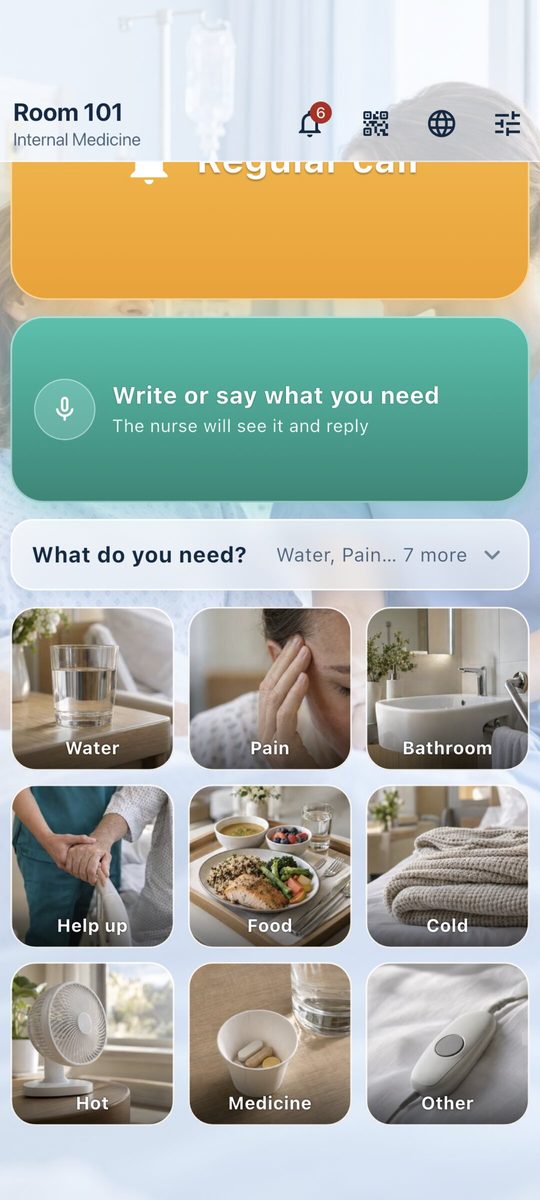
In Hospital Alert part of this happens on screen. If the patient picked a reason with a picture or typed one, the nurse sees it before walking over and can reply in the call's chat. When a nurse accepts the call — with Accept, or I'm coming on the alert screen — the patient sees "A nurse accepted the call" and, a moment later, "Nurse is on the way", with the name the nurse uses in the app; after I'm with the patient the screen says "The nurse is with you". So accept a call when you are actually going to it; if you cannot go after all, Can't go — hand over passes it on to look for another nurse. The screen does not replace a word at the bedside.
Rounding: answering before the light goes on
Hourly or intentional rounding means nurses check every patient every one to two hours using a standard protocol (Sims et al., 2018). A 2014 systematic review found moderate-strength evidence that hourly rounding programmes improve patients' view of nursing responsiveness and reduce both falls and call light use (Mitchell et al., 2014).
A later realist review of 44 papers was more cautious: rounding is widely used, but its purpose is often unclear and there is limited evidence of how it works in practice (Sims et al., 2018). Rounding is most useful as a way of anticipating needs, not as a box to tick — and it does not replace answering the light.
Call lights and HCAHPS
HCAHPS is the US national, standardised and publicly reported survey of patients' experience of hospital care. It goes to a random sample of adult inpatients between 48 hours and 42 days after discharge, and hospitals' scores are published on Care Compare (HCAHPS Fact Sheet).
For years the survey asked about the call light directly: "after you pressed the call button, how often did you get help as soon as you wanted it?" That question was removed from the updated survey used for patients discharged from 1 January 2025. Responsiveness is now measured by two questions (HCAHPS crosswalks):
- "How often did you get help in getting to the bathroom or in using a bedpan as soon as you wanted?"
- "During this hospital stay, when you asked for help right away, how often did you get help as soon as you needed?"
Patients answer never, sometimes, usually or always; the second question also offers "I never asked for help right away" (HCAHPS Survey, 2025). Together the two questions form the Responsiveness of Hospital Staff measure; CMS scheduled public reporting of the new and revised measures to begin with the October 2026 Care Compare refresh. The Hospital Value-Based Purchasing Program links part of a hospital's inpatient payment from CMS to quality measures, and its Person and Community Engagement domain is based on HCAHPS; CMS's crosswalk lists Responsiveness of Hospital Staff among that domain's dimensions from fiscal year 2030.
What this means on the ward:
- HCAHPS measures how patients remember the wait, not minutes on a report. In a study at four US hospitals, faster actual response to call lights went with higher satisfaction on "received help as soon as possible", but the link was not supported for help to the bathroom (Tzeng, Ronis & Yin, 2012).
- Help with the toilet is one of the two questions, and it was the leading reason for calls in the staff survey above. Rounds that offer help with the toilet address both.
- Tell patients their call has been heard and when someone will come: see what to say when you answer a call light.
- The habits above were studied with responsiveness in mind: hourly rounding improved how patients rated nurses' responsiveness in the 2014 review, and the No-Pass Zone hospitals judged their results by patient survey scores.
A quick call light checklist for a ward
| Check | Why |
|---|---|
| Every patient can reach and press the button | Studies of older inpatients found call bells out of reach or not understood |
| Patients who cannot call are known to the whole shift | They need another switch, a closer bed or more frequent checks |
| Any staff member answers a lit call light | The patient's own nurse is not always free |
| Response time is measured, including the longest waits | Researchers recommend monitoring it as part of fall prevention; an average can hide long waits |
| Staff know what each dome light colour and flash pattern means | The codes differ between specifications and hospitals |
| Rounds cover toileting and check the call light | Help with the toilet is the leading reason patients call |
Where a phone-based call fits
Some wards add a second way to call from the patient's own phone. With Hospital Alert, the patient scans the QR code at the bed and a call screen opens in the phone's browser: an emergency button, a regular call button and pictures of common needs such as water, pain, the bathroom or help to get up. The nurse sees the reason on the phone or at the nurse station before walking over, the staff call list shows the time since each call was made, and the patient sees when the call has been accepted. If nobody accepts it, the call goes on to the next people in the chain the hospital has set up. For setup, see the one-ward pilot checklist.
Frequently asked questions
What is a call light in a hospital?
It is the nurse call button at the bed and the lights it switches on: a lamp at the bed or by the door, a light in the corridor and an entry on the nurse station display. Americans usually say call light; in the UK the same thing is often called the call bell.
What is a dome light on a nurse call system?
It is the light in the corridor outside a patient's room that shows staff which room is calling. Its colour and flashing show the type of call, but the code is not universal: in one US federal specification a routine call is green, in another green flashing shows where staff are. Learn the legend used on your own ward.
Who should answer a call light?
Not only the patient's own nurse. One US hospital system set up a No-Pass Zone, where staff from different disciplines respond to call lights, and reported that patients' needs were met more quickly afterwards. Whoever answers should find the right person if they cannot help themselves.
How fast should nurses answer call lights?
We found no single standard time; each hospital sets its own target. In a study of four Michigan hospitals, response time ran from the call to its cancellation in the room: three hospitals averaged a little over three minutes, one more than 17 minutes. Cancelling is not the same as helping, so also check what happened after the light went off.
How do call lights affect HCAHPS scores?
Since January 2025 discharges, HCAHPS no longer asks about the call button. Responsiveness of Hospital Staff is scored on two questions: help to the bathroom or with a bedpan as soon as wanted, and help as soon as needed when asked for right away. In one four-hospital study, faster actual response to call lights went with better ratings of getting help as soon as possible, but not of help to the bathroom; a 2014 review linked hourly rounding to better ratings of nurses' responsiveness.
Why do patients use the call light most often?
In a survey of 808 nursing staff in four US hospitals, help with the toilet was the leading reason, followed by pain medication and problems with an intravenous line. So it is worth asking about the toilet on every round, before patients try to get up on their own.
Sources
- Tzeng — Perspectives of staff nurses of the reasons for and the nature of patient-initiated call lights: an exploratory survey study in four USA hospitals, BMC Health Services Research, 2010
- Tzeng et al. — The contribution of staff call light response time to fall and injurious fall rates: an exploratory study in four US hospitals using archived hospital data, BMC Health Services Research, 2012
- Montie et al. — Conduits to care: call lights and patients' perceptions of communication, Journal of Multidisciplinary Healthcare, 2017
- Duffy et al. — Ability of hospitalized older adults to use their call bell: a pilot study in a tertiary care teaching hospital, Aging Clinical and Experimental Research, 2005
- Chadwick & Hearn — A cry for help: time to re-think the patient call bell in an ageing population, British Journal of Hospital Medicine, 2013
- University Hospitals Sussex NHS Foundation Trust — Falls prevention in hospital: a guide for patients, their families and carers
- Lee et al. — No-Pass Zone: multidisciplinary approach to responding to patient needs, Journal of Nursing Care Quality, 2016
- Mitchell et al. — Hourly rounding to improve nursing responsiveness: a systematic review, Journal of Nursing Administration, 2014
- Sims et al. — Realist synthesis of intentional rounding in hospital wards: exploring the evidence of what works, for whom, in what circumstances and why, BMJ Quality & Safety, 2018
- Klemets & Toussaint — Does revealing contextual knowledge of the patient's intention help nurses' handling of nurse calls?, International Journal of Medical Informatics, 2016
- U.S. Department of Defense (USACE / NAVFAC / AFCEC) — UFGS 27 52 24, Nurse Call System, November 2020
- U.S. Department of Veterans Affairs — Section 27 52 23, Nurse Call and Code Blue Systems (master specification)
- Ali & Li — Use of Notification and Communication Technology (Call Light Systems) in Nursing Homes: Observational Study, Journal of Medical Internet Research, 2020
- Tzeng, Ronis & Yin — Relationship of actual response time to call lights and patient satisfaction at 4 US hospitals, Journal of Nursing Care Quality, 2012
- CMS / HCAHPS Project Team — HCAHPS Fact Sheet, beginning with January 1, 2025 discharges
- HCAHPS — Crosswalk of Current HCAHPS Survey questions (29) to Updated HCAHPS Survey questions (32)
- HCAHPS — Crosswalk of Updated HCAHPS Survey Questions into Publicly Reported Sub-Measures on Care Compare, beginning with the October 2026 refresh
- HCAHPS — Crosswalk of Updated HCAHPS Survey Questions to Person and Community Engagement Domain Dimensions, Hospital Value-Based Purchasing Program, FY 2030
- HCAHPS Survey (mail version, English), effective with January 1, 2025 discharges
How this article was prepared
Written by the Hospital Alert team with the help of AI tools. Everything we say about the app was checked against the app itself; facts from outside sources are linked above. This article is general information, not medical advice. Found a mistake? Write to team@hospitalalert.online.