Running a ward
Call Don't Fall sign: free templates and where to hang them
A Call, Don't Fall sign is a bedside reminder asking patients to press the call button and wait for help instead of getting up alone, for example to go to the bathroom. Write one short request in large letters, hang it where the patient sees it from the bed, and back it up by showing every patient how to call.

A Call, Don't Fall sign tells patients one thing: if you need help to get up, press the call button and wait. Below are three sign templates you can copy and print for a hospital or nursing home room, plus tips on wording, placement and printing, and why the sign only works as part of a wider falls plan. Keeping the call button itself within the patient's reach is covered in call light within reach.
Three Call, Don't Fall sign templates
Copy them freely and adapt them: write "call button", "call bell" or "call light", whichever your patients will recognise.
Template 1 — every room
PLEASE CALL, DON'T FALL
Press your call button before you get out of bed or out of your chair.
Wait for us. You are never a bother.
If no one comes, press it again or call out.
Template 2 — bathroom
NEED TO USE THE BATHROOM? CALL FIRST.
Press your call button as soon as you need to go. Don't wait until the last minute.
We will help you get there safely.
Template 3 — room with a QR code sheet
CALL, DON'T FALL
Press the call button, or scan the QR code below with your phone camera and tap Emergency call or Regular call.
Then stay where you are. If no one comes, call again or call out.
Template 2 borrows a line from the University of New Mexico Hospital's handout "Please Call, Don't Fall!", which names three moments to call: getting out of bed, going to the bathroom ("Don't wait until the last minute!") and dropping something on the floor. Template 3 is for wards where patients can also call from their own phone; the QR code is on a separate room sheet under the sign.
How to word the sign so patients use it
- One request, few words. The versions hospitals use are all short: "Please call, don't fall" (UNM Hospital), "Press and call. Don't fall." (University Hospital Southampton), "Press the call button – don't fall!" (the Northern Ireland Public Health Agency's falls leaflet for hospital patients). Put the request first and in the largest type.
- Say when to call. A slogan alone leaves patients to decide whether their need is worth a call. Southampton's factsheet spells it out: call if you need help to move, to go to the toilet or to get in or out of bed, if you feel unwell, or if something you need is out of reach.
- Answer the worry about bothering staff. In interviews with nine patients who had just fallen in hospital, most named not wanting to be a bother as a reason not to call: "I am supposed to call for help…but I don't want to bother them" (Carroll et al., 2010). St. Luke's Meridian Medical Center in Idaho made its sign partly for the same reason and set out to tell patients that staff want to be bothered (HFM Magazine, 2023). That is what "You are never a bother" is for.
- Plain words, in your patients' languages. Baylor Scott & White Medical Center – Garland in Texas revised its patient education materials and printed them in English, Spanish and Vietnamese, at a third-grade reading level (HRET, 2016); the St. Luke's signs carry the message in English and Spanish.
- Show the button. St. Luke's added a red call light emblem so the tile stands out; a picture of the actual button in the room also helps patients who won't read the text.
Where to hang a Call, Don't Fall sign
Hang it where the patient's eyes are at the moment they decide to get up:
- Facing the bed, at the eye level of a patient sitting up, so it is in view when they swing their legs out.
- Above the bed, for patients who lie flat. St. Luke's borrowed the idea of a "Call Don't Fall" ceiling tile above the bed from another hospital and put one in every room of its pilot unit.
- Next to the call button or the QR sheet, so the request and the way to act on it are in one place.
- In the bathroom, near the call button or cord (see nurse call pull cord).
- In shared areas. Bassett Medical Center in Cooperstown, New York, put its "Call, Don't Fall" signs in patient rooms and common areas.
Then test it from the bed and the chair. Before fixing anything to walls or ceilings, check your hospital's rules on signs.
How to print it
- One template per page, US Letter or A4, landscape. Make the first line as large as the page allows: it must be readable from the bed, not just from the door.
- Dark text on a light background. Use colour only for the button or the word CALL; if the call button in your rooms is red, print it red.
- Print one test copy and read it from the bed before you print for the whole ward.
- Laminate it or put it in a wipeable sleeve, and replace copies that are torn, faded or covered by other notices.
- If the room also has a QR sheet, hang it under the sign rather than over it.
Why a sign alone is not enough
Every report we found used Call, Don't Fall signs alongside other changes, so none of them shows what the sign does by itself:
- Bassett Medical Center (New York): signs in rooms and common areas, chair seat alarms, two daily huddles and help with the toilet every two hours for patients at high risk of falling. Combined, these led to a 43% reduction in falls on the medical unit (HRET, 2016).
- St. Luke's Meridian (Idaho): the ceiling tile plus volunteer safety rounds. Patients' familiarity with the tile averaged 98%, and the unit's falls went from an average of 16 to nine between October and November 2022, but the team wrote that it was too early to say whether the changes had an impact.
- University Hospitals of Morecambe Bay (England): "call don't fall" posters were one of several measures, with anti-slip socks, low beds and sensor mats, while falls causing harm went down (Nursing Times, 2017).
The stronger evidence is for something more specific than a slogan. The AHRQ-funded Fall TIPS toolkit uses a bedside poster or screen showing the patient's own fall risk factors and prevention plan; in 14 medical units at three academic medical centers it was associated with 15% fewer falls and 34% fewer injurious falls.
What makes patients actually call comes from the ward:
- Show the button and ask the patient to press it once. AHRQ lists "Have the patient demonstrate call light use" among universal fall precautions for every hospital patient.
- Keep it within reach after washing, transfers and bed changes.
- Answer it. One of the patients in the Carroll study rang for help several times, nobody came, and he set off for the bathroom on his own.
- Ask patients why they don't call. At Baylor Scott & White – Garland, 77% of men in their 50s, 60s and 70s who fell had not used the call light. Talking to them showed a bigger reason than independence: discomfort at being helped by young nurses who reminded them of their daughters and granddaughters. They were offered a male member of staff when one was available.
As the Northern Ireland leaflet tells patients, hospitals cannot prevent all falls. The sign is a reminder, not a safeguard.
Adding a QR code: the Hospital Alert room sheet
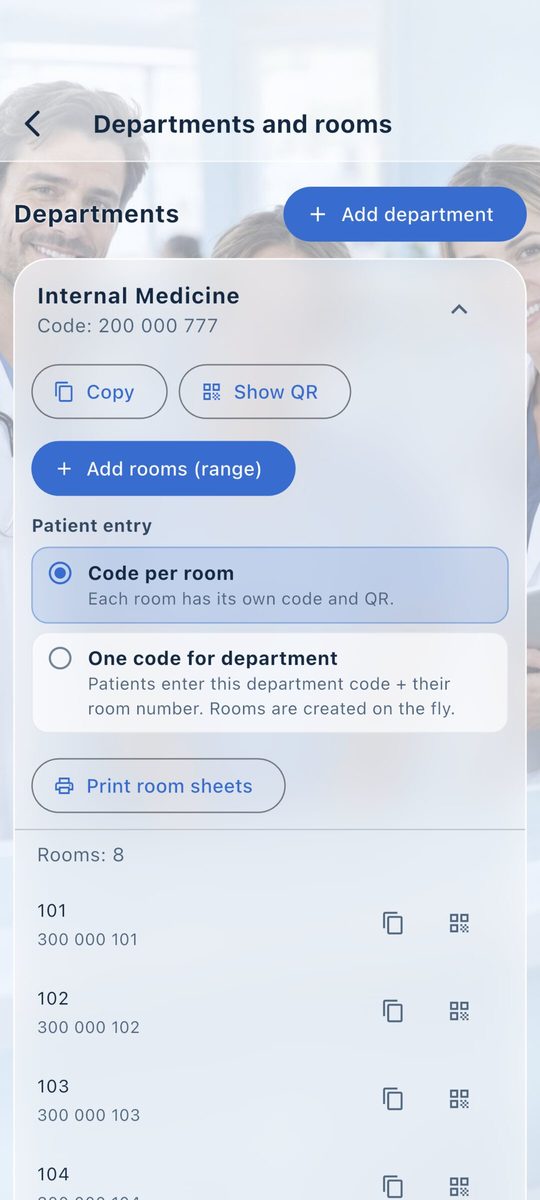
Hospital Alert, a free nurse call app for hospitals, lets patients call from their own phone alongside the bedside button. The administrator creates the department and its rooms and chooses Print room sheets; the app makes a printable A4 page for each room, which the hospital prints on its own paper and printer. Your Call, Don't Fall sign — Template 3 — hangs above it.
- What the sheet contains: the Hospital Alert name, the hospital and department, the room number, a large QR code, the nine-digit room code and one line telling the patient to point the phone camera at the code, no installation needed. At the bottom are the hospitalalert.online address and a line on where to report a problem or request a feature. There is no place for your own text, so the sign is a separate page.
- One sheet per department is the other option: a department code and QR code, after which the patient enters the room number.
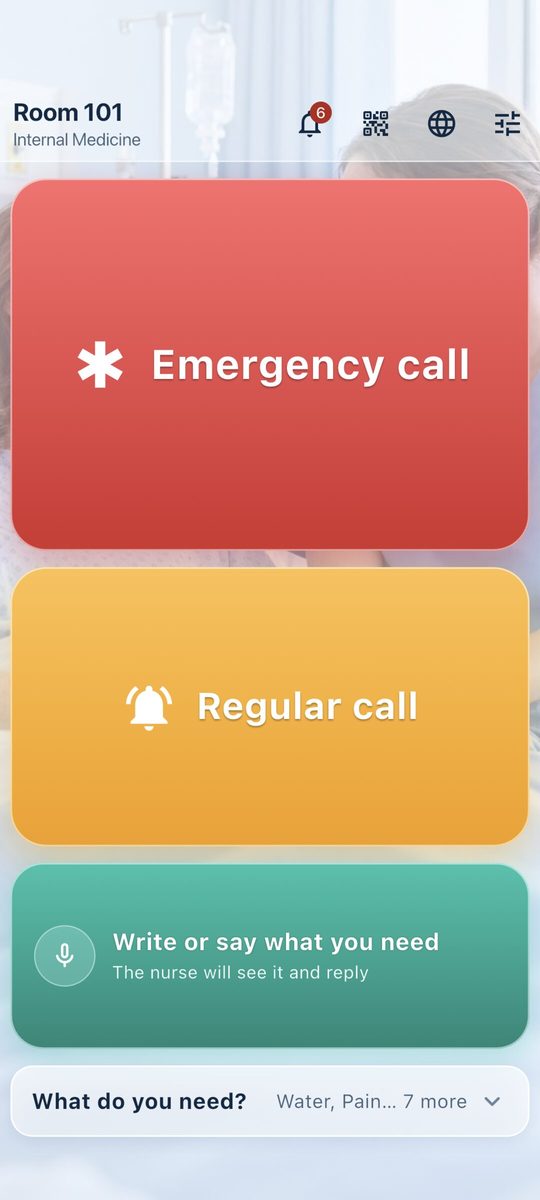
- What the patient gets: the room's call screen opens in the phone's browser, with a red Emergency call button, a yellow Regular call button and a list of common needs. The patient then sees that the call was sent and which nurse accepted it.
How the calls reach staff is explained in QR code nurse call; to try it on one ward, see the free pilot checklist.
Frequently asked questions
What does "Call, Don't Fall" mean?
It is a short reminder used in hospitals and nursing homes: if you need help to stand, walk or get to the bathroom, press the call button and wait for staff rather than getting up alone. Common versions are "Please call, don't fall" and "Press and call. Don't fall."
Where should a Call Don't Fall sign be placed?
Where the patient sees it from the bed or chair: on the wall facing the bed, next to the call button, or on the ceiling above the bed for patients who lie flat. A second copy in the bathroom helps. Lie in the bed yourself to check that the sign can be read from there.
Do Call Don't Fall signs reduce falls?
There is no good evidence for the sign on its own. Hospitals that reported fewer falls used it together with other measures, such as toileting rounds, chair alarms or volunteer safety rounds. A bedside poster with the patient's own fall risks and plan (the AHRQ-funded Fall TIPS toolkit) was linked to 15% fewer falls, but that is a tailored plan, not a slogan.
Can I copy these sign templates?
Yes. The texts on this page are free to copy, print and adapt for your ward or nursing home. Change the words to match the call device in your rooms — button, bell, light or pull cord — and get them approved by your fall prevention lead or charge nurse before you put them up.
Can a Call Don't Fall sign include a QR code?
Only if your hospital uses a system that lets patients call from their own phone. In Hospital Alert, a free nurse call app, the administrator prints a sheet with the room's QR code. The app does not add your own text to that sheet, so the Call, Don't Fall sign hangs above it as a separate page.
Sources
- Health Research & Educational Trust — Preventing Patient Falls: A Systematic Approach from the Joint Commission Center for Transforming Healthcare Project, October 2016
- HFM Magazine (AHA) — Thinking outside the typical fall prevention bundle box (St. Luke's Meridian Medical Center), 17 January 2023
- UNM Hospital — Please Call, Don't Fall! Staying Safe at UNMH (patient handout P2016-1040, 2019)
- University Hospital Southampton NHS Foundation Trust — Please use your call bell (patient factsheet 1835, version 2, reviewed July 2023)
- Public Health Agency (Northern Ireland), Regional Inpatient Falls Prevention Group — Falls prevention in hospital: information for patients and visitors, December 2023
- Carroll, Dykes & Hurley — Patients' perspectives of falling while in an acute care hospital and suggestions for prevention, Applied Nursing Research, 2010
- AHRQ — Fall TIPS: A Patient-Centered Fall Prevention Toolkit (content last reviewed February 2021)
- AHRQ — Preventing Falls in Hospitals toolkit, 3. Which fall prevention practices do you want to use? (3.2 Universal fall precautions; Internet Archive copy, February 2025)
- Nursing Times — Nurse-led measures helping trust to reduce patient falls (University Hospitals of Morecambe Bay), 9 November 2017
How this article was prepared
Written by the Hospital Alert team with the help of AI tools. Everything we say about the app was checked against the app itself; facts from outside sources are linked above. This article is general information, not medical advice. Found a mistake? Write to team@hospitalalert.online.