Running a ward
Call light within reach: why it matters and what to do
"Call light within reach" means the call button or bell is placed where the patient can press it from the bed or chair without stretching, sitting up or getting out of bed, and staff check this every time they leave the room. AHRQ lists it among universal fall precautions for every hospital patient, and US nursing home inspectors check it at the bedside.

"Call light within reach" is one of the most repeated lines in nursing: the call button or bell has to be where the patient can press it without stretching, sitting up or getting out of bed. It sounds trivial, but a call light that has slipped behind the headboard is no call light at all, and a patient who cannot call may try to get up alone. This guide explains what the phrase means, why hospitals and nursing homes treat it as a safety rule, how often it goes wrong and what a patient or family member can do when the button is out of reach. How staff answer the light once it is pressed is covered in call light in nursing.
What "within reach" means
Within reach means the patient can press the button from wherever they are at that moment: lying in bed, sitting in the chair, on the toilet. It is not enough that the call light is in the room. The cord is clipped to the bedding or the rail on the side the patient can use, the handset is not under the pillow or on the floor, and the patient knows what it is and how it works.
AHRQ's toolkit for preventing falls in hospitals puts it into its list of universal fall precautions — "universal" because they apply to every patient, whatever their fall risk. Two of the items are about the call light: "Have the patient demonstrate call light use" and "Maintain call light within reach." The same list asks staff to keep the patient's personal possessions within safe reach.
Why it matters: falls
Falls are a common harm in hospital. AHRQ estimates that 700,000 to 1 million hospitalized patients fall each year in the US, and more than a third of in-hospital falls cause an injury (AHRQ PSNet). The Joint Commission's alert on falls says 30–50% of hospital falls result in injury, and its sentinel event database held 465 reports of falls with injury between 2009 and 2015, about 63% of which resulted in death.
The link to the call light is simple: a patient who needs help to walk to the toilet and cannot call for it may go alone. One NHS trust's falls guide for patients (University Hospitals Sussex) puts it directly: if you cannot move safely without help, it is essential that you can use your call bell to ask for assistance. When a fall does happen, the Joint Commission suggests that the post-fall huddle consider whether the call light was on and for how long.
Research points the same way, with limits. In data from 28 units in four Michigan hospitals, faster call light response and higher call light use were associated with lower fall and injurious fall rates (Tzeng et al., 2012). That is an association, not proof — and a fast response only helps if the patient can reach the light in the first place.
What the rules and guidance say
- Hospitals (AHRQ). Universal fall precautions include call light demonstration and keeping it within reach. Every change — a transfer to another bed or unit, a trip off the unit for a test — is a moment to check them again. In hourly rounding, the "Placement" step means making sure the call light, phone, reading material and toileting equipment are within easy reach.
- US nursing homes (CMS). Federal rules require a call system at each resident's bedside and in toilet and bathing facilities. CMS guidance tells inspectors to "determine if the resident has the call system within reach and is able to use it if desired", that it must be accessible from the bed, and that at the toilet and bath it should be accessible to a resident lying on the floor. If a disability makes the system unusable, inspectors ask what alternatives the facility provides.
- Taking the light away. CMS guidance describes a resident whose call light was pinned to a privacy curtain out of his reach at night, because staff said he used it too much. It is given as an example of depriving a resident of care, not as a way to manage frequent calls. What helps instead is in frequent call light use.
- An NHS trust (England). The same trust's falls guide for patients and families says call bells should always be within reach of a patient, and that before visitors leave they should make sure the call bell, walking aid and glasses are within reach.
How often bells end up out of reach
More often than you would expect. In a pilot study at a Canadian teaching hospital, 11 of 37 patients aged 70 or older could not use their call bell: seven because it was out of reach, four because they did not know how to use it (Duffy et al., 2005). In a district general hospital, a review of 283 bed spaces found call bells on average 82 cm from the bed, and more than a third of patients (38.1%) could not independently understand what the bell was for and how to use it (Chadwick & Hearn, 2013).
The usual moments it goes missing are ordinary: a wash, a change of sheets, a transfer to the chair, a return from X-ray, a visitor moving the bedside table.
A checklist for staff
- Show it and ask the patient to press it once on admission, as AHRQ suggests.
- Clip it on the side the patient can use, not to the far rail or the wall.
- Check it every time you leave the room, and especially after care, a bed change or a transfer. Our guide to answering call lights covers what to say at the bedside, ending with the button back in the patient's hand.
- Think about where the patient will be. In the chair or bathroom the bed cord may be out of reach.
- Flag patients who cannot use a standard button — weak hands, confusion, poor sight — and look at other switches or closer checks. Button types are compared in nurse call button types.
- Ask families to put it back in the patient's hand before they go.
- Put a reminder in view. A Call, Don't Fall sign at the bed asks the patient to press the button before getting up.
If you cannot reach the call button
This part is for patients and the people visiting them.
- Do not get up alone if you need help to move. A fall is a worse outcome than a wait.
- Call out to staff passing by, or ask the patient in the next bed to press their button or tell a nurse.
- Use a phone. If the ward gave you a phone number for the nurse station, call it.
- Once someone comes, fix the cause: ask them to clip the bell where you can reach it, and say if it is too hard to press. The Sussex NHS guide notes that if you cannot use a call bell, staff may find another way for you to alert them.
- Relatives: before leaving, check the bell, glasses and walking aid are within reach. If the button keeps going missing, mention it to the nurse in charge.
If the button is in reach but nobody comes, see what to do when the call button is not working.
A second call button on the patient's own phone
For patients who keep their phone at hand, there is another option. In Hospital Alert, a free nurse call app, a QR code at the bed opens a call screen on the patient's own phone, in the browser, with no app to install and no name, e-mail or phone number. The patient chooses an emergency or a regular call, can pick a need from pictures — water, pain, bathroom — or write what they need, and then sees that the call was sent, that a nurse accepted it and who.
Staff get the call in the app and at the nurse station. If nobody accepts it within the set time, it moves up the chain automatically — by default to the head nurse, then the on-call doctor. An emergency call by default goes at once to the ward nurses, the on-call doctor and the head nurse. Each hospital sets its own chain.
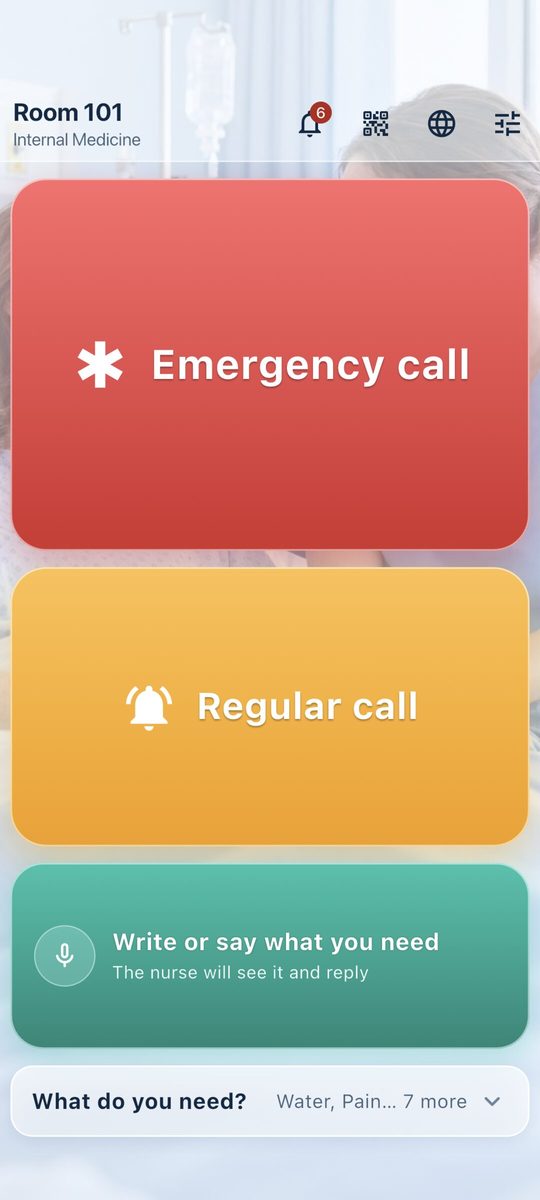
It is an extra way to call, not a reason to stop checking the bedside button. How it works in detail is in QR code nurse call; to try it in one department, see the free pilot checklist.
Frequently asked questions
What does call light within reach mean in nursing?
It means the patient can press the call button from where they are — in bed, in the chair, in the bathroom — without stretching, sitting up or getting up. Nurses place it before leaving the room and check it again after washing, transfers and bed changes. AHRQ also asks staff to have the patient show that they can use it.
Is keeping the call light within reach a fall precaution?
Yes. AHRQ's hospital fall prevention toolkit lists "maintain call light within reach" among universal fall precautions, which apply to every patient regardless of fall risk, and says they should be checked again every time a patient changes bed, unit or returns from a test.
Is it a requirement in nursing homes?
In the US, federal rules require a call system at each resident's bedside and in toilets and bathing areas. CMS guidance tells inspectors to check that the resident has the call system within reach and can use it, and that it is accessible from the bed and, at the toilet and bath, even to a resident lying on the floor.
What should I do if I cannot reach the call bell?
Do not get up alone if you need help to move. Call out to staff or a neighbouring patient, use any phone number the ward has given you, and once someone comes, ask them to clip the bell where you can reach it. If you cannot press it at all, tell staff, so they can find another way for you to call.
Can staff take the call light away from a patient who uses it a lot?
They should not. CMS guidance for nursing home inspectors describes a resident whose call light was pinned out of reach at night because staff said he used it too much, and treats it as depriving him of care. Frequent calls are a reason to look at why the patient calls, not to remove the light.
Sources
- AHRQ — Preventing Falls in Hospitals toolkit, 3. Which fall prevention practices do you want to use? (3.2 Universal fall precautions; Internet Archive copy, February 2025)
- AHRQ PSNet — Falls (primer, last reviewed 2024)
- The Joint Commission — Sentinel Event Alert 55: Preventing falls and fall-related injuries in health care facilities, 28 September 2015
- CMS — State Operations Manual, Appendix PP: Guidance to Surveyors for Long Term Care Facilities (F558, F600, F919), Rev. 232, 2025
- 42 CFR § 483.90 — Physical environment (long-term care facilities), paragraph (g) Resident call system
- Duffy et al. — Ability of hospitalized older adults to use their call bell: a pilot study in a tertiary care teaching hospital, Aging Clinical and Experimental Research, 2005
- Chadwick & Hearn — A cry for help: time to re-think the patient call bell in an ageing population, British Journal of Hospital Medicine, 2013
- Tzeng et al. — The contribution of staff call light response time to fall and injurious fall rates: an exploratory study in four US hospitals using archived hospital data, BMC Health Services Research, 2012
- University Hospitals Sussex NHS Foundation Trust — Falls prevention in hospital: a guide for patients, their families and carers, December 2023
How this article was prepared
Written by the Hospital Alert team with the help of AI tools. Everything we say about the app was checked against the app itself; facts from outside sources are linked above. This article is general information, not medical advice. Found a mistake? Write to team@hospitalalert.online.