Running a ward
Nurse call pull cord: why toilets have one and what to check
A nurse call pull cord hangs in toilets and showers so that a person who falls or feels unwell there can call for help, even from the floor. Pulling it places an emergency call that staff reset in the room. In England, guidance says the cord should be red, hang close to the wall and reach almost to the floor.

The red cord next to the toilet is easy to overlook until someone needs it. It is there for a person who has slipped, fainted or cannot get up, and who may be lying on the floor, out of reach of any button. This guide explains what the pull cord does, what the rules say about it, and what a ward or care home should check so that it works when it is pulled.
What the pull cord is for
A bedside call button covers the patient in bed. The bathroom is different: the patient is alone there and may have no phone at hand. And the toilet is a big part of why patients call at all. In a survey of 808 nursing staff in four US hospitals, help with the toilet was the leading reason patients called (Tzeng, 2010). The World Health Organization names falls as the most frequent adverse events in hospitals.
That is why bathrooms get their own call device. US federal specifications describe the pull cord as an emergency call device activated by pulling the cord, with a pendant at the end within the patient's reach, a lamp that confirms the call, a cancel button, and a water-resistant housing where it is fitted in a wet area (U.S. Department of Defense, UFGS 27 52 24). The Veterans Affairs specification lists toilet emergency stations (pull cord or push-button) and shower emergency stations (pull cord) among the devices that can start a call.
What happens when someone pulls it
- The station confirms the call with a lamp, so the person knows it has gone through.
- The call shows outside — on the light above the door, in the corridor and at the master station at the nurses' desk, together with a tone.
- It is marked as an emergency. In the Defense specification, emergency calls rank above all patient calls and below only code calls; they get their own colour, tone and flash pattern. See emergency and routine nurse calls.
- Staff come and reset it in the room. Under the VA specification every call is cleared only at the device where it was made; the Defense specification applies the same rule to all calls above routine level. The light stays on until someone is physically there.
What the rules say about pull cords
England: Approved Document M
England's official guidance on access to buildings other than homes, Approved Document M Volume 2, sets out how emergency assistance pull cords in accessible toilets should look and work:
- The cord is red, hangs as close to the wall as possible and has two red 50 mm bangles: one 100 mm above the floor and one between 800 and 1000 mm.
- It is reachable from the WC and from the floor close to the WC.
- Any lighting pull cord has a bangle that contrasts with its background and is visually distinguishable from the emergency cord.
- The alarm has visual and audible indicators that confirm the call has been received, a reset control reachable from the wheelchair and the WC (or the shower seat), and a signal that cannot be confused with the fire alarm.
- The call signal outside the toilet is placed so that it is easily seen and heard by people able to help.
United States: federal specifications
The Defense and VA specifications cover their own facilities. Besides the device itself (above), the VA specification says that in its simple tone-and-light systems a call from a toilet or bath inside a bedroom shows on the display as the bed closest to the nurse station. In mental health units both specifications move away from cords: the Defense one prohibits pull cords in behavioural health patient stations and asks for tamper-proof push-buttons, and the VA one asks for push-button emergency stations in each toilet stall and shower, with shower stations placed inside the stall at the shower-head end and sealed against water.
Other countries have their own codes. If you are fitting or changing pull cords, ask the authority that inspects your building which rules apply.
Common faults to check on every round
| Fault | Why it matters | What to do |
|---|---|---|
| Cord tied up, cut short or looped over a grab rail | Someone on the floor cannot reach it | Let it hang free to the lower bangle; report cut cords |
| Emergency cord and light cord look alike | The person pulls the wrong one, or nobody recognises the right one | Red cord with red bangles for emergencies; a different-looking light cord |
| No lamp or no sound when pulled | The person does not know if help is coming; staff may not notice | Test it; log a fault |
| Signal outside cannot be seen or heard from where staff work | The call is made but nobody responds | Check where the call shows: door light, corridor, station, staff devices |
| Reset button out of reach or used from outside | The call is cleared before anyone has seen the patient | Reset only in the room, after staff have checked on the person |
A simple routine: pull every cord during a scheduled test, with someone at the nurse station noting that the call arrived as an emergency and showed the right room. The Defense specification asks installers to demonstrate each call type and priority from every station that can place one; a ward can repeat a short version of that test regularly. Patients and visitors should be shown the cord too — it is no use if nobody knows what the red cord is for.
Calling before getting up
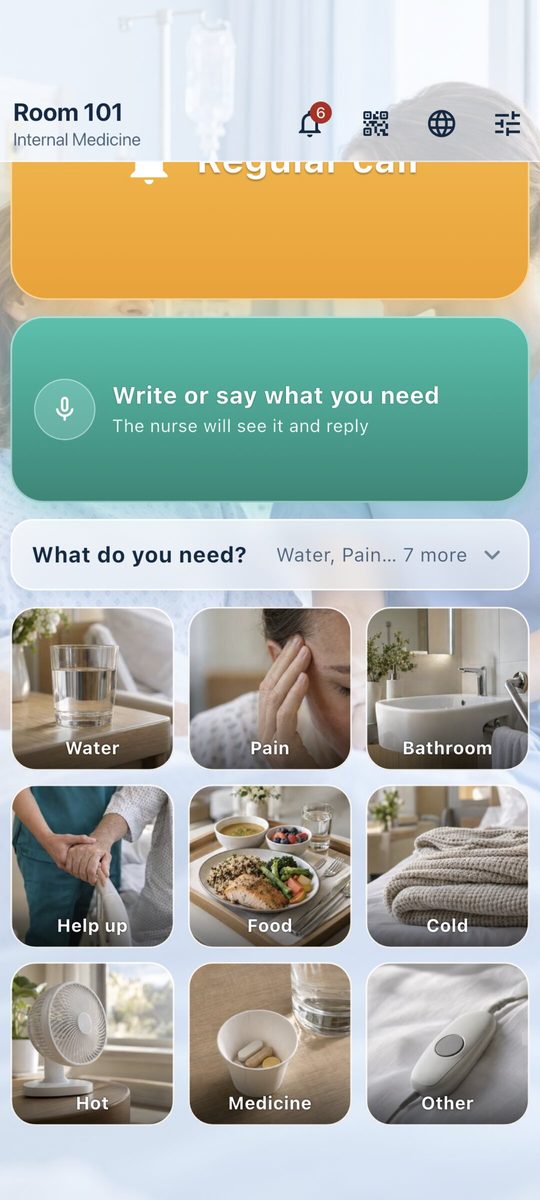
The NHS falls guide for patients and families advises them to use the call bell if they need help to move, in particular to get to the toilet (University Hospitals Sussex NHS Foundation Trust). A phone-based call can make that request specific. In Hospital Alert, the patient scans the QR code at the bed and taps a picture — for example "Bathroom" or "Help up" — so the nurse knows what is needed before walking over. For more on the bedside side of calling, see nurse call button types and what a nurse call system is.
Frequently asked questions
What happens when you pull the emergency cord in a hospital bathroom?
In a typical system a lamp on the pull station confirms the call, a light and tone come on outside the room and at the nurse station, and the call shows as an emergency. It stays on until a member of staff comes and resets it at the station in the bathroom.
Why are emergency pull cords red?
England's Approved Document M does not say why, but it asks for an emergency pull cord that is easy to identify: red, with two red bangles. Any lighting pull cord in the room should look different, so that nobody pulls the wrong one or misses the right one.
How long should a pull cord be?
Long enough to reach from the floor. Approved Document M puts the lower of two bangles 100 mm above the floor and the other between 800 and 1000 mm, and says the cord must be reachable from the WC and from the floor close to it.
Is it a problem if the pull cord is tied up?
Yes. A cord tied up out of the way, wrapped around a grab rail or cut short cannot be reached by someone on the floor, which is the situation it exists for. Untie it, report it and add the cords to the routine room check.
Do bathrooms still need a pull cord if patients have phones?
Yes. A patient who falls in the shower may not have a phone at hand, and phones are often left by the bed. A phone-based call can help patients ask for help before they get up, but it does not take the place of an emergency cord or button in the bathroom.
Sources
- GOV.UK — Approved Document M: Access to and use of buildings, Volume 2: Buildings other than dwellings (2015 edition incorporating 2020 and 2024 amendments)
- U.S. Department of Defense (USACE / NAVFAC / AFCEC) — UFGS 27 52 24, Nurse Call System, November 2020
- U.S. Department of Veterans Affairs — Specification 27 52 23, Nurse Call and Code Blue Systems, December 2020
- Tzeng — Perspectives of staff nurses of the reasons for and the nature of patient-initiated call lights: an exploratory survey study in four USA hospitals, BMC Health Services Research, 2010
- University Hospitals Sussex NHS Foundation Trust — Falls prevention in hospital: a guide for patients, their families and carers
- World Health Organization — Patient safety fact sheet, 2023
How this article was prepared
Written by the Hospital Alert team with the help of AI tools. Everything we say about the app was checked against the app itself; facts from outside sources are linked above. This article is general information, not medical advice. Found a mistake? Write to team@hospitalalert.online.