Running a ward
Alarm fatigue in nursing: what it is and what helps
Alarm fatigue is what happens when nurses and other clinicians hear so many alarms, most of which need no action, that they become desensitized: they respond more slowly, miss a real alarm, or turn alarms down or off. It is mainly about monitors, infusion pumps and ventilators, and hospitals tackle it as an organization-wide alarm management program.
Alarm fatigue is what happens when nurses hear so many alarms that they stop reacting to them the way they should. Most of the beeps turn out to need nothing, so the ear learns to discount them, and sooner or later a real one is answered late, missed or silenced. The term comes from clinical equipment: bedside monitors, pulse oximeters, infusion pumps, ventilators. Hospitals deal with it through alarm management, an organization-wide job rather than something one nurse can fix by trying harder. This guide explains the term, why nurses carry most of the load, what the Joint Commission required before and after its 2026 change, and where nurse calls, the part we work on, fit in. Short definitions of related terms are in our nurse call glossary.
What is alarm fatigue?
The Joint Commission put it plainly in its 2013 Sentinel Event Alert on medical device alarm safety. The number of alarm signals per patient per day can reach several hundred, and an estimated 85 to 99 percent of them need no clinical intervention. As a result, clinicians "become desensitized or immune to the sounds, and are overwhelmed by information – in short, they suffer from 'alarm fatigue.'" They may then turn the volume down, turn the alarm off, or change settings to limits that are no longer safe for the patient.
ECRI Institute, which put alarm hazards at number one on its Top 10 Health Technology Hazards list for 2014, breaks the effect into three parts. Caregivers can become overwhelmed, unable to respond to every alarm or to tell apart alarms sounding at the same time. They can become distracted, pulled away from other patient care. And they can become desensitized, missing an important alarm because so many earlier ones proved insignificant.
The stakes are real. The Joint Commission's sentinel event database held 98 alarm-related events reported between January 2009 and June 2012: 80 ended in death, 13 in permanent loss of function. Reporting is voluntary, so these figures show that the problem exists, not how often it happens. Beyond the factors recorded in that database, the alert names alarm fatigue as the most common contributing factor in alarm-related sentinel events.
Why nurses feel it most
Nurses are the people closest to the bedside and usually the first to hear an alarm, so most of the noise lands on them. A 2026 systematic review pooled 28 studies with 6,908 intensive care nurses. Overall, alarm fatigue came out moderate, with very large differences between studies. Higher alarm fatigue tended to go together with a greater tendency towards medical errors and with more burnout. False alarms and low trust in alarms went with more alarm fatigue; job satisfaction, resilience, alarm management support and a better work environment looked protective (Zhu et al., 2026).
When nurses describe it in their own words, the causes are not only the devices. In interviews with 15 nurses and 5 nurse managers at a large hospital in China, nurses named alarm sounds they could not tell apart, inaccurate alarm levels and devices that were awkward to operate, but also noisy, crowded wards and whether the team atmosphere was supportive and open (Liu et al., 2026). The authors conclude that alarm fatigue depends on the whole clinical system and needs a system-level approach; the review likewise suggests looking at it through the work system as a whole.
What the Joint Commission required, and what changed in 2026
From 2014, alarm safety was a National Patient Safety Goal for hospitals: NPSG.06.01.01, "Improve the safety of clinical alarm systems". It came in two phases. From July 1, 2014, leaders had to establish alarm system safety as a hospital priority. From January 1, 2016, hospitals had to set policies and procedures for the alarms they had identified as most important (R3 Report, Issue 5). In the version effective January 2025, the goal asked hospitals to:
- make alarm system safety a hospital priority set by leaders;
- identify the most important alarm signals to manage, using input from medical staff and clinical departments, the risk to patients, whether a signal is needed or only adds to alarm noise and alarm fatigue, internal incident history and published best practices;
- write policies and procedures for those alarms, covering when alarm signals may be disabled, who may set or change alarm parameters or set them to "off", how alarm signals are monitored and responded to, and how they are checked.
Those are now former requirements. Effective January 1, 2026, the Joint Commission introduced National Performance Goals for the hospital and critical access hospital programs, and states that the new chapter "replaces the former National Patient Safety Goals". Its 2026 list of 14 hospital goals does not name clinical alarms as a goal of their own; the list shows goal titles, not the requirements under them. If you are preparing for a survey, check where your alarm requirements sit in your current manual rather than relying on the old NPSG number. Other accreditors and countries have their own rules.
How hospitals tackle it: organization first
This is where the clinical and organizational sides separate. Which alarm limits suit which patients is a clinical decision for the hospital's clinicians and device experts, and we give no advice on it. The organizational frame, though, is well described. The 2013 alert lists ten recommendations and notes that the first five match those of AAMI (the Association for the Advancement of Medical Instrumentation) and ECRI Institute. Some of them, in short:
- Leadership owns it. There is a process for safe alarm management and response in the areas the hospital considers high risk.
- Know what you have. Keep an inventory of alarm-equipped devices in high-risk areas, with their default settings.
- A team across disciplines. Clinicians, clinical engineering, IT and risk management look at alarm safety in all patient care areas, review trends and keep improving.
- Training. Everyone on the care team learns the hospital's alarm process and the devices they rely on, including new staff and new devices.
- Can it be heard? Check whether the acoustics of patient care areas let critical alarms be heard.
ECRI sums up the goal of such a program in two parts: fewer clinically insignificant or avoidable alarms, so that the ones that matter stand out, and better notification and response, so that the patient gets the right care when it is needed.
Nurse calls: not in the alarm goal, but in the same noise
The Joint Commission drew a clear line here. Its 2013 report on the alarm goal says the goal covers alarms from equipment such as cardiac monitors, IV machines and ventilators, and "in general, this does not include items such as nurse call systems." So call lights are not what alarm fatigue standards are about. On a ward, though, they reach the same ears: they chime at the nurse station, in the corridor and often on staff phones. How those tones differ is covered in what call light sounds mean.
The organizational questions from alarm management carry over by analogy. They are questions for the ward to answer, not proven fixes:
- Is urgent kept rare? If routine requests go out as emergencies, the real emergency stops standing out. See emergency vs routine nurse calls.
- Who gets each call? Every phone in the department, or the nurses who are on shift for those rooms? Can the others see that someone has taken it?
- Does the nurse know why the patient is calling? A request for water and a call about pain need different responses.
- What happens to a call nobody takes? Who is next in line, and after how long?
Where Hospital Alert fits, and where it does not
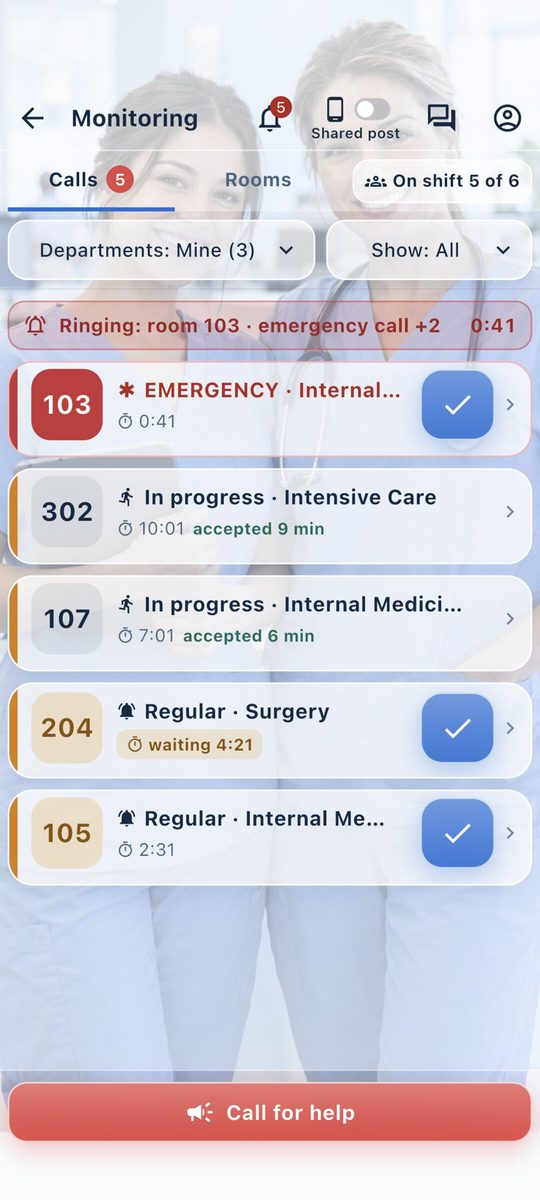
Hospital Alert is a free nurse call app: the patient scans a QR code at the bed and calls from their own phone; staff get the call in the app and at the nurse station on a computer. It deals only with patient calls. Here is how it handles the questions above:
- Emergency and regular calls use different sounds, and each alert type can have its own ringtone.
- The patient can pick a reason with a picture, such as water, pain, bathroom or medicine, so staff see what is needed.
- Colleagues see who accepted a call, so two people do not walk to the same room.
- By default a regular call reaches the nurses of the department, not one named person. If nobody accepts it, it moves on automatically; the administrator sets the chain and the timing.
- Staff who switch to "Off shift" stop getting calls on that phone. On Android, an alarm check plays a test alarm.
To try it on one ward, see a free pilot in one department.
Frequently asked questions
What is alarm fatigue in nursing?
It is the desensitization nurses develop when they are exposed to a constant stream of alarms, most of which turn out to need no action. The result can be slower responses, missed alarms that matter, and alarms turned down or off. The Joint Commission described it this way in its 2013 alert on medical device alarm safety.
What causes alarm fatigue?
Mostly volume and low value: many devices alarm at once, and most signals are not clinically significant. Studies of nurses also point to alarm sounds that are hard to tell apart, noisy and crowded wards, false alarms and low trust in alarms. Job satisfaction, alarm management support and a better work environment appear protective.
Is alarm fatigue still a Joint Commission National Patient Safety Goal?
No. From January 1, 2026, the Joint Commission replaced the National Patient Safety Goals chapter for hospitals and critical access hospitals with National Performance Goals. Clinical alarms are not listed as a goal of their own in the 2026 list of 14 hospital goals, so check your current manual to see where the former NPSG.06.01.01 requirements now sit.
How can a hospital reduce alarm fatigue?
By treating it as a system problem, not a matter of individual nurses trying harder. The Joint Commission and ECRI describe leadership ownership, a cross-disciplinary team, an inventory of alarm-equipped devices and the alarms that matter most, written policies on who responds and who may change settings, and staff training. Clinical settings are decided by the hospital's clinicians.
Do call lights cause alarm fatigue?
Not in the formal sense. The Joint Commission's former alarm goal covered equipment such as monitors and ventilators and, in its own words, generally did not include nurse call systems. Call lights still ring at the nurse station and often on staff phones, so wards often look at them in the same way: distinct emergency tones, and clear rules on who answers.
Sources
- The Joint Commission: Sentinel Event Alert, Issue 50 — Medical device alarm safety in hospitals (April 8, 2013)
- The Joint Commission: R3 Report, Issue 5 — Alarm system safety (December 11, 2013)
- The Joint Commission: National Patient Safety Goals effective January 2025 for the Hospital Program (NPSG.06.01.01)
- Joint Commission: National Performance Goals (NPGs) — page archived by the Internet Archive
- Joint Commission: 2026 Hospital National Performance Goals (NPGs), list of goals
- ECRI Institute: Top 10 Health Technology Hazards for 2014 — 1. Alarm hazards (executive brief)
- Zhu L. et al. Severity and associated factors of alarm fatigue among ICU nurses: a systematic review and meta-analysis. Nursing in Critical Care, 2026
- Liu Y. et al. Exploring alarm fatigue among clinical nurses through a human factors engineering framework: a descriptive qualitative study. Frontiers in Public Health, 2026
How this article was prepared
Written by the Hospital Alert team with the help of AI tools. Everything we say about the app was checked against the app itself; facts from outside sources are linked above. This article is general information, not medical advice. Found a mistake? Write to team@hospitalalert.online.