Nurse call without wiring
Nurse call for assisted living: UL 2560 and what to choose
In the US, call systems in assisted living fall under UL 2560 for emergency call systems, not the hospital nurse call standard UL 1069. A UL 2560 system needs a fixed call station in every resident unit, a central station showing where each call comes from, and backup power; pendants can be added but do not replace the fixed station.
In the United States, the call system in assisted living is treated as an emergency call system rather than hospital nurse call, and the UL standard written for it is UL 2560, not UL 1069. A system built to UL 2560 has a fixed call station in every resident unit, a central station that shows where each call comes from, and backup power; pendants and wristbands can be added, but they do not replace the fixed station. Rules for whether a call system is required come from each state. This guide explains why assisted living is different from a hospital, what UL 2560 asks for and what to check before you buy. For nursing homes and care homes on a small budget, see nurse call for care homes.
Why assisted living is not a small hospital
Assisted living facilities provide housing, meals and help with daily life — personal care, medication assistance, housekeeping — to older adults and people with disabilities. They are community-based settings, not institutions like nursing homes, and they usually do not offer the skilled nursing or continuous care of a nursing home. Private rooms, private bathrooms and kitchenettes vary from one setting to another (CRS, 2026).
The residents still need help to reach. In a national survey of residential care communities in 2022, 94% of residents were 65 or older and more than half were 85 or older. About six in ten reported needing help with three or more activities of daily living, most often bathing and walking, and half needed help with toileting. Alzheimer's disease and other dementias were among the most common chronic conditions (CRS, 2026).
That mix — residents living in their own rooms or apartments, with many residents who may fall or need help in the bathroom — is why call systems for assisted living are designed differently from those for a hospital ward.
Who sets the rules
Assisted living facilities are licensed and regulated by states. Unlike nursing homes, they have no federal minimum quality or staffing standards (CRS, 2026), so look to your state, not to federal rules, for what a call system must do. States also use different names for these settings, such as board and care homes or personal care homes. Before you choose a system, ask your state licensing agency what it requires, and ask your local building authority which codes and standards apply.
UL 2560 or UL 1069
UL publishes two standards for call systems in care settings. UL 1069, the Standard for Hospital Signaling and Nurse Call Equipment, is what healthcare facilities look for to show compliance with the NFPA 99 Health Care Facilities Code. UL 2560, the Standard for Emergency Call Systems for Assisted Living and Independent Living Facilities, covers emergency call systems in non-acute settings such as assisted and independent living. A system used in both kinds of facility can be evaluated against both standards together (UL Solutions, 2020).
UL 2560 was published in 2011, after a request from the National Electrical Manufacturers Association and several years of work with manufacturers, users, regulators and test laboratories. Before it existed, makers of call systems for these settings had to meet the hospital standard or skip product safety certification altogether (UL, 2012).
What UL 2560 asks of a call system
UL's 2012 white paper summarises the standard's core requirements. It describes the edition current at the time, so ask the supplier which edition their listing is to; the main points show what a system for assisted living is expected to do:
- A fixed call station in every unit. At least one permanently fixed emergency call station in every resident room or living unit; stations in other private or common areas are optional.
- A central station. At least one central notification station at a fixed location receives all calls; portable notification devices may be added.
- Backup power. The system keeps working in a power loss, and the manufacturer must state how long it runs on battery.
- Confirmation and location. Every station and pendant gives immediate feedback that the call has been placed, the central station shows where the call came from, and an emergency call must reach it within one minute.
- Cancel at the source. An emergency call can be cancelled only at the device that started it, unless the central station tells emergency from non-emergency calls and supports voice contact with the call station.
- Pendants are extras. Pendants and wristbands must meet the standard but are not a substitute for the fixed station.
- Batteries and self-tests. Wireless transmitters report a low battery at least seven days before power runs out, and wireless systems test themselves and report faults that could stop a call.
- Bathroom and sound. Devices are spray- and submersion-tested for use in a shower or bath, and audible signals reach at least 60 decibels.
UL also points out what UL 2560 does not cover that UL 1069 does: there are no requirements for code calls, and backup power, optional under UL 1069, is required under UL 2560. A system listed to UL 1069 should not be assumed to meet UL 2560 without evaluation (UL, 2012).
Choosing a system for your residents
- Start with the fixed points. A call station in each living unit, plus one where falls are most likely — the bathroom. What a bathroom pull cord should look like is covered in nurse call pull cord.
- Add wearables for residents who walk about. A pendant or wristband lets a resident call from the garden or a hallway; check range, water resistance and battery reports.
- Match the device to the person. A resident with weak hands or limited movement may need a different button; see nurse call button types.
- Decide where calls go. The central station, plus pagers or phones for staff who are away from it, and who covers the station at night.
- Ask for the listing. Which standard is the whole system listed to, in its installed configuration?
- Test it. Place a call from every unit and every bathroom and check that it arrives, with the right location, where staff will hear it.
Where Hospital Alert fits — and where it does not
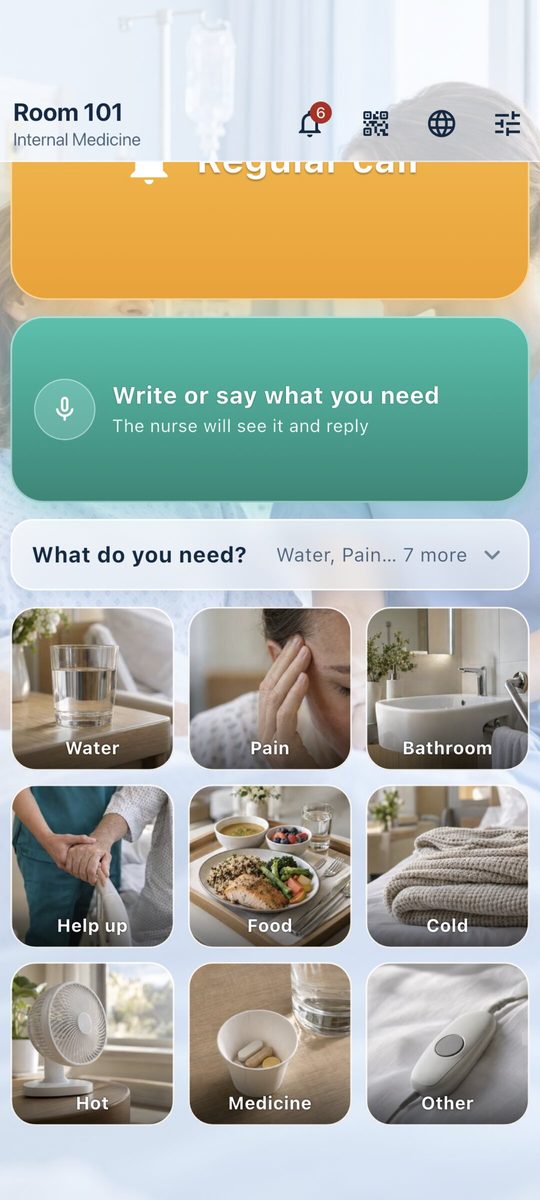
Hospital Alert was built for hospital wards, not for assisted living. A person scans a QR code and calls staff from their own phone, choosing the reason from pictures — water, pain, bathroom, help up — or writing a short message, which is translated automatically; staff receive the call in an app and in a web version on a computer. In an assisted living setting it could at most be an extra channel for residents who use smartphones, for example for everyday requests. It is not an emergency call system under UL 2560: it has no fixed station in the unit, no pendant and no bathroom cord, and it cannot help a resident who has fallen without their phone. If you want to see how it works, the pilot checklist describes a one-week trial.
Frequently asked questions
Do assisted living facilities need a nurse call system?
Assisted living facilities are licensed and regulated by states, not by federal minimum standards, so requirements differ from state to state. Check your state licensing agency. Where a call system is installed, the UL standard written for these settings is UL 2560 for emergency call systems in assisted and independent living.
What is the difference between UL 2560 and UL 1069?
UL 1069 covers hospital signaling and nurse call equipment and is what healthcare facilities use to show compliance with NFPA 99. UL 2560 covers emergency call systems for assisted and independent living. According to UL, UL 2560 requires backup power and adds water and sound tests, while it has no code call requirements.
Is a pendant enough for an assisted living resident?
Not under UL 2560. As UL summarises the standard, a certified system must have at least one permanently fixed emergency call station in every resident room or living unit. Pendants and wristbands may be added and must meet the standard's requirements, but they do not replace the fixed station.
Can staff in assisted living get calls on a pager or phone?
Yes. UL 2560 requires at least one central notification station at a fixed location and permits additional portable notification devices. Check what happens if a portable device is out of range or its battery is flat, and who watches the fixed station at night.
Can a hospital nurse call system be used in assisted living?
It can, if it is also evaluated for that use. UL notes that a system listed to UL 1069 does not automatically meet UL 2560, and that a combined evaluation can be done for a system used in both kinds of facility. Ask the supplier which listing covers your building.
Sources
How this article was prepared
Written by the Hospital Alert team with the help of AI tools. Everything we say about the app was checked against the app itself; facts from outside sources are linked above. This article is general information, not medical advice. Found a mistake? Write to team@hospitalalert.online.