Nurse call without wiring
Ward group chat vs a nurse call app: what each does well
A messenger group chat is free, familiar and good for coordinating staff; NHS England has said instant messaging can be a vital tool in a crisis. It is not built for patient calls: nobody accepts a message, nothing is passed on if no one replies, and patient details end up in a general chat. For calls, use a dedicated tool.
When a ward has no working call system, a messenger group chat can look like a quick fix: it costs nothing, everyone already has it, and a message reaches the whole team at once. Before relying on it for patient calls, it is worth knowing what a group chat does well and what it was never designed to do.
What a group chat does well
- It is already there. No purchase, no installation, no training: staff use the same app they use every day.
- It is fast for coordinating people. In 2018 NHS England's chief clinical information officer said instant messaging can be a vital part of the NHS toolkit in a crisis. After the Grenfell Tower fire, a consultant used a major-incident group to organise which staff should come in and where they were needed.
- Staff value its speed. In a survey at a Berlin university hospital, physicians named fast and uncomplicated communication as a key advantage of instant messaging (Sayegh-Jodehl et al., 2022).
- It carries more than text. Photos, voice messages and calls are built in.
Where a group chat falls short for patient calls
A patient call is a task: someone has to go to a particular room, and everyone else needs to know that it is covered. A general group chat is built for conversation, not for tasks.
- Nobody accepts the call. A message is sent and maybe read, but there is no step that tells the team who is going.
- Nothing happens if nobody answers. An unread message stays in the chat; it is not passed on to the head nurse or the doctor on call.
- Emergencies look like everything else. An urgent call arrives with the same sound as a shift question. When messaging becomes easy, more messages get sent: in a Toronto study, clinicians reported more interruptions and disagreed about what counted as urgent (Wu et al., 2011).
- The reason for the call is unclear. Nurses find it stressful not to know why a patient is calling, and knowing the reason helps them decide what to do first (Klemets & Toussaint, 2016). A chat leaves that to whoever types the message.
- Patients would need a staff member's number. To write to the ward, a patient or relative has to be given someone's phone number, and it stays in their phone after discharge.
- Patient details end up in a general chat. From the standpoint of German data protection, private messengers have been classed as unsuitable for hospitals, as the Berlin study notes. In 2018 NHS England advised staff to use only apps that meet the NHS encryption standard, not to let anyone else use their device, to switch off message notifications on the lock screen and to keep the clinical record separately.
Side-by-side comparison
| Criterion | Messenger group chat | Nurse call app (e.g. Hospital Alert) |
|---|---|---|
| Cost and setup | Free, already installed, no setup | Hospital Alert is free for hospitals today; the administrator creates rooms, prints QR sheets and invites staff |
| How the patient calls | Needs a staff member's number or a relative to pass the message on | Scans the QR code at the bed; no app, name, e-mail or phone number |
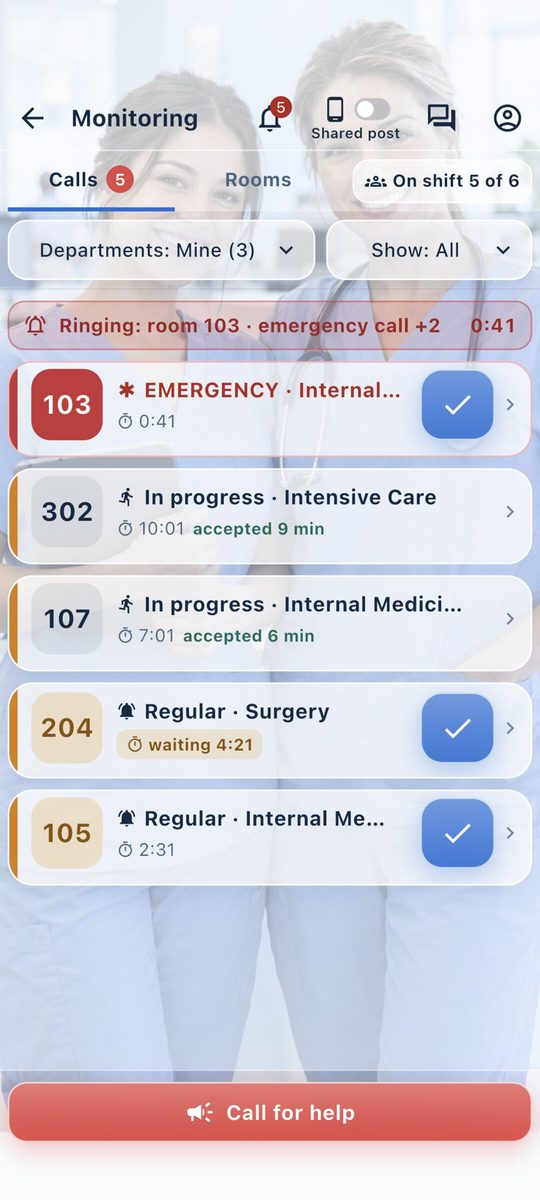
| Emergency or routine | Same chat, same notification sound | Separate emergency and regular calls with different sounds |
| Who is going | Not shown | Accept, I'm coming, I'm with the patient, Can't go — hand over |
| If nobody answers | The message waits | The call goes on to the next people in the chain set by the administrator |
| What the patient sees | At most delivered or read marks; nobody says who is coming | Each step of the call until a nurse is with them |
| Languages | Whatever the sender writes | Messages are translated automatically; in the browser version by a third-party AI service |
| Staff identity | Usually personal phone numbers and names | Staff sign in with a hospital code, login and password and appear under pseudonyms |
| Coordinating staff | Strong: free-form chat, photos, voice, any group | Built around calls, with staff chats (groups and direct messages) and a button to call colleagues for help |
| Without a network | Does not work | Does not work either |
When the chat is the right tool
A group chat is good at what it was made for: conversations between colleagues. Use it for shift swaps, quick questions, and organising people during a major incident — within your hospital's rules on messaging and patient information. Keep patient calls out of it, so that an emergency is never one message among dozens.
How to use both without confusion
- Write one rule: patient calls go through the call tool; the chat is for staff coordination only.
- Keep patient details out of the chat, or follow your hospital's information governance rules if they allow it.
- Check that alerts are heard. A muted chat is a nuisance; a muted call app is a missed patient. Test every phone on day and night shifts.
- Keep a fallback for patients who cannot use a phone and for network failures.
- Try it in one ward first. Our pilot checklist describes a one-week test; how QR code nurse call works shows the patient's side.
If calls on your ward currently reach staff by pager, see nurse pager vs smartphone.
Frequently asked questions
Can a ward use a messenger group chat as a nurse call system?
It can carry messages, but it is not built for calls. Nobody accepts a message, so others cannot see who is going; an unanswered message is not passed on to anyone; and emergencies look the same as routine chatter. Keep patient calls in a tool built for them.
Is it safe to share patient information in a group chat?
Follow your hospital's rules. In 2018 NHS England advised staff to use only apps that meet the NHS encryption standard, not let others use their device, hide message notifications on the lock screen and keep the clinical record separately, deleting the original messages once advice is transcribed.
When is a group chat the right tool?
For coordinating staff: who covers a shift, who comes in during a major incident, quick questions between colleagues. NHS England said in 2018 that instant messaging can be a vital part of its toolkit in a crisis, for example to organise which staff should come in and where they were needed.
Does a nurse call app also depend on the network?
Yes. Hospital Alert, like any messenger, needs Wi-Fi or mobile coverage on the patient's and the staff's phones, and alerts depend on phone settings. Keep another way to call for help, especially for patients who cannot use a phone.
Sources
- NHS England — Instant messaging services a “vital part of the NHS toolkit” during a crisis, November 2018
- Sayegh-Jodehl et al. — Use of Instant Messaging Software in a German Hospital: An Exploratory Investigation among Physicians, International Journal of Environmental Research and Public Health, 2022
- Wu et al. — An Evaluation of the Use of Smartphones to Communicate Between Clinicians: A Mixed-Methods Study, Journal of Medical Internet Research, 2011
- Klemets & Toussaint — Does revealing contextual knowledge of the patient's intention help nurses' handling of nurse calls?, International Journal of Medical Informatics, 2016
How this article was prepared
Written by the Hospital Alert team with the help of AI tools. Everything we say about the app was checked against the app itself; facts from outside sources are linked above. This article is general information, not medical advice. Found a mistake? Write to team@hospitalalert.online.