For patients and families
Communication board for patients: what it is, how to use it
A communication board for patients is a printed sheet of pictures, words and letters that a patient who cannot speak points to in order to show what they need: water, pain, the toilet, yes or no. Hospitals use them when a patient loses speech for a while or for good, and several boards can be downloaded free.
A communication board for patients is a printed sheet of pictures, words and letters that a patient who cannot speak points to in order to show what they need: water, pain, the toilet, yes or no. Hospitals use boards when a patient loses speech for a short time or for good, and several good boards can be downloaded free. This guide covers what goes on a board, who needs one, how to use it at the bedside, and what a board cannot do.
What is on a communication board
A board is a simple form of augmentative and alternative communication (AAC), the umbrella term for ways people communicate when they have difficulty speaking. The American Speech-Language-Hearing Association (ASHA) lists no-tech and low-tech options such as gestures, pointing to pictures and words, spelling and writing, and high-tech options such as apps, computers with artificial voices and speech-generating devices. A board sits at the low-tech end: a printed sheet, no batteries.
Two free hospital boards from Widgit Health show what usually goes on one. Each phrase comes with a symbol:
- Yes and no: “Neither yes nor no”, and “I can indicate yes and no. Please ask me yes and no questions.”
- Basic needs: “I'm very thirsty, I would like a drink”, “I need immediate help with my toileting”, “I am feeling quite a lot of pain; please help me”, “I'm feeling very cold”, “I am very uncomfortable and need to be repositioned on this bed”.
- Talking with staff: “Please talk to me directly. I can understand you”, “Please repeat”, “I have a question I really need to ask”, “I would like an interpreter”, “Please let me have pen and paper”.
- People and plans: “Please phone my carer”, “Please tell me when the doctor is coming”, “Please tell me when I will be able to go home”.
The Bedside Messages sheet is built around 26 key phrases chosen from research by a speech pathologist, Dr Bronwyn Hemsley, on what patients most want to tell their caregivers when they cannot speak. Many patients can also spell or write, which ASHA lists among low-tech options, so keep an alphabet or a pen and paper next to the board.
Who needs one
ASHA notes that some people use AAC all the time because they do not speak, some use it only sometimes, and some need it only for a short time, for example when they have had surgery and cannot talk. In a hospital that covers a wide group:
- patients who temporarily cannot speak, for example while a breathing tube is in place;
- patients with a long-term speech or language difficulty, who may already have their own AAC system;
- patients who do not share a language with staff, where a board with pictures or a phrase sheet in their language helps with basic needs.
Much of the research comes from intensive care. A systematic review of communication with conscious patients on ventilators found three studies of communication boards: they improved communication and patient satisfaction, but they can be time-consuming and limit what a patient can say beyond the printed items (ten Hoorn et al., 2016). For anyone whose speech difficulty will last, ASHA's advice is to work with a speech-language pathologist, who finds the right types of AAC for that person. A board from a printer is a start, not an assessment.
How to use a communication board at the bedside
- Put it where the patient can reach it, and check that they can see it: glasses on, good light, board at the right angle.
- Agree on yes and no first. A nod, a look up or down, or a finger on the board, whatever the patient can do reliably.
- Talk to the patient, not about them, as the boards themselves ask: “Please talk to me directly.”
- Ask one yes-or-no question at a time, and start with the most likely needs.
- Wait. Pointing can be slow and tiring; do not finish the patient's sentence for them.
- Say back what you understood and get a yes before acting on it.
- Leave room for more. If the printed items do not fit, offer the alphabet, a pen or a different board.
- Show relatives and other staff how the patient uses it, so the effort is not lost at the next shift.
Training matters too. In a South African pilot study in an intensive care unit, most nurses agreed a board could be used, but a short training session brought limited success in putting it into practice; the authors stress working together with speech-language therapists (Gropp et al., 2019).
Where to get a free communication board
Widgit Health publishes several hospital boards as free PDFs:
- Medical Encounters Board, developed with the Patient Provider Communication Network, in grid and column layouts, A4 and US Letter. Widgit's languages page lists it in 8 languages, including English.
- Bedside Messages, 26 key phrases with symbols, in around 30 languages, A4 and Letter.
Widgit says these resources can be downloaded and used in your organisation, but they are copyrighted and may not be passed on to third parties. Print one for each bed that needs it, keep a spare at the nurse station, and follow your hospital's infection control rules for anything kept at the bedside.
What a board cannot do: calling for help
A board only works when someone is already standing at the bed. At night, or between rounds, a patient who cannot speak also cannot call out. They need a call button they can press, and the staff who come need to know what the call is about.
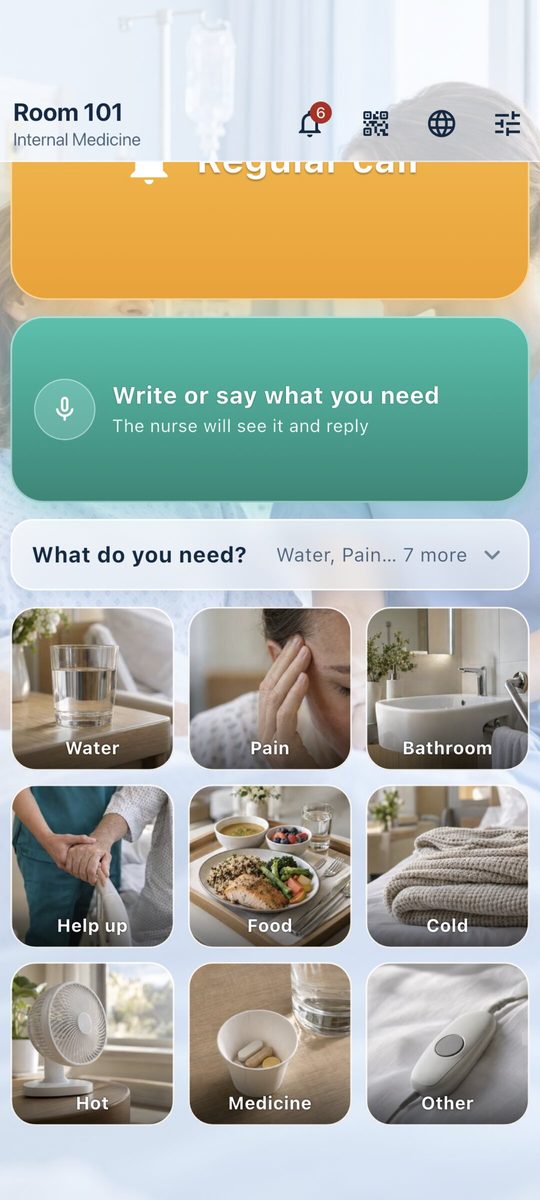
Hospital Alert is a nurse call app, not a communication board and not an AAC device. What it offers a patient who can use a phone but cannot speak is a way to call and say what they need without a voice. The patient scans the QR code at the bed; the call screen opens in the browser with an emergency button, a regular call button, “Write or say what you need” and a “What do you need?” menu with pictures: water, pain, bathroom, help getting up, food, cold, hot, medicine and other. Staff get the alert on their phones and at the nurse station, and the patient sees each step until a nurse is with them. The interface works in 19 languages, and chat messages are translated automatically, which also helps patients facing a language barrier. More detail is in QR code nurse call.
If you want to see how this works on your own ward, our pilot checklist describes a trial in one department.
Frequently asked questions
What is a communication board for patients?
It is a printed sheet with pictures, words, short phrases and sometimes the alphabet. A patient who cannot speak points to an item or spells a word, and the nurse or relative reads it back. ASHA lists pointing to pictures and words and spelling among the no-tech and low-tech forms of AAC.
Where can I get a free communication board for hospital patients?
Widgit Health offers free PDF downloads: a Medical Encounters Board developed with the Patient Provider Communication Network, in A4 and Letter sizes, and a Bedside Messages sheet of 26 key phrases with symbols in around 30 languages. They are free for your own use, but Widgit does not allow passing them on to third parties.
Who uses a communication board in a hospital?
Patients who cannot speak for a while, for example after surgery or while a breathing tube is in place, patients with a long-term speech or language difficulty, and sometimes patients who do not share a language with staff. Nurses and relatives use it with them. For long-term needs, a speech-language pathologist chooses the right tools.
How do nurses use a communication board?
Keep it within the patient's reach, agree on a clear yes and no first, ask one question at a time, let the patient point without rushing, and say back what you understood. A systematic review notes that boards can be slow and limit what a patient can say, so leave room to spell or write.
Is a nurse call app the same as a communication board?
No. A board helps a patient talk to someone who is already beside them; a nurse call app such as Hospital Alert lets the patient call staff and say what they need from their own phone. It is not an AAC device and does not help a patient who cannot use a phone.
Sources
- ASHA public information site (helpingyoucommunicate.org) — Augmentative and Alternative Communication (AAC)
- Widgit Health — Medical Encounters Board (free download)
- Widgit Health — Bedside Messages: 26 key phrases for patients supported by symbols (free download)
- Widgit Health — Downloads for professionals: communication boards and easy read sheets
- Widgit Health — International downloads: different language easy read symbol PDFs
- Ten Hoorn et al. — Communicating with conscious and mechanically ventilated critically ill patients: a systematic review, Critical Care, 2016
- Gropp et al. — Nurses' perspectives about communication with patients in an intensive care setting using a communication board: A pilot study, Health SA Gesondheid, 2019
How this article was prepared
Written by the Hospital Alert team with the help of AI tools. Everything we say about the app was checked against the app itself; facts from outside sources are linked above. This article is general information, not medical advice. Found a mistake? Write to team@hospitalalert.online.