Running a ward
Language barriers in healthcare: risks and what helps
A language barrier in healthcare means a patient and staff cannot understand each other well enough to give safe care. It is a safety risk: in US hospitals, adverse events in patients with limited English more often caused harm. The standard answer is a qualified interpreter; translated chat helps only with everyday requests between visits.
A language barrier in healthcare is any situation where a patient and the people caring for them cannot understand each other well enough to give safe care. This is not just about courtesy: research in US hospitals links it to more harmful errors. The established answer is a qualified interpreter for every conversation that matters. Picture cards and translated chat are useful too, but only for the small requests in between. Language is not the only obstacle between patients and nurses: hearing loss, being unable to speak, pain, noise and staff workload get in the way too, and we cover them below.
What counts as a language barrier
In the US the usual term is limited English proficiency (LEP). The HHS rule under Section 1557 of the Affordable Care Act defines an individual with LEP as someone whose primary language for communication is not English and who has a limited ability to read, write, speak or understand English, and adds that a person may manage in English for some purposes, such as speaking, but not for others, such as reading (45 CFR 92.4). So limited English proficiency patients include the one who chats with staff in English but cannot read the discharge instructions. In the UK and elsewhere the same problem is described as a need for interpreting or translation. Either way, the barrier is two-sided: the patient cannot explain, and staff cannot be sure they were understood.
Language barriers often come with cultural ones. The Agency for Healthcare Research and Quality (AHRQ) names three common causes of errors with patients who have limited English or a different cultural background: family members, friends or untrained staff acting as interpreters; clinicians using basic language skills to “get by”; and cultural beliefs and traditions that affect care. That is why the two are so often discussed together.
Why language barriers are dangerous
- Adverse events cause more harm. A pilot study at six Joint Commission-accredited US hospitals compared adverse events over seven months in 2005. 49.1% of events in LEP patients involved physical harm, against 29.5% in English-speaking patients, and 52.4% of LEP patients' adverse events stemmed from communication errors, against 35.9% (Divi et al., 2007).
- Missing interpreters show up in lawsuits. AHRQ cites an analysis of one malpractice insurer's claims in four states: 35 claims, 2.5% of those reviewed, were linked to language problems. In 32 of the 35 no competent interpreter was used, and in 12 family members or friends interpreted, including minor children in two.
- Some moments carry more risk. AHRQ singles out medication reconciliation, discharge, informed consent, emergency department care and surgical care. Patients with limited English also have more difficulty understanding discharge instructions: how to take their medicines, which symptoms should bring them back and when to follow up.
- Everyone is less satisfied. A 2020 systematic review of 14 studies found that language barriers lead to miscommunication, lower satisfaction for both patients and staff, and lower quality and safety of care (Al Shamsi et al., 2020).
Examples from the ward
- A relative interprets, misses the nuances of what the doctor said and does not ask about a medical term neither of them understands.
- A patient keeps a symptom to themselves because the person interpreting is their son or a neighbour.
- A nurse with high-school Spanish explains a new medicine and both sides think they understood.
- A patient goes home with written instructions in a language they do not read.
- At night, a patient who needs the bathroom or is in pain cannot say so, and waits.
The first four come straight from the causes and high-risk moments AHRQ describes. The last one is smaller, but it happens far more often, and it is where simple tools can help.
What hospitals do: a qualified interpreter is the standard
A systematic review of 21 studies that looked at professional interpreters separately found that they are associated with better clinical care than ad hoc interpreters, and appear to bring the care of LEP patients close to or level with that of patients without a language barrier (Karliner et al., 2007). Regulators say the same in their own terms:
- United States. Under the HHS rule implementing Section 1557 of the Affordable Care Act (45 CFR 92.201), covered health programs must offer a qualified interpreter when interpretation is required, free of charge. They must not make patients bring their own interpreter, must not rely on an unqualified adult except in an emergency or when the patient asks for it in private with a qualified interpreter present and this is documented, and must not rely on a child except as a temporary measure in an emergency. If machine translation is used for critical text, where accuracy is essential or the language is technical, a qualified human translator must review it.
- England. NHS England's 2018 guidance for primary care says patients should always be offered a registered interpreter, that relying on family, friends or unqualified interpreters is strongly discouraged, and that nobody under 16 should interpret except when immediate treatment is needed. For written communication it advises avoiding automated online translation such as Google Translate, because its quality cannot be assured.
In practice: informed consent, diagnosis, treatment decisions, medicines and discharge need a qualified interpreter, in person, by video or by phone. A relative, a bilingual colleague without interpreter training, or a translation app is not a substitute for these conversations.
Where translated chat helps, and where it stops
An interpreter is booked for the ward round, not for “could I have some water?”. Most of a patient's day is made of small requests like that, and they are exactly what goes unsaid when nobody shares a language. A 2020 review suggested that online translation tools may raise satisfaction, citing a single hospital study with Google Translate and MediBabble (Al Shamsi et al., 2020). Neither of the rules above allows machine translation for anything critical. Our conclusion: picture cards and translated chat are fine for simple everyday requests, as long as nothing important depends on them.
| Situation | What to use |
|---|---|
| Consent, diagnosis, treatment plan, medicines, discharge | Qualified interpreter (in person, video or phone) |
| Emergency before an interpreter is available | Give urgent care and get a qualified interpreter as soon as possible; under US rules, they confirm or add to what was said through an ad hoc interpreter |
| Written instructions and forms | Qualified translator; machine output reviewed by one |
| Everyday requests: water, pain, bathroom, blanket, help getting up | Picture cards, phrase sheets, translated chat with the ward |
Free printed tools exist. Widgit Health offers a Bedside Messages sheet, 26 key phrases with symbols in around 30 languages, and a Medical Encounters Board, which its languages page lists in 8 languages; both are free to download for use in your own organisation. For patients who cannot speak at all, see our guide to communication boards for patients.
Other communication barriers between patients and nurses
Language is only one barrier. A review of nurse–patient communication sorts barriers into four kinds: institutional, such as staff shortages, heavy workload and little time; communication-related, such as a different language or a ventilator that makes it hard to talk; environmental, such as noise and a lack of privacy; and personal or behavioural, such as the attitudes of nurses, patients and families (Kwame & Petrucka, 2021). In a survey in two hospitals, patients themselves named a hectic ward, their own anxiety, pain and physical discomfort, and nurses' reluctance to talk among the most important barriers (Norouzinia et al., 2015).
| Barrier | What happens | What helps |
|---|---|---|
| Hearing loss | Older inpatients with hearing impairment risk being labelled confused and misunderstanding the plan of care (Funk et al., 2018) | Ask about hearing and adapt how you talk; in the US, hospitals must provide aids such as a qualified sign language interpreter, real-time captioning or written materials when needed (ADA) |
| Unable to speak, for example with a breathing tube | The patient cannot say what they need or where it hurts | Agreed yes and no signals and a communication board |
| Pain, anxiety, delirium | In intensive care, patients on ventilators were less likely to raise their symptoms themselves when delirious (Tate et al., 2013) | Ask about symptoms instead of waiting to be told |
| Noise, a busy ward, no privacy | Patients may not say what they really need (Kwame & Petrucka, 2021); some do not want to discuss their condition over the intercom where a neighbour can hear (Montie et al., 2017) | Have important conversations face to face, somewhere quieter |
| Staff workload | Fewer conversations between nurses, patients and families (Kwame & Petrucka, 2021) | Planned rounds, so that talking is not squeezed between tasks; see call light in nursing |
| Waiting for a reply | A patient who has pressed the call light does not know whether anyone heard; in interviews, some patients wanted staff to confirm the call and say if they could not come yet (Montie et al., 2017) | Acknowledge the call, even if help will take a while |
These barriers often come together: an older patient who hears poorly, is in pain and speaks another language meets several of them at once. The admission question about language can cover hearing, sight and speech too, and the answer belongs in the record next to any note that an interpreter is needed.
How Hospital Alert fits in
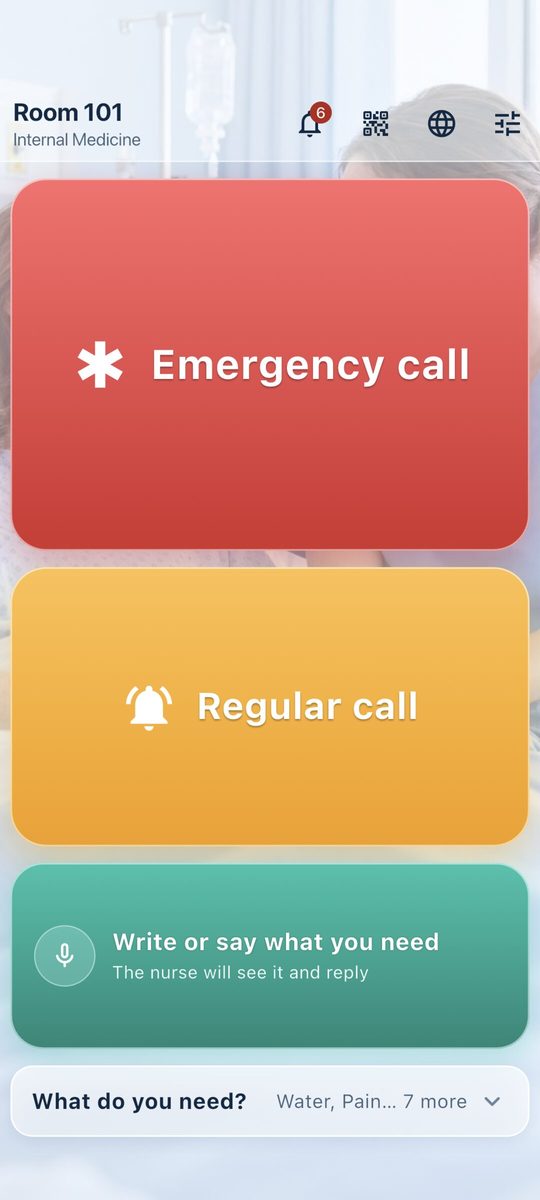
Hospital Alert is a nurse call app, not an interpreting service. The patient scans the QR code at the bed and a call screen opens in the phone's browser. The interface is available in 19 languages, switched with the language button. The patient can press the emergency or regular call button, tap a picture of a common need (water, pain, bathroom, help getting up and others), or write what they need. Messages between the patient and the staff are translated automatically, so each side writes in their own language. In the browser version, a third-party AI service does the translation, so personal or medical details should not be written in the chat. The screen also works without speaking: a patient who hears poorly, or cannot talk for a while, can tap a picture or write instead, as long as they can use a phone, and sees when a nurse has accepted the call. The patient's side is described step by step in QR code nurse call.
A short checklist for the ward
- Ask and record the language on admission, with a clear flag that an interpreter is needed. AHRQ reports that nearly all the malpractice claims it describes showed poor documentation of the patient's language needs or need for an interpreter.
- Know how to reach your interpreter service by phone and video at any hour, and put the number where staff can see it.
- Do not use children as interpreters, and use relatives only within your hospital's policy and the patient's wishes.
- Keep translated picture cards at the bed for basic needs.
- Give the patient a way to call and say what they need in their own language between interpreter visits. If you want to try that on one ward, our pilot checklist takes about a week; for how staff should use messaging, see group chat vs nurse call app.
Frequently asked questions
Who are patients with limited English proficiency?
Patients whose primary language is not English and who have a limited ability to read, write, speak or understand it — that is how the US rule under Section 1557 defines them. Someone can chat with staff in English and still be limited English proficient when it comes to reading a consent form or discharge instructions. Health programs covered by that rule must offer them a qualified interpreter, free of charge, when interpretation is needed.
What is the impact of language barriers in healthcare?
They affect safety and satisfaction. In a study at six US hospitals, 49.1% of adverse events in patients with limited English involved physical harm, against 29.5% for English speakers, and more of them stemmed from communication errors (52.4% vs 35.9%). A 2020 systematic review also found lower satisfaction among both patients and staff.
What are cultural and language barriers in healthcare?
A language barrier is about words; a cultural barrier is about beliefs and traditions that shape how a patient understands illness, treatment and the people caring for them. AHRQ names cultural beliefs and traditions as one of three common causes of errors, alongside untrained interpreters and clinicians relying on basic language skills.
Can nurses use a translation app instead of an interpreter?
Not for anything important. In the US, if a covered health program uses machine translation for critical text, a qualified human translator must review it, and NHS England advised primary care to avoid automated online translation such as Google Translate. An app can help with small everyday requests; consent, diagnosis and discharge need an interpreter.
Can a family member interpret for a patient?
Only as an exception. US rules forbid relying on an unqualified adult except in an emergency or at the patient's documented private request, and on a child except in an emergency. NHS England strongly discourages family and friends and does not accept anyone under 16 except when immediate treatment is needed.
What are the barriers to communication between nurses and patients?
Besides language, the usual ones are hearing loss; being unable to speak, for example with a breathing tube; pain, anxiety or delirium; a noisy ward with little privacy; staff workload; and not knowing whether a call for help was heard. Each needs its own answer: a sign language interpreter or captioning, a communication board, asking about symptoms, a quieter place to talk, or a reply to the call.
Sources
- AHRQ — Improving Patient Safety Systems for Patients With Limited English Proficiency: A Guide for Hospitals, Chapter 1
- Divi et al. — Language proficiency and adverse events in US hospitals: a pilot study, International Journal for Quality in Health Care, 2007
- eCFR — 45 CFR 92.4, Definitions: individual with limited English proficiency (HHS rule under Section 1557 of the Affordable Care Act)
- eCFR — 45 CFR 92.201, Meaningful access for individuals with limited English proficiency (HHS rule under Section 1557 of the Affordable Care Act)
- NHS England — Guidance for commissioners: Interpreting and Translation Services in Primary Care, September 2018
- Karliner et al. — Do professional interpreters improve clinical care for patients with limited English proficiency? A systematic review of the literature, Health Services Research, 2007
- Al Shamsi et al. — Implications of Language Barriers for Healthcare: A Systematic Review, Oman Medical Journal, 2020
- Widgit Health — Bedside Messages: 26 key phrases for patients supported by symbols (free download)
- Widgit Health — International downloads: different language easy read symbol PDFs
- Kwame & Petrucka — A literature-based study of patient-centered care and communication in nurse-patient interactions: barriers, facilitators, and the way forward, BMC Nursing, 2021
- Norouzinia et al. — Communication Barriers Perceived by Nurses and Patients, Global Journal of Health Science, 2015
- Funk et al. — Understanding the Hospital Experience of Older Adults with Hearing Impairment, American Journal of Nursing, 2018
- U.S. Department of Justice — ADA Requirements: Effective Communication
- Tate et al. — Symptom communication during critical illness: the impact of age, delirium, and delirium presentation, Journal of Gerontological Nursing, 2013
- Montie et al. — Conduits to care: call lights and patients' perceptions of communication, Journal of Multidisciplinary Healthcare, 2017
How this article was prepared
Written by the Hospital Alert team with the help of AI tools. Everything we say about the app was checked against the app itself; facts from outside sources are linked above. This article is general information, not medical advice. Found a mistake? Write to team@hospitalalert.online.